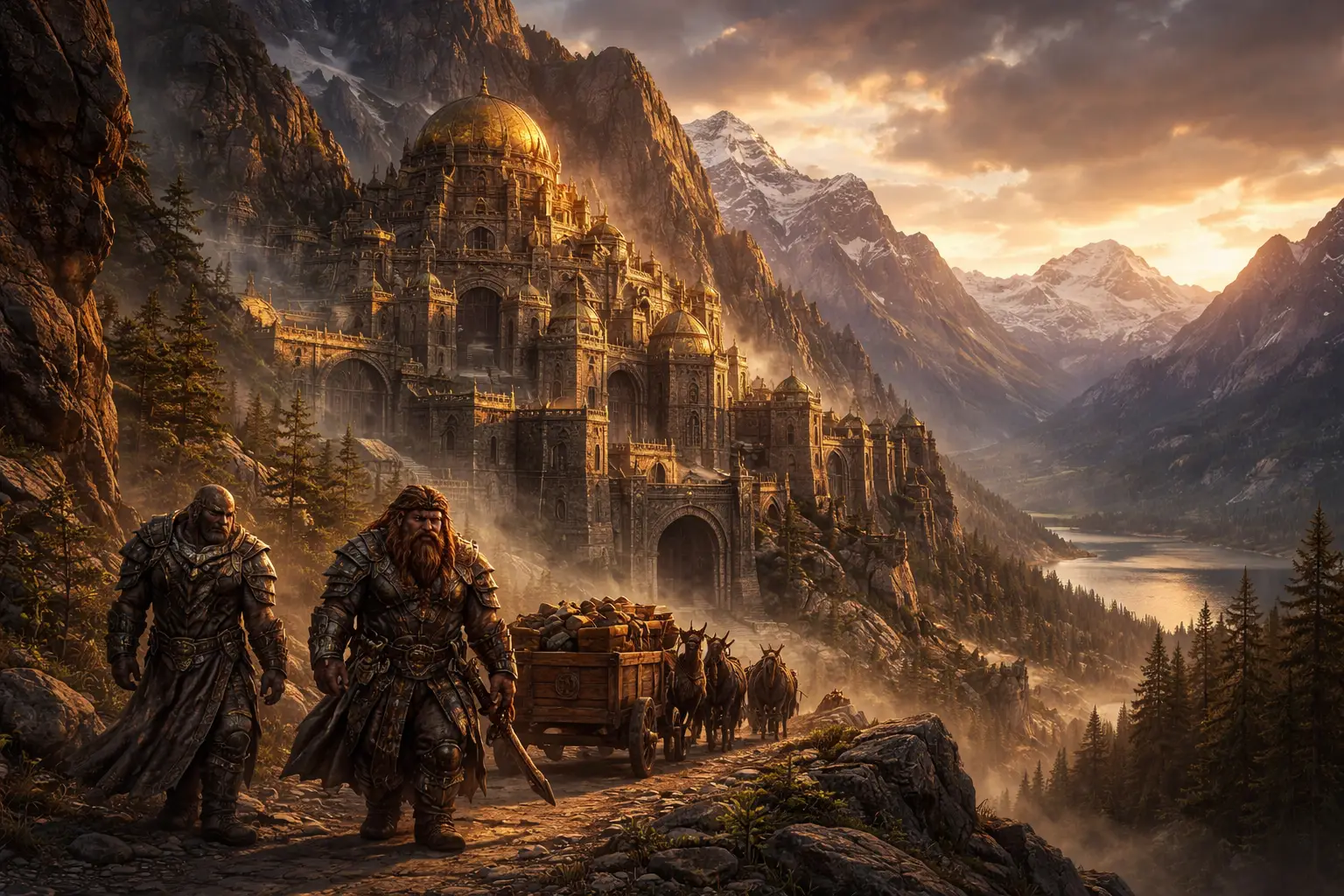
Mror Holds
Capital: Krona Peak | Ruler: The Iron Council | Government: Feudal clan confederation | Hallmarks: Banking, dwarves, metalwork, mining (precious and non-precious metals)
"You want to know what a Mror dwarf values? Look at what he carries. The axe has a name. The goblet has a history. The iron ring on his finger was his grandmother's grandmother's, and he will tell you the story of every scratch on it whether you ask or not." — Kellan Dral, trade liaison to Krona Peak, 996 YK
Per capita, the Mror Holds may be the wealthiest nation in Khorvaire — and every single dwarf in them wants you to know it. They are miners, smiths, merchant lords, and warriors whose prosperity is younger than most humans realize, a nation that went from tribute-paying Karrnathi subjects to dominant sovereign power in the space of a single generation, declared independence while the rest of the continent was busy killing each other in the Last War, and has spent the decades since growing fabulously rich and quietly terrified by what they found in their own basement.
The Mror Holds occupy the Ironroot Mountains — tra Mroreln, the Iron Roots — the mountainous spine that separates Karrnath from the Lhazaar Principalities, a landscape of sharp peaks, deep valleys, alpine meadows, and Mirror Lake at its heart, an inland sea large enough to support real sailing traditions. Most Mror communities are at least partially subterranean, extending down into the mountains, though the Mror are surface-born dwarves who appreciate sunlight and color — their halls have windows, and the great cities are not the lightless warrens outsiders sometimes imagine. Twelve ruling clans govern twelve holds from seats on the Iron Council in Krona Peak. House Kundarak, the thirteenth clan turned dragonmarked banking house, operates from ancestral lands within the mountains but no longer holds a council seat. And beneath it all, miles below the modern cities, lies the Realm Below — Sol Udar — the ruins of a vast ancient dwarven empire destroyed by the daelkyr thousands of years ago, half-reclaimed and half-infested, yielding legendary treasure and unspeakable horror in roughly equal measure.
This is not a nation at peace. It is a nation sitting on top of a war it has not won, arguing about what it dragged up from the dark, and getting richer every day it manages not to tear itself apart.
The Mror Spirit
The national character runs on pride, rivalry, and a bone-deep conviction that everything worth having should have a story behind it. From the wealthiest clan lord to the humblest miner, the Mror take ferocious pride in their possessions — not because they are materialistic in the shallow sense, but because quality matters more than appearance, and every item a dwarf carries should be able to account for itself. A magic weapon is not merely a tool; it has provenance, it has seen battles, and the dwarf who carries it will tell you about all of them. To carry something shoddy is to say something unflattering about yourself. The Mror are the nouveau riche of Eberron: a dwarf fighter drinks hard and loves a brawl, but he drinks from the finest goblet you have ever seen, and there are diamonds spelling out his axe's name set into its haft.
The dark side of that pride is a competitiveness that never shuts off. Clan rivalry defines every aspect of Mror life — economic, military, social, and culinary — and the feuds that kept the dwarves from uniting for centuries have not vanished so much as changed form. The Iron Council holds because the alternative is worse, not because twelve proud clans suddenly learned to agree. Beneath the gold and the mithral and the booming trade, the Mror Holds are a pressure vessel: ancient grudges, new terrors from below, and a fundamental disagreement about what the dwarves are becoming that has already started to crack the alliances that hold the nation together.
AUCTION NOTICE — Kol Korran's Throne, Krona Peak — Olarune, 998 YK
By order of the Soldorak Mint and under the seal of the Iron Council, the following recovered artifacts of Sol Udar shall be offered at public auction in the Hall of Ancestors: one matched set of mithral war-gauntlets bearing the sigil of an unidentified forge-master (provenance verified by Soranath artificers); one continual flame chandelier of ancient dwarven manufacture (environmental enchantments intact, buyer assumes installation costs); and one iron chest of uncertain function recovered from a sealed vault in the Mroranon deep colony (WARNING — chest has not been opened; contents unknown; sold as-is; the Iron Council accepts no liability for curses, infestations, or psychic contamination). Reserve prices available upon inquiry. Bidders must present proof of clan affiliation or a Kundarak letter of credit.
Clan and Council
The clan is everything. The Mror are a feudal society organized into holds, spires, and families, and every citizen owes allegiance to one of the twelve ruling clans. Each hold bears the name of its ruling clan, and each is subdivided into spires — smaller territories governed by lesser clans with ancient ties of kinship and marriage to the ruling line. Within a spire, families hold tenant relationships with the local clan, and most businesses are family enterprises. Land belongs to families. The creation of a new family is an extraordinarily rare event.
What makes this more than a dry administrative structure is that Mror dwarves experience their history through stories, and clans and families are the characters in those stories. A Mror tale refers to heroes and villains by family name alone — in the story of Mroranon and the Troll King, it does not matter which specific Mroranon did the deed or when. In one telling the hero is a brash youth; in another, a battle-scarred veteran; they are the same Mroranon, and every Mroranon dwarf alive is expected to live up to that example. Your family is a direct extension of your identity — betraying a family member is like stabbing yourself in the hand. This is also what drives the feuds: if a Hronnath dwarf wrongs you, the blame falls on Clan Hronnath, not merely the individual. The Mror do not forget and this collective sense of responsibility has led to blood feuds that last hundreds of years longer than any memory of the inciting incident.
The Iron Council — Mror Aulan — sits in Krona Peak and resolves disputes affecting the entire nation. It is a deliberative body, not a centralized government; the clan lords jealously guard their autonomy, and the council's authority depends on consensus that is never quite guaranteed. There is no king of the Mror Holds. There is the council, and behind it, twelve proud clans whose cooperation comes grudgingly and whose memories are very, very long. In calling themselves the Mror, the dwarves are not professing fealty to Clan Mroranon or to the ancient King Mror of Sol Udar — they are simply calling themselves "the Ironfolk."
The Twelve Clans
Each ruling clan traces its lineage to one of the legendary founders exiled from the Realm Below, and each celebrates the virtues attributed to that founder. These are not historical curiosities — they are living identities that shape politics, alliances, and daily life. A Doldarun dwarf and a Soldorak dwarf may both be Mror, but their values, their attitudes toward the Realm Below, and their opinions about what constitutes honorable conduct differ sharply enough to start wars, and occasionally have.
Clan Mroranon, the largest and most powerful, governs from Krona Peak — home to both the Iron Council and Kol Korran's Throne, the largest temple to any Sovereign in all of Khorvaire — and holds the deepest investment in the Realm Below, maintaining multiple colony outposts in the depths. Clan Doldarun produces the finest soldiers in the Holds, celebrated for courage and an absolute refusal to traffic with the daelkyr or any form of fleshcrafting; if you need an exorcist in the Ironroots, Doldarunhold is your best bet. Clan Soldorak, sitting atop vast gold and platinum deposits and operating Khorvaire's largest mint, has embraced symbionts and warlockry with a philosophy that power must be earned and the ends justify the means — Soldorak lords wear living armor in public and make no effort to hide their warlock pacts. Clan Narathun hoards arcane knowledge and practices fleshcrafting from its capital at Shadowspire, home to the Ebon Library, one of the finest schools of divination on the continent; Narathun artists produce work of haunting beauty and deep morbidity, and the clan holds long grudges over offenses that occurred centuries ago. Clan Droranath breeds fierce warriors — the "Mror Howlers" who sell their services as mercenaries through House Deneith, named for tra dolhass, the battle cry technique that summons fury in a terrifying howl. Clan Kolkarun produces the best diplomats and sailors, dwarves that rivals say have gnomish blood and Kolkarun insists simply know an opportunity when they see one. The valley clans, Lanarak and Londurak, farm and brew on opposite sides of Mirror Lake in perpetual sibling rivalry — nearly all traditional Mror spirits are mushroom-brewed, and the competition between these two over who brews better has outlasted most wars. Clan Soranath's artisans are unmatched in technique if not in scale, and its smiths are always looking for new methods, including those recovered from distinctly unsavory sources. And the Frosthaven clans — Toldorath and Tordannon — are the Holds' healers and farmers, known for their compassion and for the politically explosive position that the Jhorash'tar orcs of the mountains deserve a seat on the Iron Council.
House Kundarak — the thirteenth clan, bearers of the Mark of Warding — severed its ties to the others under the Korth Edicts and became Khorvaire's banking house. Its ancestral lands still lie within the mountains, but it has no council seat and does its best to stay out of clan politics. Kundarak has fortified all deep portals beneath its spires and shows no interest in exploring the Realm Below. There are some vaults even bankers prefer to leave sealed.
"They asked me what I found in the deep. I told them: everything my ancestors built, and everything that ate them. Same halls. Same dark." — Sergeant Hrella Doldarun, retired, now tending bar in Highhold, Sharn
The Realm Below
The defining drama of the modern Mror Holds is not trade or politics but what lies beneath them. In the early tenth century, miners in multiple holds broke through to Sol Udar — the Realm Below — and discovered the ruins of a vast ancient dwarven empire: enormous city-halls with avenues lit by continual flame, forges holding the secrets of forgotten techniques, and mines connecting to demiplanes where mineral wealth defied logic. The ancient halls were entirely empty — no bodies, no blood, no sign of what had happened to the builders — and the dwarves, rather than pondering that ominous absence, embraced them as a gift from the Sovereigns and started hauling out treasure.
They were not gifts. The ancient dwarves had been destroyed thousands of years ago by the daelkyr, and Sol Udar abutted the demiplane prison of Dyrrn the Corruptor, one of the mightiest lords of madness. The first explorers found curious tools formed from flesh and bone. Then they found the creatures that made them. Dolgrim hordes erupted from the depths. Entire colonies were consumed. While the Five Nations fought the Last War above, the Mror fell into Dol Udar — the War Below — and they have been fighting it ever since.
Today the conflict is a stalemate. Most major clans maintain fortified outposts in the depths, holding mines and colonies behind heavy defenses, and all Mror civilians conduct combat drills in preparation for the next assault. No one knows the full extent of the Realm Below. No one knows the full strength of what lives in it. The line holds because it must. But the Realm Below also yielded something that has divided the dwarves more bitterly than any external threat: symbionts — living tools and weapons crafted by the daelkyr, strange organic items of flesh and chitin that bond with their wielders and cannot be casually removed.
Clans like Doldarun and Mroranon refuse to touch them, calling them dularash — foul blood — and insisting that there can be no traffic with the daelkyr without corruption. Soldorak and Narathun call them dolaur — spoils of war — and argue they are trophies, tools, and a science to be mastered. Soldorak fleshcrafters have gone further, creating their own: living cloaks that shift with the wearer's mood, lighting bugs that replace everbright lanterns and must be fed drops of blood each day, armor that pulses with its own heartbeat.
It is the deepest fault line in the Holds. The clans that embrace symbionts say there is no danger, that this is just another form of craft. The clans that revile them say corruption is already spreading. Both sides are armed, and both sides remember every grudge. The question is not whether this division will cause a crisis, but when.
The Jhorash'tar
The dwarves are not alone in the Ironroots. The Jhorash'tar are an alliance of orc tribes that have dwelt in the mountains since before the dwarves arrived on the surface, pushed into the least hospitable southwestern regions over centuries of conflict. They follow the Path of Bones — a spiritual tradition led by bonecasters who speak with the dead and conjure spirits of fallen warriors to protect the living — and they decorate their dwellings with the bones of their own honored dead. They do not work metal, shaping and hardening bone through ritual instead. They are proud, fierce, and increasingly desperate.
The Jhorash'tar question is one of the Holds' sharpest political fault lines. Clan Droranath has fought the orcs for centuries and insists they were responsible for the destruction of the vanished Clan Noldrun — the thirteenth ruling clan, every member of which disappeared four centuries ago under circumstances no one has satisfactorily explained. The Frosthaven clans advocate for peace and integration, and have even proposed giving the orcs a seat on the Iron Council. The outcome remains unresolved, and grows more urgent as dwarven expansion presses the Jhorash'tar into ever smaller territory with no good options left.
Faith and Culture
The Sovereign Host is the dominant faith, with Kol Korran and Onatar holding pride of place — the god of commerce and the god of the forge. Boldrei and Olladra are invoked frequently; Dol Dorn has a strong following among the warrior clans. Mror talespinners maintain that the dwarves are the original chosen people of the Sovereigns, and that the Traveler stole the names of the gods from the Dwarvish language during the Exile. Clan Narathun, characteristically, maintains temples to both the Shadow and the Blood of Vol alongside the Host.
Mror cuisine would kill most humans, and this is not an exaggeration. Dwarven constitutions are exceptionally resistant to poison, and their food and drink are calibrated accordingly — thick mushroom stews, dishes made with red pudding (a form of peaceful ooze raised as livestock), and spirits brewed from subterranean fungi that are strong enough to serve as lamp fuel in a pinch. The drinks of the Five Nations are so weak by Mror standards that traveling dwarves consider the ability to brew personal supplies a basic survival skill. When outsiders visit the Holds, careful hosts steer them away from beverages that could stop a human heart. Mror communities are active at all hours — dwarven circadian rhythms are flexible, and "nightlife" is not a meaningful concept.
LETTER INTERCEPTED BY DOLDARUN BORDER PATROL — Barrakas, 997 YK
Cousin — I have seen the breastplate. It breathes. The rivets are not rivets — they are eyes, and they track you across the room. Malus wore it to the trade summit in Korth as though it were formal dress, and the Karrns nearly drew steel at the sight of it. He laughed. He said they should be grateful the armor was in a good mood. I do not know what we are becoming. but I know Doldarun is right about one thing: there is no putting this back in the ground.
Postwar Pressures
To the casual observer, the Mror star appears to be rising — limitless mines, brilliant artificers, proud and prosperous people eager to show off their wealth. Those who look deeper realize the prosperity is built on an unstable foundation.
The War Below has no resolution in sight, and a renewed daelkyr assault could come at any time — whether as a force of monsters boiling up from the depths or as a creeping madness that infects the vulnerable. The symbiont debate sharpens every year, and it maps onto ancient clan rivalries that never fully healed; Soldorak and Mroranon regard each other with open suspicion, and Doldarun has begun refusing entry to anyone carrying daelkyr-made items. Noldrunhold remains cursed and unexplored — every expedition into the vanished clan's territory has ended in disaster, and the region is shunned. And beyond the mountains, Karrnath has never entirely accepted losing the Holds; a Karrnathi editorial as recently as 998 YK openly called for military action to "cleanse the horror" of the Soldorak symbionts.
The Mror Holds have enemies above and below, ancient feuds that never healed, and a new divide that could shatter the nation. But they also have iron, gold, mithral, and twelve clans worth of stubborn dwarven pride — and the deep, unshakeable conviction that whatever comes out of the dark, whatever crawls up from the depths or marches down from Karrnath, the Ironfolk have endured worse and come out richer.
"Mror kron tral! The Ironfolks' hands build!" — traditional Mror toast
External Relations
The Holds trade with virtually every nation in Khorvaire, because virtually every nation needs metal, gemstones, or Kundarak banking. Karrnath is the closest neighbor and most complex relationship — former overlord, current trading partner, potential future threat. House Cannith has strong ties to Mroranon for industrial supply. House Deneith recruits Droranath mercenaries. House Jorasco depends on medicinal herbs from the Frosthaven clans. The Zil gnomes of Zilargo have been the dwarves' oldest non-human partners, their love of records and accounting complementing the Mror preference for story and emotion — Zil scribes have been fixtures in clan courts for centuries, and the partnership deepened as the Mror embraced international banking. The Mror maintain Highhold, a district in Sharn's Upper Dura built by dwarves for dwarves, where travelers can find Mror goods, talented smiths, and brewers who will sell you something that won't kill you if you ask nicely.