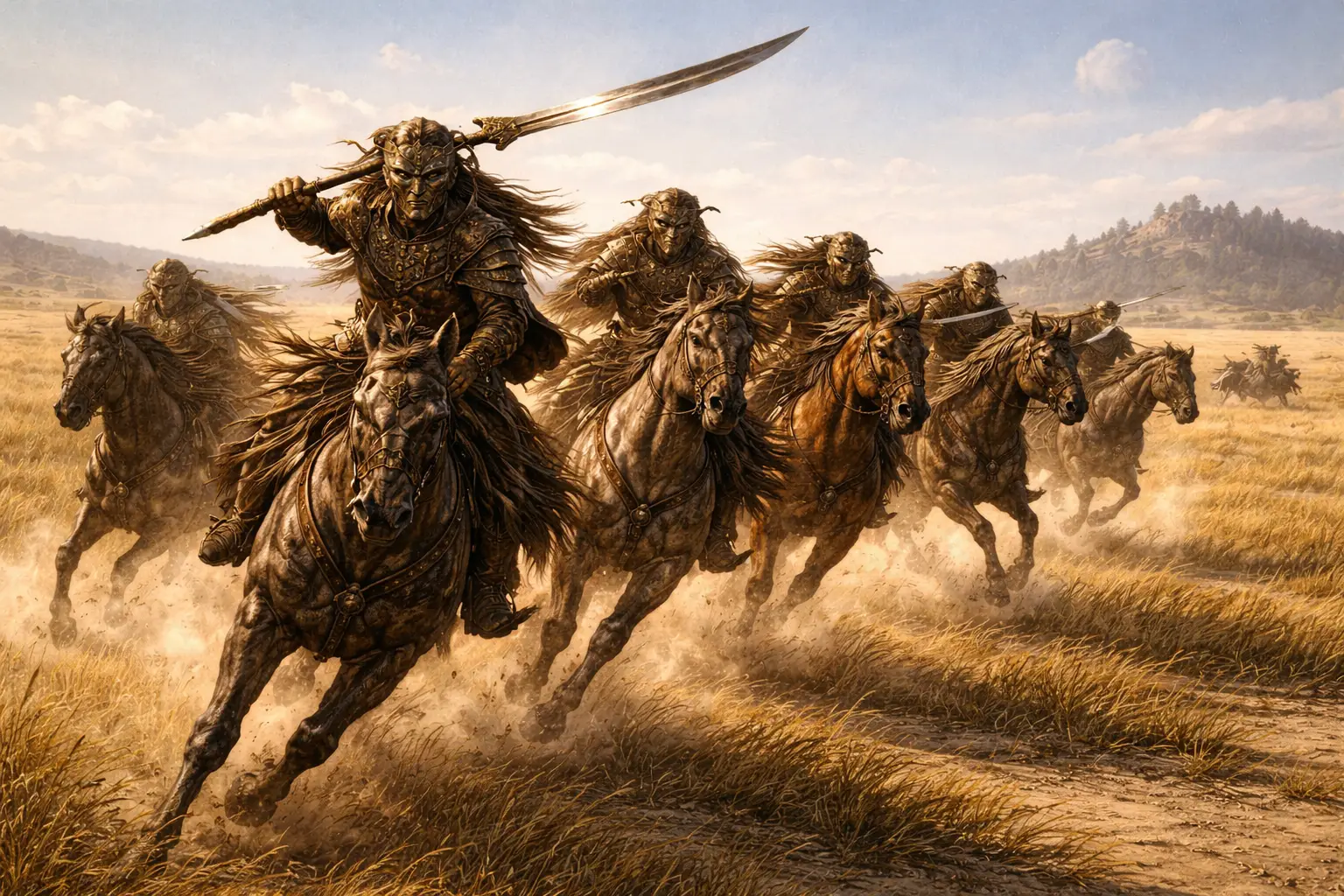
Art & Culture of Valenar
"A Phiarlan entertainer visited Taer Valaestas and attended what the elves call a Telling — a ceremony where a Keeper of the Past recounts the deeds of a patron ancestor while warriors perform the ancestor's fighting style in the arena below. The performance lasted three hours. The entertainer, who has seen every stage in Khorvaire, said afterward that it was the most technically accomplished thing she had ever witnessed and that she had no idea whether it was theater, worship, military drill, or all three. She asked a Keeper. The Keeper said, 'Those are the same thing.'" — from the travel correspondence of the Korranberg Chronicle, Eyre 998 YK
Everything Is Practice
In the Five Nations, art and war are different categories. In Aundair, the wizard paints; the soldier fights. In Karrnath, the sculptor carves; the officer commands. In Breland, the playwright entertains; the general plans. The line between aesthetic expression and military function is clear, even in nations where the two occasionally overlap.
In Valenar, there is no line. There has never been a line. The distinction does not exist in the Elvish the Tairnadal speak, and attempts to explain it to them produce the same mild confusion that the Phiarlan entertainer encountered — the sense that you are trying to separate the left hand from the right and call them different people.
Every element of Tairnadal culture — the stories, the music, the blade forms, the equestrian displays, the way a warrior stands when addressing the campfire, the angle at which a zaelshin amulet is worn on the brow — is simultaneously a creative act, a spiritual observance, and a refinement of combat skill. The Tairnadal do not train and then relax. They do not fight and then celebrate. They practice, constantly and in everything, because practice is how the ancestors are honored, and honoring the ancestors is the only purpose their culture recognizes. A warband riding in formation across the plains is executing a maneuver, performing a tradition, and praying — all at the same time, in the same motion, without drawing any distinction between the three.
This produces a culture that is, by any external standard, breathtakingly beautiful — and that does not care whether you think so.
The Telling
The central cultural event of Tairnadal life is the Telling — a ceremony in which a Keeper of the Past recounts the deeds of a patron ancestor in full, while warriors who channel that ancestor demonstrate the ancestor's techniques in live performance.
Tellings occur around campfires at night, in the great arena of Taer Valaestas, and in the circles that Keepers mark on the ground with their blades — any space consecrated by the mark becomes a temple for the duration of the ceremony. The Keeper's voice carries the story; the warriors' bodies carry the proof. A Telling of Vadallia's campaign against the Cul'sir will include mounted maneuvers in the arena, with riders executing the same formations the Queen of Swords used forty thousand years ago. A Telling of Falaen the Silence will include a display of stealth and precision killing so controlled that the audience cannot see the performer until the blade is already at the throat of the training dummy. A Telling of Taeri will include double-scimitar forms performed at a speed and technical precision that would draw gasps from a Rekkenmark weapons master — because the forms the Rekkenmark master studied were derived, at several removes, from the ones Taeri's revenants have been perfecting since before humanity existed.
The Keepers of the Past serve as both priests and performers. In addition to their spiritual duties — hearing the ancestors, conducting the rituals that determine which ancestor chooses which youth, mediating disputes, and preserving the lore — the Keepers are entertainers. This is not a secondary role. It is essential. The stories of the ancestors must be told vividly, compellingly, with the emotional force that ensures the dead are remembered not as abstractions but as people. A Keeper who cannot make an audience feel the weight of Vadallia's death at the hands of Cul'sir's curse has failed in the most fundamental duty the culture recognizes — because a story told badly is an ancestor fading from memory, and an ancestor who fades from memory is gone forever.
OVERHEARD AT THE ARENA — Taer Valaestas, Nymm 998 YK
"You are watching, but you are not watching correctly. You see a rider performing a turn. That is not what is happening. What is happening is that the rider is being Vadallia. The horse is being Vadallia's horse. The turn is the turn Vadallia made at the battle of the Cul'sir Gorge, when she broke through the giant line and reached the slaves on the other side. If you watch the turn and see only a turn, you have missed everything. Watch again."
The Blade Dance
The tradition that outsiders find most striking — and most dangerous to witness up close — is what the Five Nations call blade dancing and the Tairnadal simply call form practice.
The double-bladed scimitar is the signature weapon of the Valenar: a haft of fine wood supporting a long, curving blade on either end, balanced for mounted and dismounted combat, forged with techniques refined across millennia. Most modern scimitar forms are drawn from the teachings of Taeri, the greatest swordsman of the Age of Giants, and his revenants have spent forty thousand years perfecting those forms into something that transcends mere technique. When a master practitioner performs the blade forms at speed — the weapon spinning in continuous arcs, the body moving in patterns so fluid that the elf appears to be dancing rather than fighting — the result is one of the most visually spectacular and technically demanding martial traditions in Khorvaire.
The Tairnadal do not call it dancing because they do not think of it as performance. Every form is a combat technique. Every sequence of forms is a tactical doctrine. The "dance" is a method of fighting that happens to be beautiful, the way a hawk's dive happens to be beautiful — the beauty is a byproduct of perfection, not its purpose. But the beauty is real, and it is devastating to watch.
Blade forms are practiced alone, in pairs, and in warbands. Solo practice is meditation — a warrior moving through the ancestor's sequences in trance communion, experiencing the ancestor's memories while their body executes the ancestor's techniques. Paired practice is sparring — real blades, real speed, real risk, because there is no point to a bout that does not test the skills of the combatants. Warband practice is coordinated movement — six or twelve warriors performing interlocking sequences in formation, their blades carving patterns in the air that map the tactical geometry of an engagement. Watching a full warband blade practice is like watching a flock of starlings change direction — individual bodies moving as a single organism, each one aware of every other, the whole greater than the sum of its parts and considerably more lethal.
The revenant blade tradition produces the most extraordinary practitioners. Elite revenants who have honed their ancestral connection to the point where it produces supernatural effects — where the blade moves faster than muscle should allow, where the warrior seems to know what the opponent will do before they do it — are given the title of revenant blade and are regarded as living proof that the ancestor is truly present. A revenant blade performing the forms is not merely skilled. They are channeling forty thousand years of perfected technique through a body that the ancestor is actively guiding, and the result is combat art that no other tradition on Khorvaire can replicate.
Foreign visitors to Taer Valaestas are routinely invited to the arena to watch. They are also routinely invited to spar. The invitation is friendly. The result is educational.
"I am a Blademark veteran of twelve years. I have fought Karrns, Thranes, Darguuls, and a warforged titan. A Tairnadal youth — she could not have been older than fifty, which I am told is barely an adult — challenged me to a friendly bout in the arena. The bout lasted nine seconds. I did not land a single blow. She helped me up afterward and said, very sincerely, that I had good footwork. I have been thinking about that for six months." — anonymous Deneith soldier, dictating a letter home
The Zaelshin and the Zaelta
The visual markers of Tairnadal identity are the zaelshin and the zaelta — the amulet and the mask that together announce who a warrior is, in the deepest sense the Tairnadal recognize.
The zaelshin is a sigil-bearing amulet — the seal of the wearer's patron ancestor, worn either as a brooch at the chest or embedded in the forehead of a helmet. Every zaelshin design is unique to its ancestor, and a Tairnadal who sees another elf's zaelshin knows immediately who they are channeling, what their role in the warband is, and what their capabilities are likely to be. Recognizing a zaelshin as an outsider is a meaningful gesture of respect; misidentifying one is an insult that will be corrected, firmly.
The zaelta — the "spirit mask" — is a veil covering the lower face, worn in battle and during rituals. Its purpose is to ensure that when an enemy or an audience looks at a Tairnadal warrior, they see the zaelshin first — the ancestor, not the individual. The elf beneath the mask is a vessel. The ancestor they carry is the point. A Vadallia revenant riding into battle wearing the Queen of Swords' zaelshin on her brow and the zaelta across her face is not a person going to war. She is a forty-thousand-year-old hero going to war, wearing a living body the way a Karrnathi officer wears a uniform.
The craftsmanship of zaelshin amulets is a zaelantar art tradition in its own right — the smiths who forge them channel ancestors who were legendary artisans, and a finely wrought zaelshin is valued as highly as the blade it rides above. The materials range from worked bronze to mithral to settings incorporating fragments of recovered Xen'drik relics, and the style carries subtle information about the wearer's status, achievements, and the depth of their ancestral connection.
The Arena
The great arena at Taer Valaestas is the single most important cultural site in Valenar — a vast open space within the bronzewood walls used for horse training, races, equestrian displays, blade practice, Tellings, sparring matches, and every other activity that the Tairnadal consider worth doing in public, which is to say, every activity that involves demonstrating skill.
The arena is not an amphitheater in the Brelish sense — there is no stage, no separation between performer and audience. The space is open ground, and anyone present may enter it. Visiting warriors who watch from the edge will be invited to participate. Declining is acceptable. Accepting poorly is embarrassing but forgiven. Accepting well is the fastest way to earn Tairnadal respect that any outsider has ever discovered.
Horse races are the most common spectacle — not sport in the recreational sense, but competitions that test the bond between rider and mount with a seriousness that reflects the spiritual weight the Tairnadal place on their animals. A race in the arena is a test of whether the ancestral spirit is truly present in both horse and rider, and a warband whose mounts perform poorly faces questions about the strength of their connection that have implications well beyond equestrian pride.
What the Youth Are Doing
Tairnadal children do not have a childhood in the way humans understand it. They have an audition.
From birth, a Tairnadal elf is raised communally by the zaelantar — the peaceful souls — in the settled communities. Parents are known but not central; biological lineage is secondary to the spiritual lineage that will come later. For at least sixty years — the entirety of what humans would consider a full life — the young elf trains in basic combat skills, studies the stories of every patron ancestor, cares for younger children, and works at the tasks the community requires. Through this process, each youth is auditioning for the ancestors. The elf who excels at stealth hopes to be chosen by Falaen. The elf who leads their peers hopes to be chosen by Vadallia. The elf who fights with reckless brilliance hopes to be chosen by Taeri.
The ancestor chooses the elf, not the other way around. The choice cannot be questioned. A youth who spent decades training as an archer may be chosen by a patron ancestor renowned for magic — not for their archery, but for some quality of character the ancestor recognized that the elf did not. The moment of selection is the most important event in a Tairnadal's life: the transition from youth to revenant, from auditioning to embodying, from waiting to becoming. Everything before is preparation. Everything after is purpose.
The youths who have not yet been chosen defend Taer Senadal on Aerenal — the stone fortress designed to be attacked, where armies take turns assaulting the walls while the youth hone their skills in defense. On Valenar, the equivalent is the endless patrol: youth formations riding the plains under the guidance of retired warriors, practicing the same maneuvers the ancestors practiced, waiting for the moment that changes everything.
What the Campfire Sounds Like
Tairnadal music is spare, percussive, and built around the voice.
There are no orchestras. There are no concert halls. Music happens around the campfire, on the march, and in the circles the Keepers mark on the ground. The primary instrument is the voice itself — the Keeper's chant, carrying the ancestor's story with a rhythmic precision that locks into the listener's breathing and pulls them into the trance-state where communion with the ancestor is strongest. Percussion supports the voice: hand drums, the flat of a blade struck against a shield rim, the rhythmic stamp of boots on hard ground. String instruments exist but are uncommon — a single bowed instrument, spare and high-pitched, used in mourning songs and in the quiet Tellings held at dawn before a warband rides out.
The sound is nothing like the lush orchestral traditions of Aundair or the driving hammered rhythms of the Mror. It is closer to the percussive swamp music of the Shadow Marches — stripped, functional, rhythmically hypnotic — but where Marcher music reads the environment, Tairnadal music reads the dead. A campfire chant performed by a Keeper for a warband on the eve of a raid is not entertainment. It is invocation — a calling-forth of the ancestors into the circle of firelight, so that when the warriors ride at dawn, they ride with the dead at their backs.
FRAGMENT — overheard at a Tairnadal campfire, recorded by a Khoravar administrator who was not certain she was supposed to be listening, Valenar steppes, 997 YK
The Keeper's voice rose and fell over the drum-pulse like a blade spinning on its axis — not melody in any sense a Brelish musician would recognize, but something older, something that made the hair stand on my arms. The warriors around the fire were not still. They swayed, their hands moving in small gestures I later learned were the abbreviated forms of their ancestors' combat techniques — practicing, even while listening, even while praying. When the Keeper stopped, the silence lasted exactly as long as a drawn breath. Then the lu-shan stood and said one word — her ancestor's name — and the warband rose as a single body and walked into the dark toward their horses.
What Outsiders See
Visitors to Valenar encounter a culture that is profoundly alien to the Five Nations sensibility — not hostile, not inaccessible, but operating on assumptions so different that the experience requires constant recalibration.
The first thing outsiders notice is the beauty. The horses are magnificent. The riders move with an economy of motion that makes a Karrnathi dress parade look like a pub crawl. The blades flash in the sun. The bronzewood walls of Taer Valaestas are extraordinary. The arena displays are breathtaking.
The second thing outsiders notice is that none of it is for them. The beauty is not decorative. The displays are not entertainment. The precision is not showmanship. Everything the Tairnadal do is oriented inward, toward the ancestors, and the fact that it happens to be spectacular is incidental — the way a predator's speed happens to be graceful. A visitor who compliments a Tairnadal warrior on the beauty of their blade work will receive a polite acknowledgment and the faint sense that the compliment has missed the point, the way a priest might acknowledge a tourist who compliments the cathedral's architecture when the tourist has not noticed the altar.
The Khoravar and the Khunan, who live alongside the Tairnadal without fully participating in their culture, have developed their own traditions — Khoravar artisans in Moonshadow produce work that blends Tairnadal aesthetics with Five Nations sensibility, and the Khunan villages maintain the Sarlonan-descended folk traditions they brought with them centuries ago. These cultures exist in the same space as the Tairnadal without merging with them, the way separate rivers can flow through the same valley without mixing their waters.
"In Fairhaven, they put art in a gallery. In Sharn, they put art on a stage. In Taer Valaestas, art puts you in the dirt and helps you up and says you have good footwork." — Khoravar merchant, Pylas Maradal