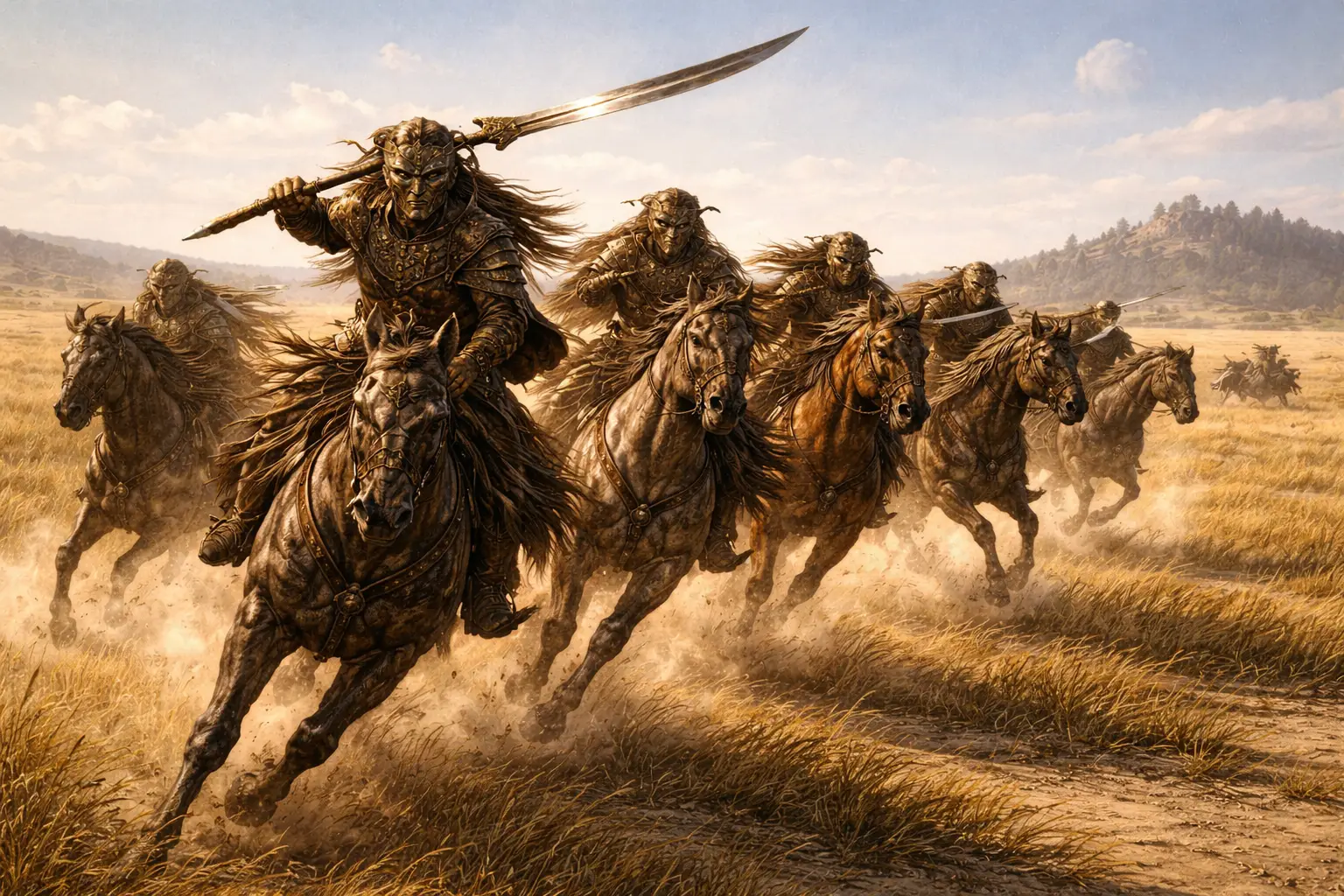
Politics of Valenar
From the diplomatic correspondence of Daera Sorandal, Valenar's sole representative to the courts of the west, Sypheros 997 YK:
The Brelish ambassador asked me — again — to explain Valenar's system of government. I told him we have a var-shan who commands forty-five warclans, a body of Keepers who preserve the ancestors, and a population of half-elves who handle the rest. He asked where the legislature was. I told him there was no legislature. He asked where the judiciary was. I told him there was no judiciary. He asked how disputes were settled. I told him the warband settles them, or the ancestors do. He wrote all of this down very carefully and then said, "So it's a military dictatorship." I said no. He said, "Then what is it?" I said it was an army that accidentally acquired a country and has been trying to give the country part away to someone competent ever since.
An Army with a Country Attached
The simplest way to understand the politics of Valenar is to understand that the politics of Valenar do not exist. What exists is a military command structure forty thousand years old, transplanted to a piece of Khorvaire it never intended to keep, surrounded by a civilian population it never intended to acquire, and operating with the serene confidence of an institution that considers everything outside its chain of command to be someone else's problem.
The Tairnadal do not distinguish between military and political authority because they have never needed to. On Aerenal, where the Tairnadal lived as nomadic armies for tens of thousands of years, there was no civilian population to govern — the zaelantar who maintained the settlements and raised the young were part of the same culture, following the same faith, answering to the same ancestors. The system worked because everyone in it understood what it was for. When Shaeras Vadallia seized eastern Cyre in 956 YK, he imported this system wholesale into a territory containing tens of thousands of Khunan farmers, a growing Khoravar immigrant population, a port city with international shipping traffic, and all the messy, mundane requirements of a functioning nation. The system was not designed for any of this. It has not been redesigned since. What has happened instead is that other people — mostly half-elves — have quietly built the missing infrastructure around the army's edges, the way moss grows on the side of a moving boulder.
The Var-Shan and the Chain of Ancestors
The Five Nations call Shaeras Vadallia the High King. The Tairnadal call him var-shan — "great lord" — a military rank, not a royal title. Every Tairnadal army has a var-shan. Shaeras is the var-shan of the Army of Valenar, which makes him the highest-ranking Tairnadal on Khorvaire. It does not make him a sovereign in any sense that the Treaty of Thronehold intended.
What makes the Tairnadal hierarchy unlike any other command structure in Khorvaire is that rank is not earned through seniority, appointment, or election. It is earned through ancestry. A shan — the leader of a warclan — holds command because they are the revenant of a patron ancestor who was a leader. Within a warclan, the Vadallia revenant leads, because Vadallia led. The Falaen revenant advises on stealth and assassination, because Falaen was the Silence. The Taeri revenant fights, brilliantly and ferociously, but is never appointed to command, because Taeri was a swordsman, not a general — and no one in Tairnadal history has ever been confused about the difference.
This principle flows through every level of the hierarchy. The forty-five warclans of the Army of Valenar each answer to a shan. Within each warclan, warbands — the basic social and combat unit, essentially permanent families whose members serve together for life — answer to a lu-shan, a "band lord." At any given time, roughly twenty clans are under Shaeras's direct command; the rest operate independently in the field, following general directives but exercising the kind of autonomous judgment that would give a Rekkenmark instructor a nervous collapse. When a lu-shan must make a split-second decision in combat, their word is absolute. When the matter is not urgent, the warband debates around the campfire and consensus rules. The lu-shan rarely overrides the group — not because they lack the authority, but because the warband's respect is personal, not institutional. They follow this particular elf because this particular elf channels this particular ancestor, and that ancestor earned the right to lead forty thousand years ago.
The Keepers of the Past sit outside the chain of command and above it simultaneously. They are spiritual authorities who can hear all the ancestors, who determine which ancestor has chosen which elf, and whose interpretation of ancestral precedent carries a weight that no military order can override. A shan who ignores a Keeper's guidance is not court-martialed — there is no court — but is defying the spiritual foundation on which the entire civilization rests. It has happened. It does not happen twice.
"In the Five Nations, authority comes from a crown, a constitution, or a sword. In Valenar, authority comes from a dead hero who chose you before you were old enough to hold a weapon. You do not earn it. You do not inherit it. It finds you, and then you spend the rest of your life proving you deserve it." — Keeper of the Past, speaking at a diplomatic reception in Pylas Maradal
The People Who Do Everything Else
The Tairnadal hierarchy governs the Tairnadal. It does not govern Valenar. The distinction is the entire political story of the nation.
Approximately twenty thousand Tairnadal elves occupy a territory that was home to tens of thousands of Khunan human farmers before the elves arrived and that has since attracted a growing population of Khoravar half-elves. The elves need the farmers to produce food. They need the half-elves to handle trade, diplomacy, infrastructure, and the thousand mundane tasks that a nation requires and that no warband considers part of its ancestral duty. What the elves have never done is build a system that connects their military hierarchy to the people who actually run the country.
The Khoravar filled the gap. Drawn by House Lyrandar's investment and the dream of a half-elven homeland, Khoravar immigrants have constructed an administrative apparatus from scratch — tax collection in the form of supply quotas, trade regulation through the harbor office at Pylas Maradal, dispute resolution through informal councils of tar-shans (the Tairnadal term for a civilian district leader, borrowed by the half-elves because no one offered them a better one), and a growing body of commercial law that no elf has ever read. The Khoravar Trade Council in Pylas Maradal sets tariffs, licenses merchants, and operates the port with an efficiency that would impress a Zil factor. None of this has been formally authorized by the var-shan. None of it has been formally prohibited. The elves do not care what the administrators do, provided the supply wagons arrive on schedule and no one gets in the way of the warbands.
Moonshadow, a young village on the Old Road built by Khoravar immigrants from across Khorvaire, represents the optimistic extreme — a community of scholars, artisans, and idealists who believe Valenar can become a genuine homeland for half-elves, a place where the Khoravar are not guests in someone else's nation but citizens of their own. Whether the Tairnadal share this vision, or will ever be persuaded to acknowledge it, is the question the Moonshadow settlers are betting their lives on.
The Khunan farmers, meanwhile, do what they have always done: they plant, they harvest, they provide what is demanded, and they outlast whoever is demanding it. The Cyran feudal lords who governed eastern Cyre before the elves were petty tyrants imposed by Galifar, and many Khunan observe with characteristically dry pragmatism that indifferent overlords who send druidic advisors when a village falls behind are a measurable improvement over cruel overlords who sent tax collectors and beatings. The Khunan have no political organization that the elves interact with, no representative on any body, and no voice in any decision. They have patience, and the reasonable expectation that the elves, like everyone who came before them, will eventually leave.
Daera Sorandal and the Diplomacy of Misdirection
Valenar has no embassy in any nation. No consulate. No diplomatic corps. What it has is one elf — Daera Sorandal, a Tairnadal bard of extraordinary talent — who serves as the nation's entire foreign policy apparatus.
Daera is, by every credible assessment, one of the finest diplomats in Khorvaire. She fights her battles with words, and she has kept every nation on the continent from uniting against the Valenar through the simple, audacious technique of telling each one a different story. In Breland, she emphasizes how the elves are weakening and distracting the dangerous hobgoblins of Darguun — a service Breland should appreciate. In Thrane, she claims the Valenar cannot sit idle while the Karrns continue their wicked ways. In Karrnath, she dismisses the border raids as the work of criminals acting without authorization. She has a different narrative for every court, calibrated to exploit each nation's prejudices, and so far she has prevented the one thing that could end the Valenar experiment: a coordinated response.
The work is exhausting, precarious, and entirely dependent on the assumption that the courts of the west will never compare notes. bit this assumption has held for two years. Daera dances through the contradiction with a skill that her warband ancestors would recognize as battlefield maneuvering — feint left, strike right, never let the enemy see the full picture. As long as she succeeds, the elves can continue provoking each neighbor individually. The moment she fails, forty-five warclans will face the combined attention of every nation they have antagonized, and the war the Tairnadal are hoping for will arrive on terms they may not have chosen.
"The elves have one diplomat. I have forty. She is winning." — attributed to a Karrnathi foreign ministry official
What Passes for Law
Among the Tairnadal, disputes are resolved by the warband, the shan, or the Keepers — through consensus, ancestral precedent, and the understanding that a warrior who dishonors their ancestor faces consequences worse than any court could impose. Elves who cannot live within the expectations of the culture are expelled and fostered to the Aereni, which the Tairnadal consider a form of living death and the Aereni consider a rescue.
Among the Khoravar, the informal legal tradition that has developed around the harbor office in Pylas Maradal and the tar-shan councils in Taer Valaestas draws on Galifaran precedent — the practical, case-by-case adjudication of people who need law and have not been given any. Among the Khunan, justice is whatever the village headman says it is, the same arrangement that has operated in the eastern provinces since before the elves, before the Cyrans, and before anyone thought to impose a system on people who had already built one.
The Galifar Code of Justice does not apply. No treaty law is enforced. A Sentinel Marshal pursuing a fugitive into Valenar will find that the Khoravar administrators are cooperative, the Khunan are indifferent, and the Tairnadal are interested only if the fugitive looks like a worthy fight.
The Tensions That Are Not Tensions Yet
Valenar's political fault lines do not look like other nations' fault lines. There is no succession crisis — the var-shan holds command until the ancestors choose otherwise. There is no economic crisis — the Tairnadal do not think about economics. There is no constitutional crisis — there is nothing to be in crisis about.
What Valenar has are three populations with three incompatible visions of what the nation is for, held in suspension by the fact that the most powerful of the three does not care what the other two think and the other two have not yet accumulated enough leverage to force the question.
The Tairnadal want war. They will continue provoking their neighbors until they get one, and when it arrives, the supply chain that feeds their horses and forges their weapons will be the first thing their enemies target — which means the Khoravar and Khunan who maintain that chain will bear the cost of a conflict they never asked for.
House Lyrandar is building something the elves have not noticed. If the Khoravar administrative class continues to grow — if Pylas Maradal becomes a genuine commercial hub, if Moonshadow produces a generation of half-elven civic leaders, if the Trade Council's informal authority solidifies into something the elves can no longer ignore — then Valenar may find itself with a political class that has interests the military hierarchy cannot overrule without destroying the infrastructure it depends on.
And on Aerenal, Tairnadal armies that chose not to join the Valenar initiative are watching. A var-shan who provokes a war and loses it has not merely failed a campaign. He has failed the ancestors — and the judgment of a Keeper of the Past, delivered in the presence of the Shanutar council, is a verdict from which there is no appeal and no recovery.
Carved above the gate of the arena in Taer Valaestas, in Elvish, renewed each season by the Keepers of the Past:
THE SWORD DOES NOT ASK WHO FARMS THE FIELD. THE FIELD DOES NOT ASK WHO CARRIES THE SWORD. BOTH SERVE THE ANCESTORS.