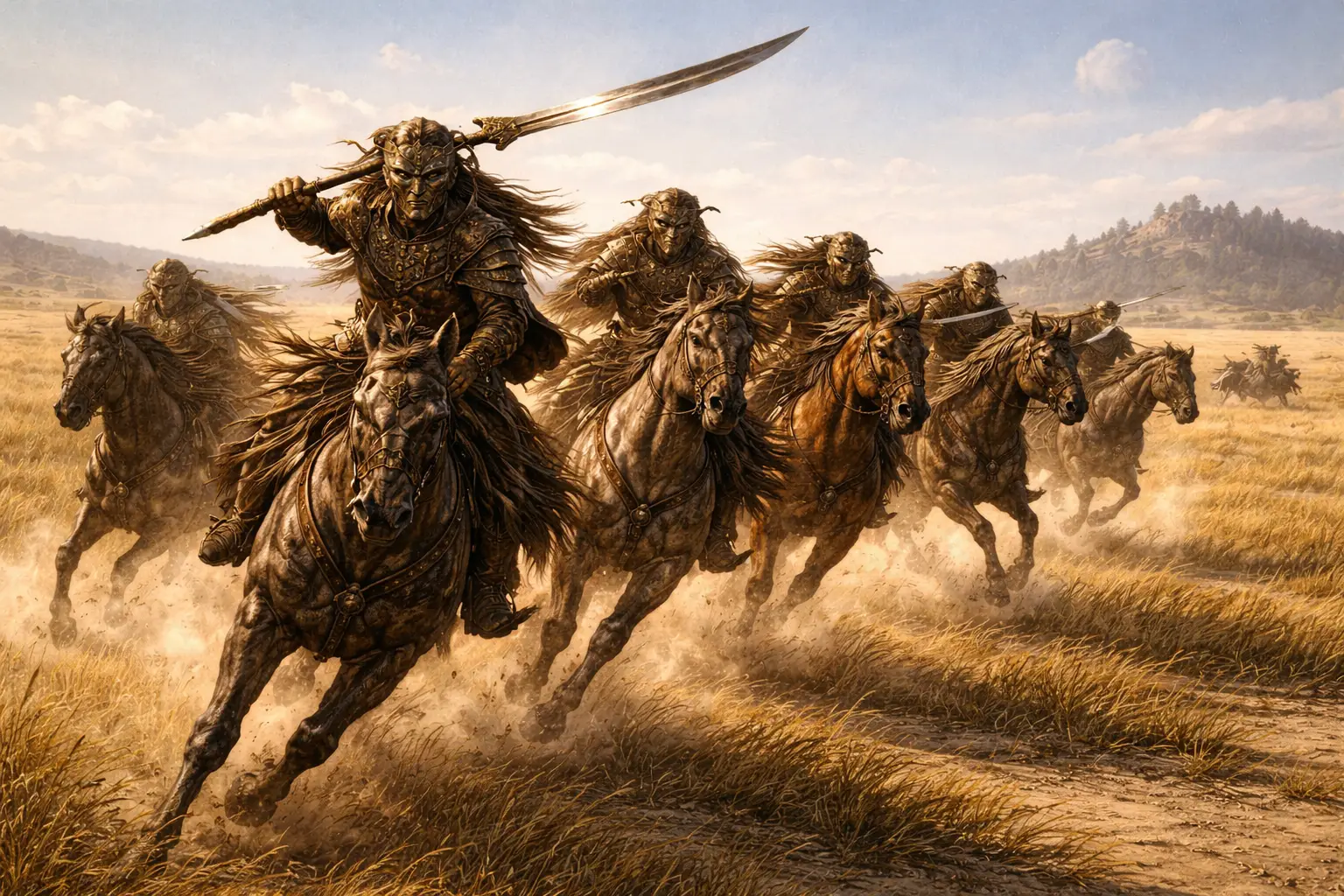
Economy & Industry of Valenar
"A Kundarak assessor asked me to describe Valenar's economy. I told her: grain goes in, warhorses come out. She asked about exports. I said: mercenaries and the fear of mercenaries. She asked about imports. I said: everything the elves can't raid on horseback. She closed her ledger and said, 'This is the least diversified economy I have ever seen.' I told her the elves would consider that a compliment." — Khoravar harbor prefect, Pylas Maradal
A Supply Chain That Became a Country
Valenar's economy is more like a warfront supply chain than a proper working industry.
An economy implies production, exchange, accumulation, growth — the machinery of a society interested in prosperity. The Tairnadal are not interested in prosperity; they are interested in keeping forty-five warclans mounted, armed, fed, and moving, indefinitely, at a tempo that would exhaust a conventional army in months. Everything else — trade, agriculture, craftsmanship, the port at Pylas Maradal, the market in Taer Valaestas — exists to support that objective and the moment a Khoravar administrator or a Khunan farmer forgets this, the supply quotas remind them.
A Kundarak assessor attempting to calculate Valenar's gross domestic product would find almost nothing to measure. The elves do not trade for profit. The Khunan farmers produce to meet quotas, not to sell at market. The only conventional commercial activity in the nation flows through Pylas Maradal, where House Lyrandar operates a port that connects Valenar to the outside world — and most of that commerce is import rather than export, because a nation of nomadic warriors does not produce much that other nations want to buy. What Valenar produces is soldiers. What it exports is violence. Everything else is overhead.
The Supply Quotas
The economic foundation of Valenar is grain, livestock, leather, and fodder — the raw materials required to keep an army in the field. These are produced by the Khunan farming villages that occupy the fertile plains south of the Blade Desert, the same villages that fed eastern Cyre for centuries before the elves arrived.
Each village is assigned a supply quota by the Khoravar administration — a quantity of grain, meat, hides, and other materials that must be delivered to designated collection points on a regular schedule. The quotas are not negotiable in the conventional sense; they represent what the army needs, and the army's needs come first. But the system is not the punitive extraction that the Cyran feudal lords practiced before the elves. Villages that meet their quotas are left entirely alone — no further tax, no conscription, no interference in internal affairs. Villages that fall behind receive assistance from the Siyal Marrain — the Tairnadal druids who tend the army's beasts — in the form of agricultural advice, weather management, and minor primal magic that can salvage a failing crop or improve a struggling herd.
This arrangement is, by the standards of the Five Nations, unusual. By the standards of the Khunan, who spent centuries under Cyran nobles who taxed them into poverty and beat them when they complained, it is an improvement that most farmers acknowledge with the dry pragmatism of people who have outlasted multiple regimes. The elves do not care about the Khunan's wellbeing in any sentimental sense. They care about the supply wagons arriving on time. The result, paradoxically, is a system that treats the farming population better than any government they have experienced — because the elves have no incentive to extract more than they need, and every incentive to keep the farms productive.
The strain is real, however, for the army never stands down. Forty-five warclans on permanent patrol — plus the horses, the supply trains, the fortress garrisons, the druidic infrastructure — demand a volume of agricultural output that pushes the plains to their limit. The Khunan can feed the army in a good year. In a bad year — drought, blight, a particularly harsh Blade Desert sandstorm scouring the northern fields — the margin disappears, and villages that were comfortably meeting quotas find themselves choosing between feeding the army and feeding themselves. The elves have not yet faced this crisis at scale; when they do, the answer will reveal whether "druidic assistance" extends to protecting the farmers or merely protecting the harvest.
COLLECTION POINT NOTICE — posted at a Khunan village granary, undated
Quota for the current season: 40 bushels grain, 12 head cattle, 200 lbs. cured leather. Delivery to the Toraan waypoint by the second Sar of Nymm. Shortfalls will be reviewed by the district tar-shan. Assistance from the Siyal Marrain is available on request. Do not wait until the wagons are late to request it.
The Horses
If grain is the foundation of Valenar's economy, horses are its only product that the rest of the world wants — and the rest of the world cannot have them.
The Siyal Marrain, the Tairnadal druids who breed and tend the army's mounts, maintain herds of extraordinary quality. Valenar horses are the finest in Khorvaire as a baseline — fast, brave, and responsive beyond anything House Vadalis has produced. The true Tairnadal animals, those channeling the spirits of legendary ancestors, are something beyond equine — potentially sapient, certainly supernatural, and bonded to their riders through the same ancestral connection that defines Tairnadal faith. House Vadalis has spent decades and considerable fortunes trying to replicate these animals and has failed every time, because the magic is in the bond between rider and mount, not in the bloodline alone. A Tairnadal horse separated from its bonded revenant for more than a few days loses the ancestral spirit. A foal bred in Vadalis captivity is born mundane.
The result is that Valenar horses are the most coveted mounts on the continent and the one commodity the Tairnadal will never sell. Exceptional Tairnadal animals occasionally bond with non-elves — an event considered remarkable and deeply meaningful by the Keepers of the Past — but this cannot be commercialized. The horses are not products. They are partners in the ancestral mission, and treating them as livestock would be a spiritual offense that no Tairnadal would contemplate.
What Vadalis can purchase, and does, are the conventional horses the Siyal Marrain breed as baseline stock — animals that are excellent by any non-Tairnadal standard but that lack the ancestral bonding. These horses command premium prices and represent one of the few legitimate exports from Valenar that does not involve someone getting stabbed.
Pylas Maradal: The Port That Used to Be a Smugglers' Haven
Pylas Maradal is the economic aperture through which Valenar connects to the outside world — the only place in the nation where conventional commerce occurs at any meaningful scale.
When the region was part of Cyre, the city was called Southport: a coastal town with a deep harbor, a flexible attitude toward customs law, and a thriving smuggling trade that the Cyran authorities in distant Metrol could not be troubled to suppress. Pirates from the Lhazaar Principalities used Southport as a resupply point. Merchants from Q'barra, Sarlona, and Aerenal docked there to trade without the oversight of the larger Five Nations ports. The city's economy ran on the understanding that nobody would ask too many questions about what was in the hold.
House Lyrandar transformed the port after the elves took power. The half-elf house invested heavily — building shipyards, constructing a large house enclave, and developing the infrastructure that a proper trade port requires. Lyrandar's investment was not altruistic; it was the foundation of the house's long-term ambition to make Valenar a Khoravar homeland, and a functional port is the first thing any homeland needs. Pylas Maradal now handles traffic from Q'barra, Sarlona, and Aerenal, and it serves as the primary channel for imports into Valenar — finished goods, metal stock, alchemical supplies, luxury items, and everything else that a nation of nomadic warriors and subsistence farmers does not produce for itself.
The port is administered by Khoravar officials under a trade council that sets tariffs and licenses merchants. The Tairnadal have no involvement in its operation. They do not understand tariffs. They do not care about tariffs. The Khoravar who run the harbor have learned not to explain tariffs to the elves, because the conversation inevitably ends with the elf asking why the harbor does not simply take what it needs and the Khoravar explaining that this is, in fact, what tariffs are, expressed in a way that does not require swords.
HARBOR LOG — Pylas Maradal, Nymm 998 YK
Inbound: Lyrandar galleon Stormwind's Grace — 30 crates steel stock (Cannith stamp), 12 barrels alchemical reagent (Jorasco consignment), 8 crates finished tools, 4 bolts Brelish textile. Origin: Sharn.
Inbound: Aereni merchant Pale Dawn — 14 crates densewood lumber, 6 casks Aereni wine, 2 sealed containers (contents classified, Keepers of the Past consignment). Origin: Pylas Talaer.
Outbound: Independent trader Raven's Luck — 6 horses (conventional stock, Vadalis purchase order), 2 crates cured leather, 1 crate Blade Desert relics (provenance documented, Khoravar export license). Destination: Regalport.
The Mercenary Export
Valenar does not broker mercenaries through House Deneith the way Darguun does. The Tairnadal do not sell their services for gold — they fight because the ancestors demand it, not because a client is paying. But the practical effect is similar: Valenar warbands operating abroad — in Q'barra, the Mournland, Xen'drik, and the borderlands of Darguun and Karrnath — generate a form of economic return that the Khoravar administrators have learned to channel.
A warband that raids a Darguun border post and returns with captured arms and armor has increased the nation's military stock without requiring an import. A warband that ventures into the Mournland and recovers pre-Mourning artifacts has produced something of considerable value to collectors, scholars, and the dragonmarked houses. A warband that explores an ancient ruin in the Blade Desert and recovers Tairnadal relics from the elf-goblin wars has acquired an item whose spiritual value is incalculable to the Keepers of the Past and whose monetary value, should the Khoravar ever manage to persuade the elves to part with a lesser piece, is extraordinary.
The relics scattered across the Blade Desert are the closest thing Valenar has to a natural resource — ancient weapons, armor, and artifacts from wars fought tens of thousands of years ago, preserved in the desert sand or locked in fortresses that have slipped out of alignment with time. The Keepers of the Past treat these sites as sacred. The Khoravar administrators treat them as potential revenue. The elves treat them as opportunities to recover the tools their ancestors used, which is the same thing as a religious pilgrimage and considerably more dangerous. Adventurers hired to explore these sites should expect to negotiate terms with a Khoravar factor and then deal with Tairnadal warbands who may or may not acknowledge the factor's authority, depending on whether the site contains something an ancestor once carried.
The Dragonmarked Presence
House Lyrandar dominates the dragonmarked landscape in Valenar. Its investment in Pylas Maradal's shipyards and its enclave in the port make it the primary commercial institution in the nation, and its vision for Valenar as a Khoravar homeland gives it a stake in the nation's future that extends beyond commerce. Most of the other houses maintain token outposts in Taer Valaestas — enough to service the needs of the foreign merchants who trade in the capital's market — but none have invested on Lyrandar's scale.
House Vadalis watches the Siyal Marrain with frustrated longing. The house has not given up on replicating Tairnadal animals, and the conventional horses it purchases from Valenar's baseline stock are among the finest in its stables. House Ghallanda provides hospitality services in Taer Valaestas and Pylas Maradal — essential, given that the Tairnadal concept of hospitality involves offering a guest the chance to spar. House Deneith has no formal presence; the Tairnadal view the Sentinel Marshal authority as an irrelevance, and the house has learned not to send agents who look like they are looking for a fight unless they are prepared to receive one.
Trade and Transit
Valenar is one of the most isolated nations in Khorvaire. The Blade Desert blocks overland transit from the north. There is no lightning rail — the Cyran-era lines were destroyed when the elves took the territory, and neither the Tairnadal nor the Khoravar have the resources or the inclination to rebuild them. The only reliable routes into the nation are by sea through Pylas Maradal, by air (the Taer Valaestas airship tower handles limited traffic), or overland through the Blade Desert with a guide, adequate water, and the understanding that a well-armed party will be treated as a challenge by any warbands it encounters.
Trade partners are limited. Aerenal provides densewood, bronzewood, and other exotic lumber through Aereni merchants who dock at Pylas Maradal. Q'barra provides occasional traffic — dragonshards and jungle goods moving through the port. The Lhazaar Principalities handle some eastern commerce, though the relationship is opportunistic rather than formalized. The Mror Holds provide metal through Lyrandar intermediaries. And the broader Five Nations provide finished goods, alchemical supplies, and the food imports that supplement local production when the quotas run short.
What Valenar does not have — and does not want — is integration into the continental trade network the way Breland or even Q'barra is integrated. The elves did not seize this territory to build a trading partner. They seized it to build a stage for war, and every galifar that flows through Pylas Maradal is, from the Tairnadal perspective, a logistical necessity rather than an economic achievement.
"I asked the shan what Valenar exported. She said, 'Nothing you can afford.' I asked what Valenar imported. She said, 'Everything we cannot make while riding.' I asked if the nation had any economic objectives at all. She considered the question for a long time and then said, 'Sharper swords.'" — Kundarak trade assessor's report, filed from Taer Valaestas, 998 YK