Valenar
Capital: Taer Valaestas | Ruler: High King Shaeras Vadallia | Government: Military occupation administered by Khoravar half-elves | Hallmarks: Elves, horses, mercenaries, ancestor worship
"A Karrnathi officer asked one of the Valenar why they kept raiding across the border when they knew Karrnath could field ten times their number. The elf smiled and said, 'Yes. That is exactly the point.'" — from the field dispatches of First Warlord Gruden ir'Erdei, Vulyar, 997 YK
In the middle of a century-long war fought over thrones and treaties, an army of elves from a distant island crossed the sea, accepted Cyre's gold, fought Cyre's enemies with a brilliance that left every strategist on the continent staring — and then turned on their employers, seized a sizable portion of eastern Cyre, and declared it their own. They invoked a claim to the land that predated humanity's arrival on Khorvaire by tens of thousands of years. The other nations, exhausted and unwilling to fight an enemy whose cavalry had no equal, let them keep it. Eventually the Treaty of Thronehold recognized the new elf kingdom of Valenar in 996 YK. The elves accepted the recognition without much interest. They had not come for a kingdom.
Valenar occupies the southeastern corner of Khorvaire, between the Blade Desert to the north — a harsh barrier of sand and wind separating the elf kingdom from the rest of the continent — and the southern coast, where the port of Pylas Maradal faces the Thunder Sea. South of the desert, the land transitions from rolling steppes to fertile plains that once fed eastern Cyre, and most of the human population — Khunan-descended farmers whose ancestors were here long before Galifar — still works the same fields under new management. Fortress towers dot the landscape as military outposts. Warbands patrol the plains on horses so fast and so fearless that House Vadalis has spent decades trying to breed their equal and has never succeeded. And at the center of the kingdom, behind a living wall of bronzewood thorns, sits Taer Valaestas — a city built for war and waiting for it.
TRAVEL ADVISORY — issued by House Orien, distributed at waystation offices, 997 YK
Travelers to Valenar are advised that the Blade Desert crossing remains hazardous. The elves do not interfere with peaceful caravans, however a well-armed group of travelers will be treated as a challenge. Parties that appear to be adventurers or mercenaries should expect to be approached by Valenar warbands seeking combat for sport.
The Valenar Spirit
Understanding Valenar requires understanding one thing that most outsiders get wrong: the Valenar do not want to rule. They do not want land, wealth, tribute, or political influence. What they want — what their entire civilization is organized around — is war. Not the industrialized slaughter of the Last War, but the specific kind of desperate, outnumbered, asymmetric conflict that their legendary ancestors fought against the giant slavemasters of Xen'drik tens of thousands of years ago. The nation of Valenar exists because the elves need a territory that someone powerful will eventually try to take from them. The kingdom is bait; the war is the point.
Every Tairnadal elf — the elven people from whom the Valenar are drawn — carries the spirit of a dead hero. When a young Tairnadal reaches adulthood, a patron ancestor chooses them — the spirit of a legendary champion preserved across tens of thousands of years by the devotion of the living. The elf becomes a revenant: a living vessel for the ancestor's spirit, devoted to walking the path the ancestor walked, fighting as they fought, embodying their virtues and flaws so completely that the dead hero lives again. A Tairnadal's name is their given name followed by their patron ancestor's name — Shaeras Vadallia carries the spirit of the legendary Queen of Swords, the finest warlord of the Age of Giants. Every warrior's combat style, personality, and moral code flows from the ancestor who chose them. If the revenant fails to honor the ancestor — if they live a quiet life, if they never face a worthy enemy — the spirit fades, and a hero who survived forty thousand years is lost forever.
The Keepers of the Past maintain this tradition. Unlike ordinary revenants who channel a single ancestor, the Keepers can hear all the ancestors, preserving their stories and ensuring every legacy is remembered. They do not rule — the Tairnadal are led by shans, military lords — but no major decision is made without consulting them. The Keepers serve as the spiritual center of a culture that is, in the deepest sense, a civilization of the living built to serve the dead.
The result is a people whose relentless hunger for battle is not bloodlust but devotion. Every raid into Darguun, every skirmish on the Karrnathi border, every challenge issued to a well-armed caravan on the Blade Desert road is a prayer — an attempt to recreate the conditions under which the ancestors earned their immortality, so that their spirits endure for another generation.
"You ask why the Valenar are so eager to fight. For a Tairnadal warrior, every battle is a conversation with someone who died forty thousand years ago. Every time they draw their blade, they are proving to that spirit that they are worthy of carrying its name." — Daera Solaen, Keeper of the Past, speaking to a Brelish diplomat
The Shape of the Nation
The forty-five warclans of the Army of Valenar — each several hundred strong, each led by a shan — rotate between patrol duty under High King Shaeras Vadallia's direct command and independent operations in the field. The elves are nomadic by tradition, and most warbands spend their time riding the plains and seeking combat rather than sitting in a capital. The kingdom runs on a permanent war footing, and the villages that feed it are expected to maintain supply quotas that keep the army operational.
The actual day-to-day administration falls to the Khoravar — half-elves, many of them immigrants drawn by House Lyrandar's vision of making Valenar a half-elven homeland. The Khoravar handle the tasks the Tairnadal consider beneath their attention: tax collection, trade, dispute resolution, and the mundane business of running a functioning territory while its military overlords ride circles around it looking for someone to fight. The village of Moonshadow, built on the Old Road by Khoravar immigrants from across Khorvaire, represents the most optimistic version of this arrangement — a community that hopes Valenar can become something more than a military camp.
The Khunan humans who farm the plains are the third layer — the people who were here before the elves, before the Cyran nobles Galifar installed as their feudal overlords, and who have outlasted every regime change by continuing to plant crops and keeping their heads down. Many feel they are genuinely better off under the elves, who leave them alone as long as quotas are met and send druidic advisors rather than tax collectors when a village falls behind. Others resent any overlord and dream of independence.
Taer Valaestas, the capital, sits behind its wall of living bronzewood thorns — a fortress-city hosting the royal palace, the primary temple of the Keepers of the Past, dragonmarked house outposts, a foreign merchants' market, and a vast arena used for horse training, races, and equestrian displays. Pylas Maradal, the southern port once known as Southport, is the second city — House Lyrandar has invested heavily in its shipyards, and the port handles traffic from Q'barra, Sarlona, and Aerenal. Scattered across the plains and the Blade Desert are ruins and haunted fortresses from the ancient elf-goblin wars — battlefields that have slipped out of alignment with time, relics of a struggle that the Tairnadal remember as though it happened yesterday, because for them it never stopped.
The Horses
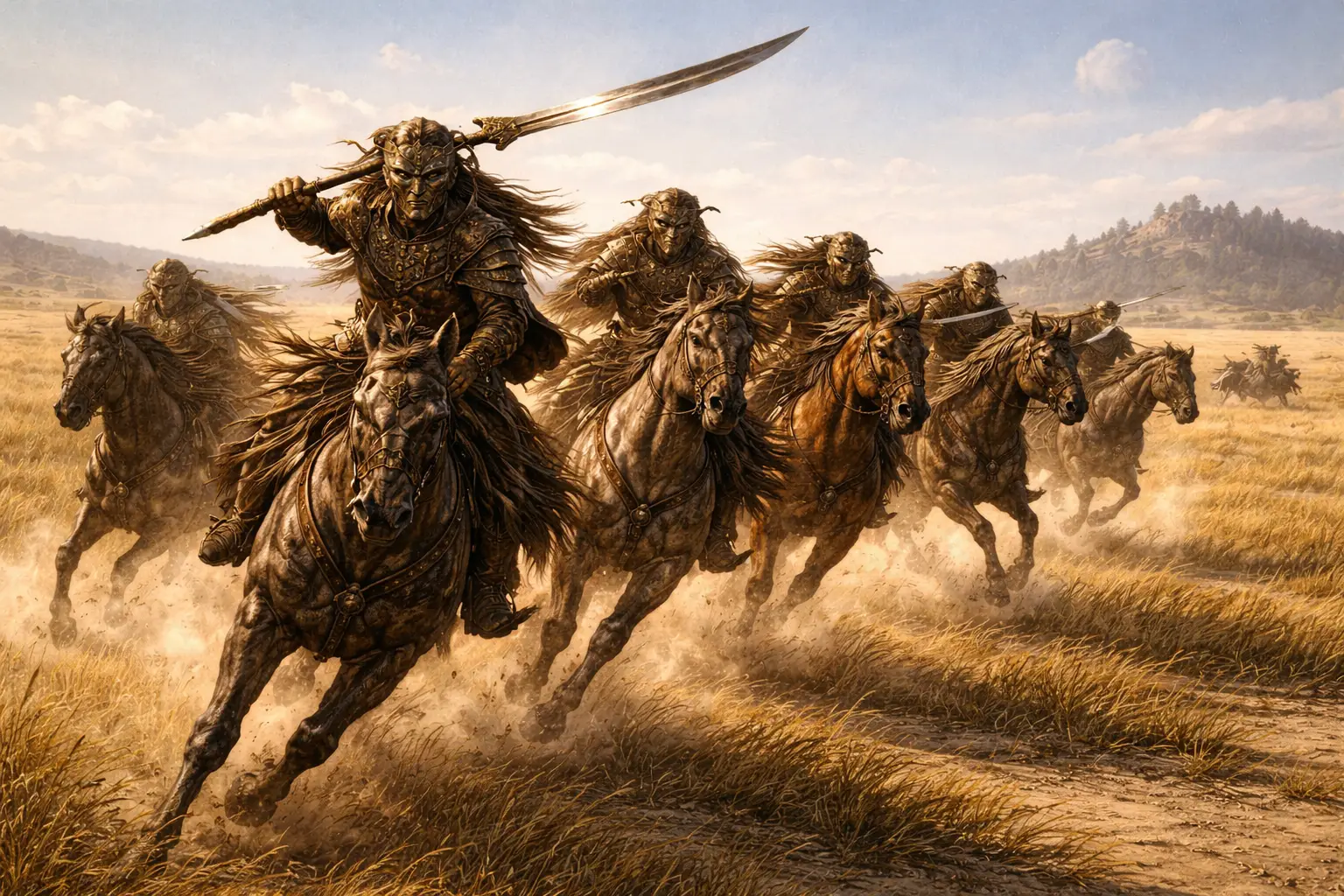
No discussion of Valenar is complete without the horses. Valenar steeds are the finest mounts in Khorvaire — faster, braver, and more intelligent than anything House Vadalis has ever bred. Vadalis has tried repeatedly to replicate them and failed every time, because Valenar horses are not purely biological. A true Tairnadal animal channels the spirit of its own legendary ancestor, just as the elf who rides it does. The legends of Vadallia include her remarkable horse; when a Vadallia revenant forms a strong bond with a mount, the horse can begin channeling that same ancestral spirit, becoming something more than a horse — potentially sapient, certainly supernatural. Separate the animal from its bonded revenant for more than a few days, and the spirit departs. Breed it in captivity, away from Tairnadal companions, and the offspring are born mundane. The magic is in the bond, not the bloodline.
Other Tairnadal animals exist — hawks bonded to Falaen revenants, wolves bonded to followers of Vaela — but the horses are the most visible and the most militarily significant. A Valenar warband in full charge, riders and mounts alike channeling the spirits of heroes forty thousand years dead, is one of the most terrifying and most beautiful sights on the continent.
Postwar Pressures
The Treaty of Thronehold recognized Valenar, but the elves are already pushing its limits. Warbands regularly raid into Darguun and Karrnath. Some venture into the Mournland or the jungles of Q'barra seeking worthy monstrosities. Shaeras has promised to restrain his warriors while doing nothing of the kind, because restraint would defeat the entire purpose of the enterprise; every provocation is a calculated attempt to bait a powerful neighbor into committing the full-scale invasion that would give the Valenar what they truly want: a war worthy of their ancestors.
First Warlord Gruden ir'Erdei of Karrnath's Vulyar duchy understands this and is convinced war is inevitable. He would rather begin now, before the elves can recover more ancient artifacts and fortifications from the ruins scattered across the Blade Desert. Kaius III has ordered restraint. The tension within Karrnath's command structure — between a king who counsels patience and a warlord who sees delay as surrender — could hand the elves exactly what they are waiting for.
Meanwhile, the villages that sustain the army are struggling to maintain supply quotas on a permanent war footing. The elves are not cruel overlords — communities that fall short receive druidic help rather than punishment — but an army that never stands down demands a supply chain that never rests, and the Khunan farmers who provide it were not consulted about the arrangement.
External Relations
Karrnath is the primary target — the most powerful military on the continent and the one whose southern duchy bears the brunt of Valenar raiding. The Darguun border is the secondary front, with Valenar warbands clashing regularly with Ghaal'dar patrols. House Lyrandar is the most significant dragonmarked presence, investing heavily in infrastructure and quietly hoping the elf kingdom becomes a Khoravar homeland. The Aereni of Aerenal maintain their ancient alliance with the Tairnadal, though the two elven cultures — one sedentary and death-focused, the other nomadic and war-focused — are fundamentally different temperaments wearing the same face.
The rest of Khorvaire regards Valenar with a mixture of admiration and exasperation. The cavalry is magnificent. The warriors are peerless. And the nation's foreign policy consists entirely of picking fights with everyone within riding distance and waiting, with visible eagerness, for someone to hit back.
The Valenar Character
The Valenar character runs on two instincts that outsiders find equal parts inspiring and impossible to live with. The first is a devotion to the dead so absolute that it reshapes the living — the bone-deep conviction that the ancestor who chose you is watching, measuring, and that every moment of your life is either a tribute to their legend or a betrayal of it. A Valenar elf does not wake up and decide what to do with the day. The ancestor decides. The patron spirit who fought giants, freed slaves, led rebellions, or died on their feet rather than kneel is not a memory. It is a standard, and the standard does not relent. This quality produces warriors who train with a focus that borders on worship, scouts who track a quarry for weeks across terrain that would break a Deneith ranger because the ancestor tracked further, blademasters who challenge the deadliest opponent in a room not out of arrogance but because anything less would be unworthy of the name they carry, druids who tend the war-horses and the thorned walls with a reverence that the Eldeen Wardens would recognize as faith, and Keepers of the Past who have memorized the deeds of a thousand heroes across forty thousand years and who weep when they encounter a revenant whose life has dimmed an ancestor's flame.
The second is a tactical brilliance so deep it's instinctive — a forty-thousand-year inheritance of guerrilla warfare, asymmetric combat, and the intimate knowledge of how a smaller, faster, smarter force defeats a larger, stronger, stupider one. The Valenar do not charge blindly. They maneuver, feint, withdraw, and strike at the moment of maximum advantage, because that is what the ancestors did against the giants, and honoring the ancestors means fighting well, not just fighting often. This quality produces cavalry commanders who read a battlefield the way a Lhazaar captain reads the tide, assassins whose patience would unnerve a Thuranni shadow, warclan shans who dismantle a Karrnathi regiment through three weeks of attrition before the Karrns even realize the war has started, and lone riders who cross the Blade Desert on a mission their ancestor began forty thousand years ago and they intend to finish.
The dark side of these qualities is an isolation that can become inhumanity. A people whose every waking moment is measured against a dead hero's standard have very little room for gentleness, doubt, or the ordinary pleasures of a life lived for its own sake. The Valenar do not build homes — they build staging grounds. They do not form families — they form warbands, and their children are given to the community before they can walk. They do not grieve their own dead the way other peoples do, because the dead are not gone; they are simply waiting for a worthier vessel. And a warrior whose ancestor was known for cruelty is expected to be cruel, because the faith demands emulation, not judgment. The Valenar are a civilization that has made death the measure of life — and for every warrior who earns glory worthy of the ancestors, there are others who burn out young, or who drive away everyone who cannot keep pace, or who discover too late that a life spent in the shadow of someone else's legend leaves no room for one of your own.
"The shadow of war hangs long over Valenar." — popular saying in Taer Valaestas