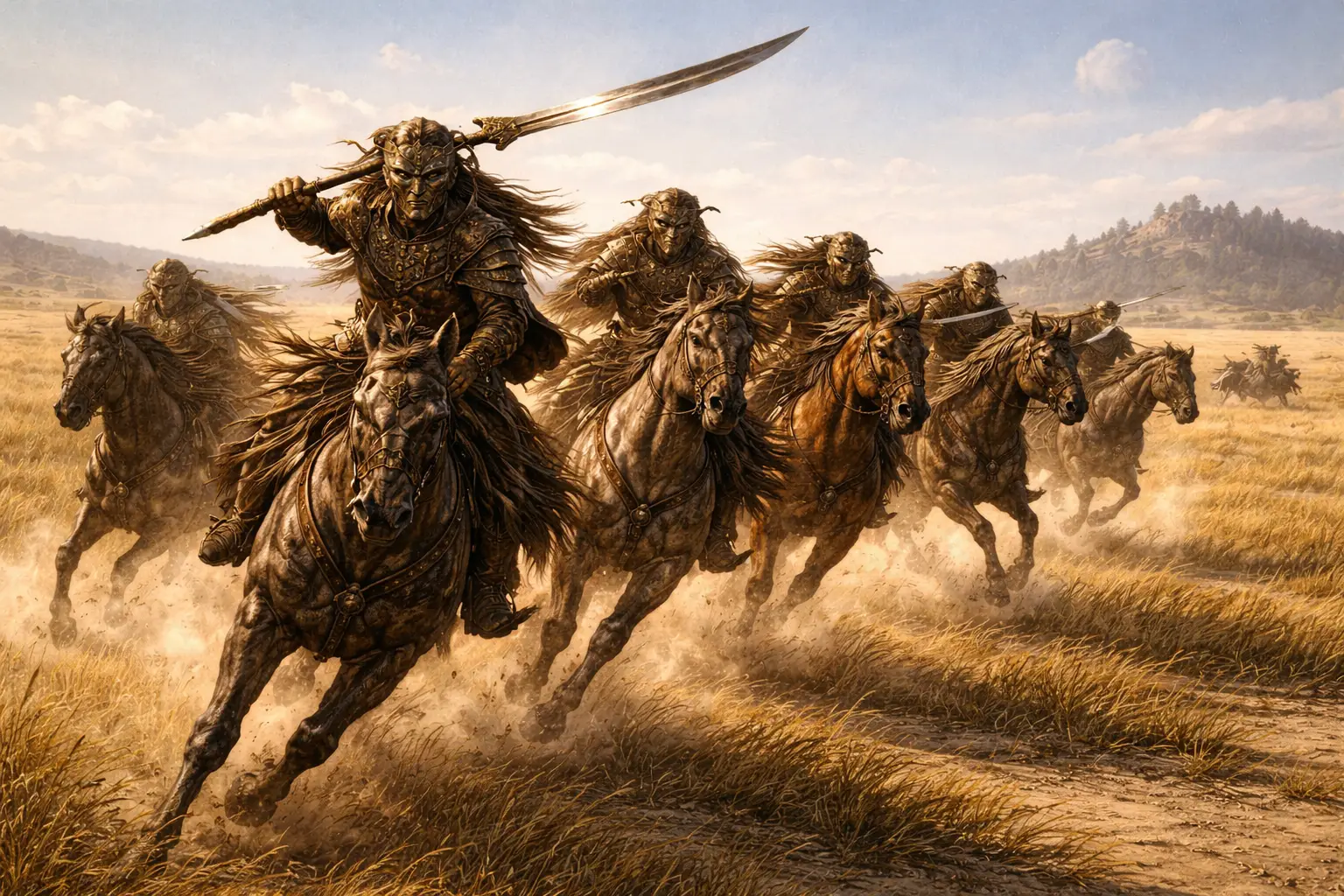
History of Valenar
"The humans think our history begins when we took this land from Cyre. The Aereni think it begins when we left Xen'drik. We know the truth: it begins the moment Vadallia drew her blade against the first giant who told her she was property. Everything since has been the same war. We simply change the enemy." — attributed to a Keeper of the Past, speaking at the Shanutar
Before the Elves Were Free
The history of Valenar does not begin in Valenar; it does not even begin on Aerenal. It begins in chains — in the slave pens and labor camps of ancient Xen'drik, approximately forty thousand years ago, where elves served the giant empires that ruled the continent and owned everything that lived on it.
The details of elven slavery under the giants have been debated by scholars for millennia, but the broad shape is not in dispute. The Cul'sir Dominion — the largest and most powerful of the giant civilizations — held vast populations of elves as laborers, servants, and magical resources. The wizard Cardaen, who would become one of the Tairnadal's most celebrated patron ancestors, was raised in isolation by the titan Cul'sir himself and trained to produce arcane innovations for his master, never knowing the truth of his people's condition until the day he was rescued. Other elves served as gladiators, household slaves, and raw material for the magebreeding experiments that eventually produced the drow. Some lived in conditions of relative comfort. None were free.
The elves who would become the ancestors of the Tairnadal were the ones who refused to accept this. Over centuries — perhaps over millennia — scattered groups of escaped elves built hidden communities in the wilds of Xen'drik, beyond the sight of the giants. The Gyrderi, primal druids who had forged pacts with the spirits of the land, used wild shape to infiltrate giant cities and liberate captives. The ancestors of House Phiarlan carried messages between the resistance groups as bards and scouts. And the martial warbands — the direct forebears of the Tairnadal — fought a guerrilla war against the most powerful civilization the world had ever seen, knowing they could win battles but never the war.
INSCRIPTION — carved in Elvish on a stone tree in Shanai Orioth, the great elven burial ground in Xen'drik
"They fell here so that others could run. Remember the cost of the road you walk."
The Rebellion and the Exodus (circa –40,000 YK)
The war changed when the Cul'sir Dominion broke itself. The firing of the Moonbreaker — a weapon of apocalyptic power aimed at some enemy the giants feared more than the elves — shattered the Dominion's own dream-based magic and devastated the empire from within. The elven resistance seized the moment. Vadallia, the Queen of Swords, united the scattered clans and the Gyrderi under a single banner through sheer force of personality and strategic brilliance. A full-scale rebellion erupted across Xen'drik.
What followed was not a clean victory. The giants were weakened but not broken, and they responded with escalating desperation — unleashing curses, creating the drow as weapons against their own former slaves, and resorting to blood magic that laid waste to armies. Vadallia died in battle, struck down by a curse of Cul'sir's design. The wizard Cardaen, who had loved her, entered the fight in a grief-driven fury that turned the tide of a critical engagement. When the prophet Aeren called for the great exodus — a flight to the eastern land that would bear his name — Cardaen refused to leave. He vowed to slay Cul'sir personally, to ensure the elves could never be threatened again. Neither Cardaen nor Cul'sir were ever heard from afterward.
The Gyrderi — the primal druids whose wild shape had been vital to the resistance — were struck by a giant curse that trapped them in their animal forms. Unable to speak or cast spells, they continued to fight, but when the elves sailed east, the Gyrderi stayed behind. Whether their bond to the land of Xen'drik prevented them from leaving, or whether they chose to remain so the exodus ships would not be burdened, remains a mystery. Their sacrifice became the origin of the Tairnadal animal tradition: modern Valenar horses, hawks, and wolves channel the spirits of these ancient druids, honoring the heroes who gave everything and were left behind.
The exodus was brutal. Aeren died before the elves reached their new home. The survivors named the island in his memory — Aerenal — and began the long, slow work of building a new civilization from nothing. They brought no wealth, no cities, no infrastructure. They brought their dead.
The Birth of the Tairnadal (circa –40,000 to –25,000 YK)
On Aerenal, the elves divided. The Aereni — those who settled in the southern forests — developed a culture centered on preserving the spirits of their greatest dead through the positive energy of Irian, eventually creating the Undying Court: a council of deathless elves sustained by the devotion of the living. The Aereni looked backward and inward, building a civilization devoted to mastering the arts their ancestors had practiced and ensuring that no elf would ever be forgotten.
The Tairnadal took a different path. Settling on the northern steppes of Aerenal — open plains that bore some resemblance to the grasslands of Xen'drik — they preserved their ancestors not through undeath but through emulation. The heroes of the rebellion became patron ancestors, and the young elves who channeled their spirits became revenants, living vessels dedicated to walking the path the dead had walked. The Keepers of the Past were established to maintain the stories and ensure every ancestor was remembered. And the culture that emerged was relentlessly, structurally martial — because the ancestors had been warriors, and honoring them meant fighting.
But fighting whom? The giants were gone. Xen'drik was shattered and cursed. The Tairnadal had preserved the spirits of guerrilla fighters who battled overwhelming odds — and now they lived on an island where no one was trying to kill them. The solution was the wargame: a tradition of complex, ongoing military exercises that allowed the warbands to practice the arts of their ancestors without an actual enemy. Armies attacked the fortress of Taer Senadal — a stone stronghold specifically designed to be assaulted — while its youth defenders honed their skills in defense. The wargames were taken as seriously as real combat, because for the Tairnadal, the distinction barely existed. Every exercise was an offering to the dead. Every training bout was a prayer.
This went on for tens of thousands of years.
"Forty thousand years of wargames. Try to understand what that means. Forty thousand years of perfecting tactics, studying every ancestor's technique, breeding the finest horses in the world, and waiting — with absolute patience — for a real enemy to appear. When the Last War came, the Five Nations thought they were hiring mercenaries. They were hiring a civilization that had been rehearsing for this moment since before humanity existed." — Keeper of the Past, provenance uncertain
The Khorvaire Campaigns (circa –25,000 YK onward)
The Tairnadal did not spend all forty thousand years on Aerenal. The ancestors had fought goblins, and so must their revenants. Tairnadal armies crossed to Khorvaire and fought the Dhakaani Empire during the height of its power — not for territory, but because the dar were the closest available analogue to the giants. These campaigns produced new patron ancestors: heroes whose deeds fighting the goblins joined the legends of the original rebellion in the canon of Tairnadal faith. Daealyth, a Taeri revenant, accomplished great deeds in battles against the dar. The Blade Desert and the plains of what is now Valenar are scattered with ruins from these ancient clashes — fortresses and battlefields that have slipped out of alignment with time, relics of a struggle that produced some of the Tairnadal's most celebrated heroes.
When dragons attacked Aerenal — as they did periodically over the millennia — the Draleus Tairn, the smallest and most fearsome of the Tairnadal armies, earned their reputation defending the island. Some say the Draleus Tairn hunt rogue dragons across Eberron to this day, and that their champions have ventured into the plains of Argonnessen itself.
The Tairnadal also maintained three great cities on Aerenal: Var-Shalas, the largest, seat of the Shanutar council and the Keepers of the Past; Shae Thoridor, a center of artisan production and Keeper lore; and Taer Senadal, the stone fortress that existed solely to be attacked by trainees. The Tairnadal are nomadic by nature — their armies are migratory city-states that follow paths across the northern steppes — but these permanent settlements anchored the culture and provided the infrastructure that sustained the armies between campaigns.
The Mercenary Period and the Last War (894–956 YK)
When the Last War erupted in 894 YK and the Five Nations began tearing each other apart, the Tairnadal saw something they had not seen in a very long time: a real war.
Cyre — which controlled eastern Khorvaire, including the territory that would become Valenar — hired Tairnadal mercenaries to supplement its armies. The arrangement was straightforward: Cyre paid gold, and the elves provided the finest light cavalry on the continent. The Valenar mercenaries were devastating in the field — faster, more mobile, and more tactically sophisticated than anything the other nations could counter. Cyre's enemies learned to dread the sight of Tairnadal warhorses on the horizon.
What Cyre did not understand was why the elves were fighting. The Tairnadal had not come for gold. They had come because the Last War offered the closest approximation to the ancestral conflict that the modern world had produced — a sprawling, chaotic, multi-front war in which a mobile force could fight outnumbered against larger enemies and win through skill and cunning. Every engagement was an opportunity to honor the ancestors. Every campaign was a rehearsal for something the Tairnadal had been planning for longer than Cyre had existed.
The territory itself mattered for a different reason. The land that Cyre called its eastern provinces was the same land where the Tairnadal had fought the Dhakaani goblins tens of thousands of years earlier. The Blade Desert, the steppes, the ruins in the hills — these were places where Tairnadal ancestors had bled and died and earned their immortality. The elves were not mercenaries defending foreign soil. They were returning to a battlefield they had never forgotten.
KORRANBERG CHRONICLE — Barrakas 957 YK
TAIRNADAL MERCENARIES DECLARE INDEPENDENT KINGDOM — CYRE STUNNED
"The mercenary forces under the command of the warlord styling himself 'High King Shaeras Vadallia' have declared sovereignty over the region east of the Blade Desert, formerly the provinces of Eastern Cyre. Cyran military command is calling the declaration a 'breach of contract.' The elves, by all reports, are unmoved."
The Seizure (956 YK)
In 956 YK, Shaeras Vadallia — var-shan of the Army of Valenar, revenant of the Queen of Swords — did what his ancestor would have done. He betrayed Cyre.
The betrayal was not impulsive. It was the culmination of decades of strategic positioning. Shaeras had spent years building the Tairnadal military presence in eastern Cyre, cultivating relationships with the local Khunan population, and ensuring that when the moment came, the elves would hold the territory and Cyre would be unable to respond. The region east of the Blade Desert had been effectively a separate land for centuries — its Khunan farmers had been governed by Cyran nobles imposed on them by Galifar, and many had no love for Metrol. When the elves declared sovereignty, the Khunan largely stayed where they were. Some were relieved. The Cyran feudal lords had been worse.
Shaeras invoked the Tairnadal's ancient claim — the blood spilled in wars against the Dhakaani, the ruins in the hills, the ancestors whose spirits still walked the steppes. The claim was tens of thousands of years old. It was also, from the perspective of the Five Nations, legally meaningless. But the Five Nations were exhausted, and the Valenar cavalry was not something anyone wanted to fight. Cyre protested. No one came to Cyre's aid. The territory was lost.
The remaining decades of the Last War saw the Valenar consolidating their position. House Lyrandar — the half-elf house, eager to build a Khoravar homeland — invested heavily in infrastructure, helping transform the port of Southport into Pylas Maradal and supporting the construction of Taer Valaestas as the new capital. The Khoravar who came to administer the kingdom were not conquerors; they were immigrants seeking a place where half-elves might belong. The Khunan continued farming. The elves continued riding. And when the Mourning destroyed Cyre in 994 YK, the land east of the Blade Desert — untouched, unclaimed by the dead-grey mist — became the only piece of Cyre that still existed.
The Treaty of Thronehold (996 YK)
The Treaty of Thronehold recognized Valenar as a sovereign nation. No one seriously contested it. The Cyran diaspora — shattered, homeless, voiceless — had no power to object, and no other nation was willing to fight a war to return a dead kingdom's eastern provinces to a prince who ruled a refugee camp in Breland.
Shaeras accepted the recognition the way a swordsman accepts applause: briefly, without particular interest, before returning to the work that mattered. The kingdom was never the objective. The kingdom was the stage.
The Postwar Kingdom (996 YK–Present)
In the two years since Thronehold, Valenar has done everything in its power to ensure that peace does not break out.
Warbands raid into Darguun, clashing with Ghaal'dar patrols along the western border. Warbands raid into Karrnath, striking the southern duchy of Vulyar with a regularity that has made First Warlord Gruden ir'Erdei one of the most frustrated military commanders on the continent. Warbands venture into the Mournland, seeking glory against whatever horrors the dead-grey mist has produced. Some cross into Q'barra's jungles. Shaeras has promised, repeatedly and with visible insincerity, to restrain his warriors.
He will not restrain them. Restraint would defeat the entire purpose. The Valenar seized this land so that someone powerful would try to take it back. Every raid is an invitation. Every provocation is a prayer. The ancestors fought a guerrilla war against overwhelming odds — outnumbered, outmatched, and fighting with such brilliance that their legends survived forty thousand years. To properly honor those ancestors, the Valenar need an enemy that can provide the same conditions. A powerful nation marshaling its full military strength against a smaller, faster, more skilled elven force — that is the war they are waiting for.
Whether it comes from Karrnath, Darguun, or somewhere no one has anticipated, the Valenar intend to be ready. They have been rehearsing for forty thousand years. They are not going to stop now.
Carved into the living bronzewood wall of Taer Valaestas, in Elvish, in letters that grow back whenever they are cut:
THE ANCESTORS WATCH. THE BLADES REMEMBER. THE WAR CONTINUES.