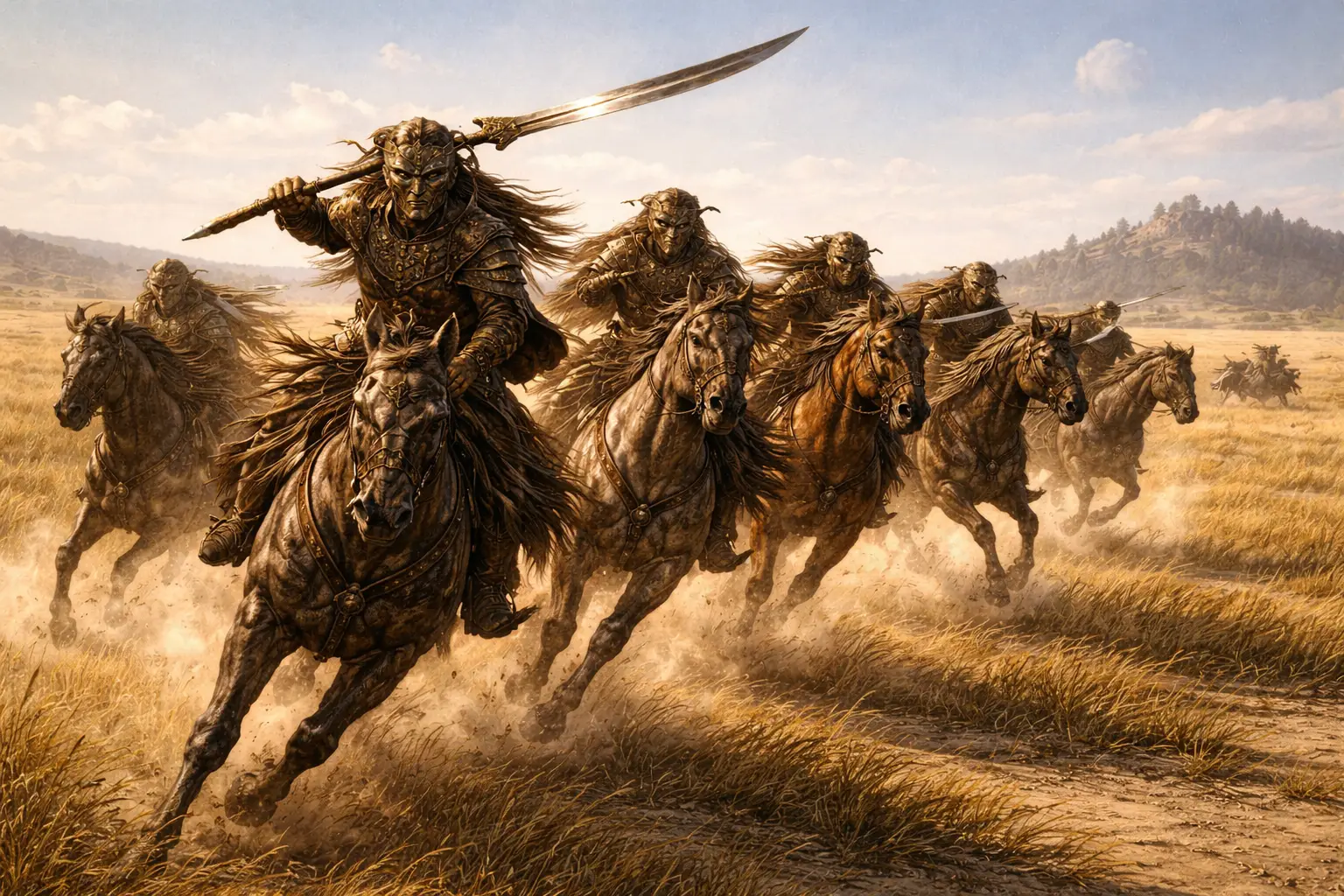
Military & Security of Valenar
From an after-action report filed by Captain Jorren Lassk, Karrnathi Southern Command, Vulyar, Barrakas 997 YK:
Engagement at the Cyre River ford, 14 Barrakas. Contact with a Valenar warband of approximately thirty riders. Our column numbered one hundred and forty, with axebeak cavalry on the flanks and infantry in the center.
The elves hit the left flank at dawn. By the time the axebeaks wheeled to respond, the riders had already disengaged and circled behind us. They struck the supply wagons. Then they were gone. The entire engagement lasted less than four minutes. We lost eleven soldiers, six axebeaks, and three wagons of provisions. The elves lost nothing. We recovered no bodies. We recovered no wounded. We recovered a single arrow driven into the command tent's center post with a strip of silk tied to the shaft, which our interpreter identified as a traditional Tairnadal marker meaning "I was here." The shan's personal signature was woven into the silk.
I am requesting additional garrison support and permission to pursue. I am aware this is what they want.
The Army Is the Nation
Other nations have armies. Valenar is one.
There is no distinction in Tairnadal society between military and civilian life in the way the Five Nations understand it. Every adult elf who has received a patron ancestor is a warrior. The zaelantar — the "peaceful souls" who maintain the settlements, breed the horses, forge the weapons, and raise the young — are not non-combatants in any meaningful sense; they are warriors between assignments, warriors whose ancestors had civic gifts, or warriors-in-training who have not yet been chosen. The zaeltairn — the "warrior souls" who ride and fight — are the ones the rest of Khorvaire sees, and what the rest of Khorvaire sees is the finest light cavalry on the continent backed by forty thousand years of accumulated tactical doctrine that no war college has ever matched because no war college has ever had forty thousand years to refine its curriculum.
The Army of Valenar consists of forty-five warclans, each several hundred strong. At any time, roughly twenty operate under the var-shan's direct command from Taer Valaestas. The remaining twenty-five are deployed independently — patrolling the borders, raiding into Karrnath and Darguun, venturing into the Mournland, or conducting long-range operations in Q'barra and the Blade Desert. These independent clans follow Shaeras's general directives but exercise autonomous judgment that would be unthinkable in a Rekkenmark-trained army. A shan operating three weeks' ride from the capital does not wait for orders. She acts on the judgment of the ancestor she channels, and the var-shan trusts the ancestor.
How the Warband Fights
The warband — ten to thirty warriors led by a lu-shan — is the irreducible combat unit. A warband is not a platoon rotated out on a schedule. It is a permanent family whose members serve together for decades or lifetimes, who know each other's fighting styles the way a musician knows the other instruments in an ensemble, and who move together with a coordination that outsiders consistently mistake for telepathy. It is not telepathy. It is practice — the kind of practice that accrues when a unit has been training together since its members were adolescents and the doctrine they follow was refined across four hundred centuries.
The standard Tairnadal engagement is cavalry — fast, mobile, and devastating. The warband's signature weapon is the Valenar double-bladed scimitar: a haft of fine wood supporting a long, curving blade on either end, forged with techniques honed over millennia, light enough to wield from horseback with lethal fluidity. Each scimitar is a masterpiece; a Valenar blade in the hands of a non-elf is generally assumed to have been stolen, and a Tairnadal who encounters one may demand its return or challenge the bearer to prove their worthiness to carry it.
But the warband is not exclusively cavalry. The composition varies by the ancestors its members channel, and a single warband may contain a bewildering diversity of combat specialists operating in tight coordination:
A Vadallia revenant leads — strategic, decisive, ruthless with enemies and devoted to the elves. A Taeri revenant fights at the point of contact — the double scimitar forms most Tairnadal practice are drawn from his teachings, and his revenants seek the deadliest single combat they can find. A Falaen revenant scouts ahead or operates behind enemy lines — patient, taciturn, willing to wait weeks for the perfect moment to strike. Falaen's revenants tend toward Assassin rogues and Gloom Stalker rangers, and notably they often avoid horses, since Falaen herself had no love for them. A Vaela revenant fights alongside bonded beasts — wolves, hawks, or stranger things — with a primal ferocity that blurs the line between elf and animal. And the warband's druids and rangers provide the magical infrastructure: walls of thorns that spring from the earth to seal a pass, beast companions that scout or fight alongside the cavalry, and weather manipulation that can turn a clear morning into a blinding sandstorm in the Blade Desert.
The Silent Bands deserve particular attention. These are warbands composed entirely of Falaen revenants — specialized long-term covert operations units that can infiltrate, observe, and eliminate with a patience and discipline that would unnerve a Thuranni shadow. A Silent Band might spend months embedded in enemy territory before striking, and when it does, the target rarely sees the blade that kills them. The Five Nations' intelligence services are aware these units exist. They have not succeeded in identifying one before it acted.
"I served on the Vulyar border for three years. In that time I fought the elves eleven times. I won twice. Both times, I am now fairly certain they let me win because they were testing something — a new formation, a new feint, I don't know. The other nine times were not close. The worst part is not the losing. The worst part is that they are clearly enjoying themselves." — Karrnathi sergeant, retired, dictating memoirs
Druidic Warfare
The Five Nations fight with steel and arcane artillery. The Valenar fight with steel and the living world.
Tairnadal warbands include druids and rangers as standard components, not as auxiliary specialists. Druidic magic is woven into the military at every level — not the spectacular arcane bombardment of an Aundairian wandslinger battery, but the quiet, structural magic of a tradition that has been weaponizing nature for longer than the Five Nations have existed. Walls of bronzewood thorns surround elven fortresses and can be grown on command to seal a breach or close a pass. Beasts fight alongside the cavalry — not summoned creatures, but living animals bonded to their riders through the same ancestral connection that defines Tairnadal faith. A warband's druid can accelerate crop growth to keep a forward outpost fed, redirect a stream to flood an enemy camp, or coax the Blade Desert's sand into a choking screen that blinds a pursuing column.
The Siyal Marrain — the druids who breed and tend the Tairnadal animals — are not frontline combatants, but their contribution to the military is incalculable. Without them, there are no horses. Without the horses, there is no cavalry. Without the cavalry, the Tairnadal are foot soldiers, and foot soldiers cannot fight the kind of fast, mobile, asymmetric war the ancestors fought against the giants. The Siyal Marrain are the logistical spine of the entire operation, and a strike against them would be one of the few attacks that could genuinely cripple the Army of Valenar — a fact that is presumably not lost on Gruden ir'Erdei of Vulyar, who has spent years studying how to fight an enemy whose greatest vulnerability is its horse breeders.
Fortifications
Tairnadal doctrine is offensive and mobile, but the elves are not fools about defense. Taer Valaestas sits behind a living wall of bronzewood thorns — a fortification that grows, repairs itself, and can be thickened or extended by druidic command. The wall is not decorative; it is a military installation that would require siege engines or significant magical firepower to breach, and the druids who maintain it can reshape it in response to an assault.
Beyond the capital, fortress towers are scattered across the plains as military outposts — stone and bronzewood structures garrisoned by rotating warclans that serve as rally points, supply caches, and forward operating bases. These towers are not impressive by the standards of Rekkenmark's fortification manuals. They do not need to be. The towers are not meant to hold territory — they are meant to project force and provide staging areas for the mobile warfare that is the Tairnadal's true strength.
The Blade Desert itself is the nation's primary defense on the northern approach. The sand, heat, and absence of reliable water make any overland invasion from the north a logistical nightmare, and the Tairnadal know the desert's terrain intimately. A Karrnathi column crossing the Blade Desert would face dehydration, sandstorms, and warbands who have been riding these dunes since before the Karrns learned to saddle a horse. Gruden ir'Erdei knows this. His planning accounts for it. Whether his planning accounts for it sufficiently is the question that may decide a war.
What the Enemy Faces
A Rekkenmark-trained officer assessing the Army of Valenar would note the following: approximately twenty thousand warriors organized into forty-five clans, supported by druidic infrastructure and mounted on the finest horses in Khorvaire. The force is light cavalry with no heavy infantry, no siege engines, no arcane artillery in the conventional sense, and no fortifications beyond the capital and its outpost towers. It has no navy. It has no air force. Its supply chain is thin and depends on a farming population that has no reason to be loyal.
The same officer, if she was honest, would then note: the force has been training continuously for forty thousand years, its tactical doctrine was forged in a guerrilla war against a civilization that could crush mountains, its warriors channel the spirits of heroes who invented the techniques she studied at the academy, its horses are supernatural, its druids can reshape the battlefield on command, and its intelligence arm — the Silent Bands — operates at a level that Karrnathi counterintelligence has never successfully penetrated.
The officer would then note that the Valenar do not want to hold ground. They want to be attacked. They have arranged their entire nation as an invitation for a more powerful enemy to commit a conventional invasion, at which point the Tairnadal will abandon the territory, retreat into the steppes and the desert, and fight exactly the kind of war the ancestors fought against the giants — outnumbered, outmatched, and fighting with a skill that the enemy cannot counter because the enemy has not had forty thousand years to practice.
The officer would close the report with a recommendation that Karrnath not invade. The recommendation would be overruled by a warlord who has watched his soldiers die in border raids for years and whose patience has been worn to nothing. And the elves — patient, coiled, intent — would be waiting.
INTERCEPTED DISPATCH — Karrnathi Southern Command, Vult 997 YK, classification: restricted
TO: First Warlord Gruden ir'Erdei, Vulyar FROM: Intelligence Directorate, Korth
Sir — Analysis of Valenar raiding patterns over the past eighteen months confirms a deliberate escalation curve. The attacks are not random. They target supply lines, morale, and political patience. Our assessment is that the Tairnadal are following a provocation doctrine designed to produce exactly the response you are proposing.
We recommend restraint. We acknowledge this recommendation will not be welcome.
The Borders
The Karrnathi border is the active front. Valenar warbands raid the duchy of Vulyar with a regularity that has made it the most dangerous posting in the Karrnathi military. The raids are not about territory or plunder — they are about provoking a full-scale response. Gruden ir'Erdei commands Vulyar's defense with the Conquering Fist heavy cavalry and domesticated axebeak riders, forces that are individually formidable but that lack the Tairnadal's speed and tactical flexibility. The Karrnathi fort known as Fort Bones — rebuilt after Valenar druids invoked an earthquake to level it, with the bones of slain elves mixed into the mortar as a monument to Karrnathi spite — stands as the grimmest symbol of the border conflict.
The Darguun border sees regular skirmishes with Ghaal'dar patrols. The goblinoids are a secondary target — dangerous enough to provide worthwhile combat, organized enough to mount a credible response, but not powerful enough to threaten the Tairnadal in the way Karrnath could.
The Mournland draws warbands looking for the most extreme challenges available — fighting the horrors of the dead-grey mist, where the enemy is unpredictable and the terrain is hostile. Q'barra's jungles see occasional incursions. And the Blade Desert itself hides ancient elf-goblin war sites that the Tairnadal treat as both sacred ground and training exercises — battlefields that have slipped out of alignment with time, where the past is physically present and a warband exploring a ruin may encounter echoes of a conflict fought before the Dhakaani Empire fell.
Internal Security
There is none — or rather, the army is the internal security, and the army is everywhere. A nation on permanent war footing with warbands patrolling every stretch of the kingdom does not need a constabulary. The Khunan farming villages are not policed because they do not need to be — crime in a village whose nearest neighbors are a community of people who have known each other for generations is handled by the headman, and outsiders who cause trouble in Khunan territory discover that a village full of people who have been living next to an army for forty years has absorbed certain practical skills.
Pylas Maradal has the closest thing to a security service — Khoravar harbor guards who enforce the trade council's regulations and keep the docks orderly. Taer Valaestas is guarded by whatever warclans are currently stationed there, which means the garrison changes regularly and the security posture depends on which shan is in command this month. Foreign visitors to the capital should expect to be watched, assessed, and — if they appear capable — challenged to spar. This is not hostile. It is the Tairnadal being friendly.
Carved into the wall of the arena at Taer Valaestas, where visiting warriors are invited to demonstrate their skill, in Elvish:
THE BLADE DOES NOT KNOW THE WORD "PEACETIME."