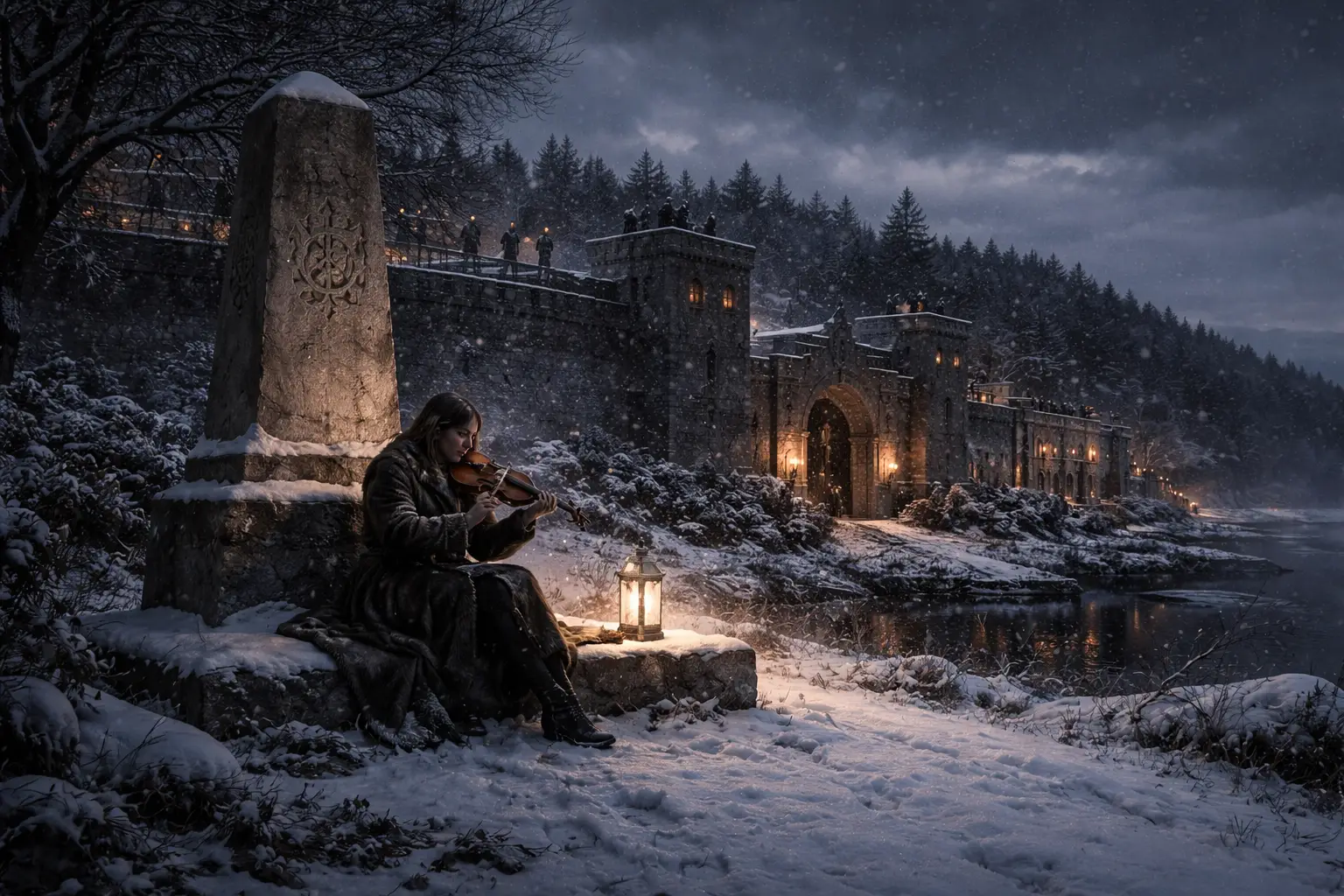
History of Karrnath
"Karrnath did not begin with Galifar. It began with blood and iron, a thousand years before a crown was placed on the old man's head." — Professor Hamund ir'Talas, University of Vedykar
Every student at Rekkenmark learns that Karrn the Conqueror forged the nation Galifar would later build an empire around. But Karrnath's history neither begins nor ends with conquest. It stretches back through goblinoid empires and elven exiles, passes through a continent-wide purge of the aberrant-marked, survives eight centuries as Galifar's sword arm, and arrives at the present day through a war that broke something fundamental in the national character — a bargain with the dead that the nation has not yet finished paying for.
The Conqueror (–2,000 to –1,000 YK)
Before humans arrived, the territory that would become Karrnath belonged to the Empire of Dhakaan. When the daelkyr wars shattered that civilization, the goblin successor kingdoms that remained were fractious and diminished — unable to hold against the human settlers who arrived through Scions Sound around –2,000 YK and pressed inland through successive conflicts, eventually establishing petty kingdoms that warred with each other as readily as they had fought the goblins.
Within two centuries, the Mark of Sentinel appeared among a handful of western Karrnathi families — the first dragonmark to manifest in humanity. Its bearers became the region's first warlords, the earliest forerunners of House Deneith. In the same period, elven exiles fleeing Aerenal arrived at Karrlakton. When local warlords discovered vampires among their number, the refugees were driven north through the Nightwood to the head of the Karrn River, where they founded Atur — establishing the Blood of Vol's foothold in the region, a foothold that would outlast every dynasty and every royal edict aimed at uprooting it.
Around –1,000 YK, Karrn the Conqueror was born in Karrlakton. His greatest triumph was a bargain, not a battle: he united the Sentinel-marked families into a single force loyal to him — the proto-House Deneith — granting them Karrlakton's central keep in exchange for their armies. With this magically enhanced host, he conquered Korth, swept through the remaining kingdoms, and united all of Karrnath. His unification campaign included a deliberate war of extermination against the remaining goblin kingdoms so thorough that Karrnath still has the smallest goblinoid population of any Five Nation. Unsatisfied, he floated his armies down the Cyre River to seize Metrol — a conquest so alarming it united Daskara, Thaliost, and Wroat against him. Karrn's defeat freed Metrol. But the nation he forged kept its feudal bonds. He had attempted to conquer the continent; none would succeed until Galifar, a thousand years later.
The Purge of the Marked
In the era following Karrn's campaigns, the dragonmarked families bound themselves into grand alliances — and aberrant dragonmarks began to appear with increasing frequency. Houses Deneith and Jorasco convened a summit of the ten known houses, launching the bloody purge now called the War of the Mark. In Karrnath, there was no organized resistance of the kind that erupted in Sharn. Deneith enforcers rounded up the aberrant-marked; Jorasco attempted to remove their marks; when that proved impossible, the prisoners were executed. The dragonmarked of Karrnath were the first and most ruthless in carrying out the slaughter. Most Karrns today know only the propagandized version: the houses valiantly defending common folk from monsters.
At the war's conclusion, Baron Hadran d'Cannith proposed founding a joint research institution in Korth — the Twelve, named by the architect Alder d'Cannith who believed that number of true dragonmarks would eventually flow through living blood, giving Karrnath its first institution of arcane education.
The Empire's Sword (1–894 YK)
Galifar ir'Wynarn was born in Karrlakton, the same city as Karrn, a thousand years later. He rose to rule Karrnath through political guile, negotiating the Korth Edicts with the Twelve — favored economic status for the houses in exchange for their loyalty — and with that foundation unified the Five Nations in 1 YK. His son Karrn was given Karrnath to govern and instructed to found Rekkenmark Academy on a Shavarath manifest zone that enhanced battle acuity and training. For over eight hundred years, every nation's officers trained at Rekkenmark. Karrnathi nobility dominated its upper ranks. The nation was the empire's sword arm: respected, essential, and increasingly seen as rigid as power consolidated in Aundair, Breland, and Cyre.
Prince Karrn's first challenge was the Mror Holds. Through military might and diplomatic intrigue, he exploited the existing feuds between the dwarven clans, isolated them one by one, and subjugated the Ironroot Mountains without ever stepping foot inside. The dwarves were incorporated as a grand duchy — self-governing, but tribute-paying. The arrangement would hold for over nine hundred years.
The centuries under Galifar were stable and, by Karrnathi standards, uneventful. The most significant disruption came in the middle of the sixth century, when a reclusive necromancer led a group called the Talons of Ice in a campaign of terror across the nation. The combined forces of the knights of Dol Arrah, templars of the Silver Flame, and the Karrnathi military defeated the Talons — but the horrors they unleashed entered household legend, and the architect of the terror was neither captured nor confirmed dead. That name would surface again, centuries later, under circumstances that would reshape the nation.
In the ninth century, the lightning rail transformed rural Karrnath. King Jarot's construction of rail lines connected isolated communities to continental trade for the first time — the Korranberg Chronicle expanded into farming villages, rural cheese and ale reached distant consumers, and an independent merchant class emerged. Karrnath on the eve of the Last War was wealthier, more connected, and more confident than it had been in generations. It was also, as the crown's advisors would later observe, completely unprepared for what happened next.
PRIVATE CORRESPONDENCE — recovered from the personal archive of Duchess Forsindh ir'Jaranus of Vasfold, circa 920 YK
"The dwarves pay their tribute. They pay it promptly, they pay it in full, and they pay it with a politeness that makes my skin crawl. I have administered this duchy for eleven years and I have never once heard a Mror lord complain about the tax burden. They simply hand over the gold and smile. I do not trust that smile."
The Bargain (894–910 YK)
From the Korth Sentinel, special broadsheet, 12 Therendor 894 YK:
KING JAROT IS DEAD. Long live the next King of Galifar — but who shall it be? Prince Kaius has closed the city gates. The Code of Kaius is now in effect. Mandatory service begins at dawn.
King Jarot died in 894 YK, and the kingdom died with him. His five children had been raised to govern provinces, not to share a throne. Kaius, Jarot's third child and governor of Karrnath, conspired with his brother Thalin of Thrane to deny the succession to their eldest sister Mishann of Cyre. Mishann's younger brother Wrogar of Breland backed her claim. The alliance fractured. Five siblings became five kings. The Last War began.
Kaius declared independence, instituted the Code of Kaius — a harsh set of martial laws and mandatory military service requirements that remains in effect to this day — and marched his armies against Aundair and Cyre simultaneously. The early campaigns were catastrophic. Plague and famine ravaged his forces in the war's opening years — crops failed, livestock sickened, and the armies that should have been marching on Metrol were struggling to feed themselves.
It was in this crisis, in 896 YK, that the leaders of the Blood of Vol approached Kaius with a bargain: necromantic power for the war effort, in exchange for making the Blood of Vol the state religion and establishing the Order of the Emerald Claw as a royal knightly order. Kaius, desperate and out of options, accepted.
The Ministry of the Dead was founded. Researchers Gyrnar Shult and Malevanor, working from Fort Bones above one of Karrnath's most potent Mabaran manifest zones, developed the Odakyr Rites — necromantic procedures that produced true Karrnathi undead: soldiers who never slept, never needed food, and held their positions without fear. Lightning rail cars full of coffins traveled to Atur. They returned with standing legions for the front.
Kaius I died in 910 YK under mysterious circumstances. The bargain survived him.
"He took the deal because the alternative was starvation. He regretted the deal the moment the first corpse stood up in his colors. He could not undo the deal because by then the corpses were winning his battles. This is how Karrnath works. You do what is required. You endure what follows." — attributed to a Rekkenmark military historian, name withheld
A Hundred Years of War (910–976 YK)
The war ground on for decades. Aundair captured Rekkenmark early; Kaius I had already destroyed sections of the White Arch Bridge to cut the Aundairian supply line, and saboteurs of unknown nationality finished the bridge's destruction in 928 YK, permanently severing Rekkenmark from the west. Thrane — initially Karrnath's ally — broke the alliance when Karrnath raised undead, and launched wyvern raids against Rekkenmark and Korth that cemented a hatred outlasting the war itself. Karrnath retaliated by destroying Shadukar and fighting pitched naval battles across Scions Sound.
In 914 YK, the Mror Holds declared independence — the dwarven clans convening their first Iron Council and renouncing all obligations to the Karrnathi crown. Karrnath's plague-depleted army could not spare the forces for a mountain campaign against impregnable clan-holds, and the loss of Mror tribute devastated the treasury at the worst possible moment. The border duchy of Vasfold, which had existed for centuries specifically to manage the flow of dwarven wealth, lost its purpose overnight.
In 956 YK, the Tairnadal mercenaries Cyre had hired to fight Karrnath seized eastern Cyre and declared the independent nation of Valenar, transforming mercenaries into a hostile state on Karrnath's southern flank. The border with Valenar — running through the duchy of Vulyar — would become the most dangerous posting in the Karrnathi military. Years later, King Jaron — son and successor of Kaius II — made diplomatic inroads with High King Shaeras Vadallia, buying off the southern raiders and redirecting their attention toward Aundair and Cyre.
The Blood of Vol permeated Karrnathi society. State support swelled the Seeker population from fewer than one in ten to nearly half the country within eighty years. The Order of the Emerald Claw embedded itself in military and civic institutions. Undead soldiers became a permanent feature of the Karrnathi arsenal. And the question that would eventually tear the arrangement apart — who the Emerald Claw actually served — grew louder with every year.
The Regent's Disclosures (976 YK)
Jaron's sudden death in 972 YK elevated his sister Moranna to the regency while his son came of age. In 976 YK, she revealed what crown intelligence had uncovered: the Order of the Emerald Claw had been operating under the direction of a hidden master beyond the crown's authority, and many Blood of Vol faith leaders had served as that conspiracy's agents rather than the nation's. Her ensuing publicity campaign included public vampire executions that revealed some nobles had secretly passed into undeath while continuing to rule. The Emerald Claw's patron — a mysterious figure the crown identified only as an enemy of the state — was declared a threat to the nation. The Sovereign Host was reinstated as Karrnath's official religion.
The Seeker chivalric orders were disbanded. The Emerald Claw, the oldest and most powerful of them, refused to disarm. It fractured, went underground, and transformed from a knightly order into a terrorist organization — turning its talents against Moranna and her allies while continuing to serve the hidden master the regent had failed to destroy.
Moranna's revelation did not solve the problem. It merely changed its shape. The Blood of Vol had been the state religion for eighty years. Nearly half the population were Seekers. The undead legions — the nation's most powerful military asset — were products of Seeker necromancy. Moranna could strip the faith's official status, but she could not strip it from the culture, the military, or the memories of every Karrnathi soldier who had fought alongside the dead.
The tail end of her regency was troubled. Aundair razed Narath in 989 YK — the city destroyed in a devastating assault that marked the war's most crushing blow to Karrnathi morale. In late 993, a Cyran army backed by the warforged colossus WX-31 — nicknamed "Karrnslayer" — drove deep into Karrnath and sacked Atur's reanimation facilities in direct retaliation for the undead legions that had devastated Metrol. The Cyrans withdrew. Months later, on 20 Olarune 994 YK, Cyre became the Mournland. Tens of thousands of Karrns — soldiers staging in seized Cyran territory for a push into Breland — died in the grey mists alongside everyone else.
The Treaty of Thronehold (996 YK)
Kaius III assumed the throne in 991 YK, inheriting a nation fractured by a century of war, religious upheaval, and accumulated grief. He married Etrigani, an Aereni diplomat — a match initially whispered about as a political ploy but now regarded as a genuine love match. An Aereni queen in a nation that had spent eighty years raising the dead: the statement was unmistakable.
Despite his warlords' dissent, Kaius served as a primary architect of the Treaty of Thronehold, working with King Boranel of Breland and the child-Keeper Jaela Daran to bring Queen Aurala of Aundair to the table. Karrnath recognized the independence of the Mror Holds, the Talenta Plains, the Lhazaar Principalities, Q'barra, Valenar, and Darguun — territories that had technically all been Karrnathi. The treaty required Kaius to inter the undead legions in Atur's catacombs. He complied.
Warlord Drago Thul refused the peace. He publicly accused Kaius III of being Kaius I returned as a vampire — a charge with legal teeth, since undead cannot inherit titles or lands under the Code of Galifar. Kaius answered by gathering his warlords under midday sun and cutting his palm to show freely flowing blood. Thul was publicly disgraced and fled to Stormreach in Xen'drik, where he continues to rally opposition to "the monster on the throne." The tale of the Vampire King has never fully died.
The Unanswered Questions (996 YK–Present)
The treaty ended the fighting, but it did not settle the argument. Three unresolved legacies define the postwar period.
The first is the warlord problem. Many of Karrnath's military commanders believe the nation would have won the Last War and that Kaius surrendered their destiny. The At All Costs faction within the Order of Rekkenmark accumulates power and conspires toward a coup it is not yet positioned to execute. A king whose commitment to peace is genuine faces generals whose patience is finite and whose memories of victory are longer than their memories of loss.
The second is the Valenar border. Tairnadal warbands continue to raid the duchy of Vulyar with a regularity that has made First Warlord Gruden ir'Erdei one of the most frustrated military commanders on the continent. The raids are not about territory — they are provocations designed to bait Karrnath into a wider war. Kaius has ordered restraint. Gruden believes restraint is surrender. The tension between them could hand the elves exactly what they want.
The third is the Blood of Vol. Roughly three in ten Karrns still identify as Seekers. The Emerald Claw persists as a terrorist organization, its cells embedded in power structures the crown cannot simply purge. The undead legions wait in Atur's catacombs — loyal, disciplined, and unified in ways that no living army has ever been. The question of what the nation owes its dead, and what the dead may yet do for it, remains Karrnath's oldest and most dangerous open account.
The war is over. The bargain is not.
"The war is over. The Code is not. The rations are not. The dead are not. What exactly ended?" — overheard in a Korth tavern, 998 YK