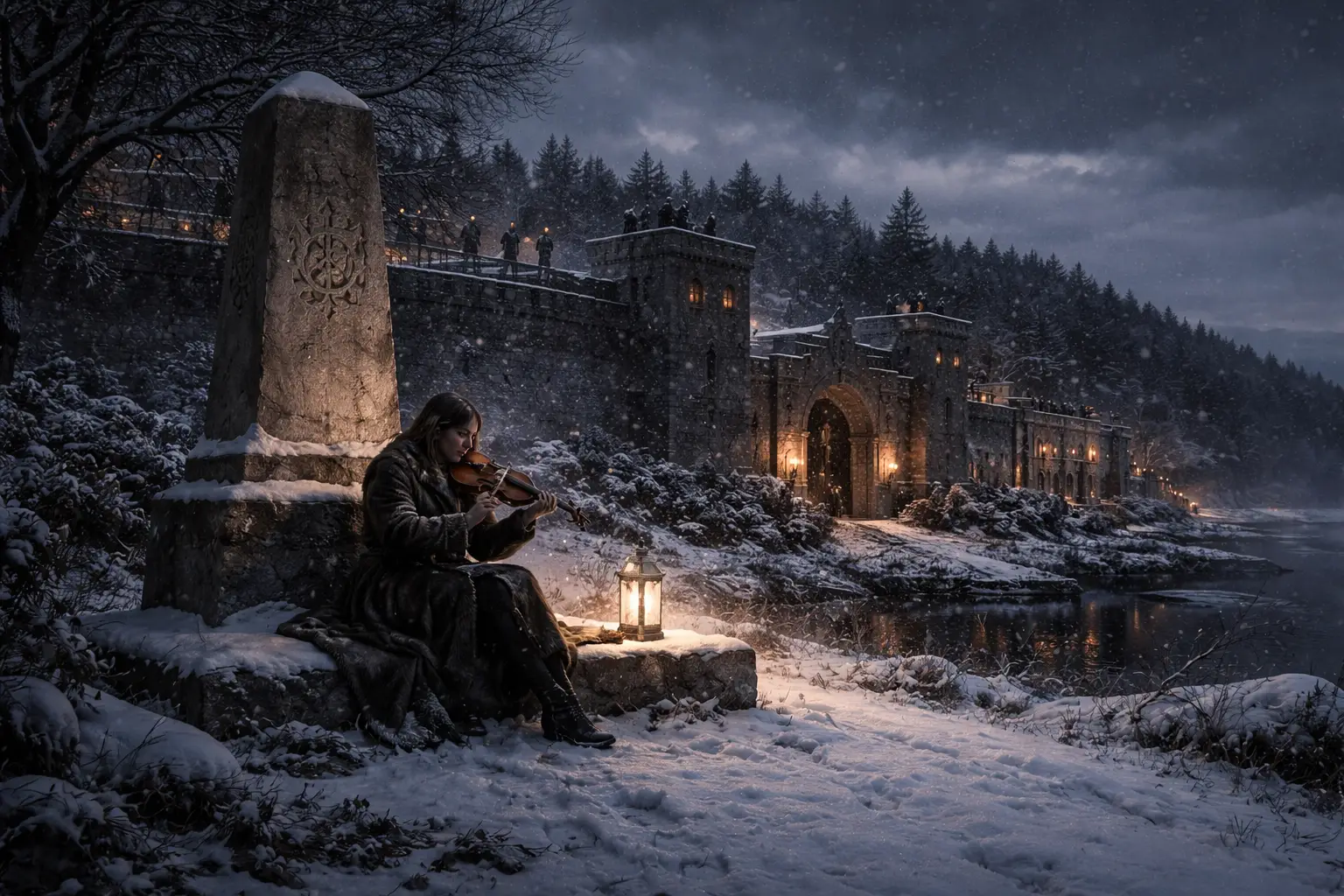
Karrnath
Capital: Korth | Ruler: King Kaius ir'Wynarn III | Government: Feudal monarchy; eight duchies administered by warlords | Hallmarks: Ale, dairy, glass, livestock, lumber, martial discipline, paper, textiles, undead
"If discipline were a resource, Karrnath would export it by the ton." — Ellian Thorne, Brelish diplomat to Karrnath
The royal line of Karrnath traces back further than any other in the Five Nations — to Karrn the Conqueror, the warlord who forced the fractious northeastern human kingdoms into submission centuries before Galifar ir'Wynarn rode south from Korth to forge a continent-spanning empire. That origin, military and hierarchical, built on the forced capitulation of rivals, has never fully left the national character. When Galifar himself needed a seat of power, he chose Korth; when he needed an officer academy, he built Rekkenmark. The roots of Galifar run through Karrnath, and the nation still carries itself as though that lineage justifies its hardness.
Governed from Korth under a feudal monarchy in which warlords hold vast regional authority, Karrnath's political structure predates even Galifar — and depends, more than any official would acknowledge, on a young king's ability to keep eight powerful dukes from tearing it apart. Its cities are stern and orderly, heavy with the architecture of war and the smell of forge smoke; its countryside still carries the scars of famine, plague, and a century of conscription that emptied villages of entire generations. The dark chapter of the Last War — eighty years of state-sponsored necromancy, Blood of Vol dominance, and the horror of the undead legions — did not simply end with the Treaty of Thronehold. It fractured public opinion and left behind institutions, loyalties, and secrets that no treaty could dissolve.
The Karrnathi Soul
The Karrnathi national character is defined by discipline, endurance, and a deep suspicion of anything that looks like softness. Karrns are somber folk who disapprove of extravagance and excessive displays of emotion — they measure each other by reliability, visible competence, and the willingness to endure hardship without complaint. Charm and persuasion are regarded with suspicion, associated with weakness or deception. Intimidation lands better than flattery; a tavern argument settled with a fist earns more respect than one settled with a smile. The nation endured chronic plague and famine during the Last War, and that experience calcified what was already a culture of stoicism into something grimmer: an acceptance that hardship is permanent and that the proper response is readiness rather than grievance.
The dark side of these qualities is a rigidity that tolerates authoritarian control and demands conformity. The Code of Kaius — a far harsher variation of the Code of Galifar — remains in effect, approaching martial law. Wartime rationing persists. Citizens accused of crimes have no jury and no independent judiciary. Warforged have fewer rights here than in any other treaty nation, with many pushed back into indentured servitude despite Thronehold's promises of freedom. Changelings face a legal system where the sweeping powers of local commanders make even ordinary misunderstandings dangerous. Karrnath is a nation that prizes order and expects sacrifice — and it does not always ask permission before extracting either.
"A Karrn does not ask whether the winter will be hard. A Karrn asks whether the stores are deep enough." — Common proverb in the duchies of Korth and Rekkenmark
Crown and Warlords
King Kaius ir'Wynarn III assumed the throne in 991 YK, inheriting a nation in turmoil from his aunt Moranna, who had served as regent since King Jaron's sudden death in 972 YK. In theory, Karrnath's government is a strict pyramid — king at the apex, eight warlords ruling their duchies beneath him, those duchies divided into counties and reeves. In practice, the warlords vary dramatically in their compliance. They raise troops as the feudal structure demands, but use every other form of support as leverage to pursue their own political ends, and more than one sees the throne as within reach.
Where tradition would have had him marry a ducal heir to bind a powerful duchy to the crown, Kaius instead married Etrigani, an Aereni diplomat — a choice initially met with noble whispers, now regarded as a genuine love match. His most consequential act was serving as a primary architect of the Treaty of Thronehold, working alongside King Boranel of Breland and Keeper Jaela Daran to bring the remaining claimants to the negotiating table. His warlords groaned: many believe Karrnath would have eventually won the Last War, and that Kaius denied them their rightful destiny. A not-so-secret society called At All Costs, embedded in the upper ranks of the Order of Rekkenmark, plots to unseat him.
Kaius also faces a stranger challenge. Warlord Drago Thul publicly accused the king of being Kaius I himself, returned as a vampire — citing his uncanny resemblance to his ancestor and the suspicious circumstances of Kaius I's death, which were tied to the Queen of the Dead. Under the Code of Kaius, undead cannot hold titles or lands, making this more than gossip. Kaius III answered dramatically, meeting the warlords under midday sun and cutting his palm to show his blood flowing freely. Though publicly disgraced, Drago Thul refused to yield and fled to Stormreach in Xen'drik, where he continues to agitate against "the monster that sits on our throne." The tale of the Vampire King has proven surprisingly resilient.
Karrnath's equivalent to the King's Citadel of Breland is the Dark Cabinet, a national intelligence agency created by Regent Moranna to fill the void left when House Phiarlan split and House Thuranni proved too limited in reach. The Dark Cabinet answers to the crown alone. House Thuranni fills a different role: its assassins have replaced the Order of the Emerald Claw for wetwork operations, and alleged ties between the two organizations appear not to trouble the crown.
The Shape of the Nation
Korth, the capital, is a city-fortress on the edge of the Nightwood and the seat of King Kaius III. Its walls bristle with the weapons of war and military marches through its streets serve dual purposes — bolstering domestic spirits and unsettling foreign diplomats. The forges of Korth produce some of the finest armor and weapons in Khorvaire, and the city was the first in Karrnath to build an airship docking tower. It hosts major enclaves of Houses Cannith, Deneith, Jorasco, Kundarak, Medani, Orien, and Thuranni, as well as the Tower of the Twelve. Of Karrnath's duchies, Korth's people are the most outward-facing, the most supportive of the Treaty, and the most firmly Vassal in their faith.
Atur, known as the City of Night, is the historic stronghold of the Blood of Vol and Karrnath's only grand duchy. Its Mabaran manifest zone and rich onyx mines fueled wartime undead production; the catacombs below now hold the interred legions under the Treaty's disarmament provisions. Rulership is not hereditary — it is held by the Warden of the Lake of Shadows, a meritocratic title granted to whoever can endure the festering darkness beneath Nighthold. The mummy lord Hass Malevanor serves as high priest and spiritual leader of the faith.
Rekkenmark is home to the Academy, the premier military institute of all Galifar prior to the war, built above a Shavarath manifest zone that sharpens battle acuity. Every Galifaran officer once trained here; the war set classmates against each other across every front. The Academy has reopened to international students, but getting to the city remains difficult — the White Arch Bridge to Thaliost and Western Khorvaire was destroyed during the war and has never been repaired. Karrlakton, on the Cyre River opposite the Mournland, is the birthplace of both Karrn the Conqueror and Galifar I, and the center of House Deneith power, with Sentinel Tower dominating the skyline. Fort Bones and Fort Zombie continue to garrison primarily undead soldiers, watching borders that remain militarized in spirit regardless of what the treaty requires. And the Nightwood, a massive forest on the edge of Korth with deep ties to Mabar, periodically releases monsters into surrounding regions — criminals who flee into it find its dangers more final than any Karrnathi executioner.
"We do not train soldiers to be brave. Bravery is expected. We train them to be perfect." — Inscription above the gates of Rekkenmark Academy
Faith and Culture
The Sovereign Host is the dominant faith, with Boldrei, Dol Arrah, and Dol Dorn especially prominent — embodying home, sacred duty, and martial endurance. Roughly eleven in twenty Karrns identify as Vassals. The religious calendar anchors community life: Brightblade sees military commanders organizing martial tournaments that influence a youth's placement during mandatory service, and Boldrei's Feast has been emphasized by the crown as a celebration of "the prosperity made possible through peace."
The Blood of Vol remains deeply embedded in society despite losing state sponsorship in 976 YK. Roughly three in ten Karrns still identify as Seekers. Kaius III has banned open worship within Korth, but communities outside the capital practice freely. Seeker communities are led by local abactors who operate with significant independence; there is no rigid hierarchy, and practices vary from village to village, especially the rituals for managing Mabaran manifest zones that keep agricultural land productive.
Karrnathi culture reflects the climate and the wars. Cuisine runs to casseroles, soups, stews, sausages, cheeses, dark breads, and strong ales — sustaining fare for long winters. Fashion emulates military dress: sharp lines, dark fabrics, metal accents, and the universal appreciation of a solid cloak. Architecture is heavy, symmetrical, and functional — monoliths, obelisks, and severe stonework give many Karrnathi streets the atmosphere of memorial grounds. In Korth, opera performances involving the Sovereigns fill grand halls; in Karrlakton, House Deneith patronizes a precision-focused ballet tradition; in the countryside, dizzying viol music and traveling shows carry the culture of the cities into farming villages. The national pastime is conqueror, a chess-like war game beloved across every level of society.
Postwar Pressures
Three fault lines dominate Karrnathi politics since the Treaty. The warlord problem — powerful dukes who believe Kaius betrayed Karrnath's destiny by pursuing peace, with the At All Costs conspiracy actively working toward a coup — defines the internal political landscape. Kaius manages them through careful balance and the implicit threat of the undead legions, whose loyalty in a civil war is itself an open question no one wants to test.
The Valenar border is the second pressure point. High King Shaeras Vadallia maintains the thinnest deniability while warbands continue to raid southern Karrnath in violation of the Treaty. Kaius understands the provocations are deliberate — Vadallia wants to bait him into a war his warlords would eagerly support — and has ordered his southern duchies to hold their forces tight while pursuing a defensive alliance with the halflings of the Talenta Plains.
The third is the unresolved legacy of the Blood of Vol. Seekers and traditionalists have never settled whether the undead saved Karrnath or disgraced it. The legal status of undead as property, the diminishment of protections for sapient undead who once served the state, and the simmering question of whether the faith's deeper conspiracies have truly been rooted out — these tensions shape every level of Karrnathi politics and occasionally break into violence.
External Relations
Breland is Karrnath's most significant strategic partner, cemented by Kaius's collaboration with Boranel during the Thronehold negotiations. Relations with Thrane are cold — the two nations began as allies, broke when Karrnath raised undead, and spent the rest of the war in fierce opposition. The Mror Holds, independent since 914 YK, maintain a relationship that ranges from icy to functional; trade is a practical necessity, but Karrnath's history of annexation attempts has hardened dwarven hearts. The Lhazaar Principalities profit from warm relations with the crown now that the Bloodsails have broken away. The Eldeen Reaches and Karrnath share a relationship of mutual commercial interest forged during the wartime famines. And Riedra, which extended generous food aid during the lean years, remains a wary but low-priority concern for a king focused on Khorvaire's internal politics.
The Karrnathi Character
The Karrnathi national character runs on two reinforcing instincts. The first is an expectation of hardship — not pessimism exactly, but the bone-deep assumption that things will get worse before they get better, and that the measure of a person is whether they were ready when it happened. Karrns do not admire those who endure suffering loudly or with visible distress; they admire those who endure it without breaking stride. A Karrn who has survived famine, plague, conscription, and the loss of an entire generation from their village does not consider themselves exceptional. This produces people who are steady under pressure and deeply unimpressed by displays of emotion, charm, or cleverness, especially if they do not come attached to results.
The second is a loyalty that runs through structure rather than sentiment. Karrns do not trust individuals so much as they trust institutions, chains of command, and demonstrated competence within a known system. The soldier who held the line at Fort Bones through three rotations, the abactor who kept a village fed through a Mabaran winter, the reeve who administers harsh law but administers it consistently, the smith who forges the same blade a hundred times until every one is flawless — these are recognizable Karrnathi types, and all of them command a respect that no amount of personal magnetism could earn on its own. Even criminals in Karrnath tend to operate with a certain grim professionalism; the con artist who relies on charm and misdirection is a Brelish archetype, not a Karrnathi one. This quality produces veterans who came home from the war and immediately reported for civilian duty, bone knights who served the Blood of Vol and now protect Seeker villages the crown has abandoned, warforged who conform to Karrnathi expectations because the alternative is worse, minor nobles who despise the king's peace but obey it because the chain of command has not yet told them otherwise, and old soldiers playing conqueror in frozen taverns while waiting for orders that may never come. Karrnath is full of people who looked at the hand they were dealt and decided to hold the line.
Ever seen a Karrn smile? Scariest thing in Eberron.