The following is a brief primer on how to become a harrower—one who knows how to read a harrow deck. This merely scratches the surface of how to use the deck, but it will allow you to use the deck to glean important information about yourself and those you encounter.
Before you conduct a reading, set the stage for a dramatic encounter. Clear the table, and place the deck in front of you.
The reading is conducted in two parts: first you’ll perform the choosing, and then you’ll perform the spread.
The Choosing
Ask your subjects—those who come to you for a reading—what they seek from it. Phrase the request in the form of a single question, then decide which of the six following abilities best suits that question. For example, a question of health might indicate the suit of Shields (Constitution), while a question regarding love might indicate the suit of Crowns (Charisma). Ultimately, it is up to you to choose which suit most fits—a question regarding love could just as well draw upon the suit of Stars (Wisdom), for example.
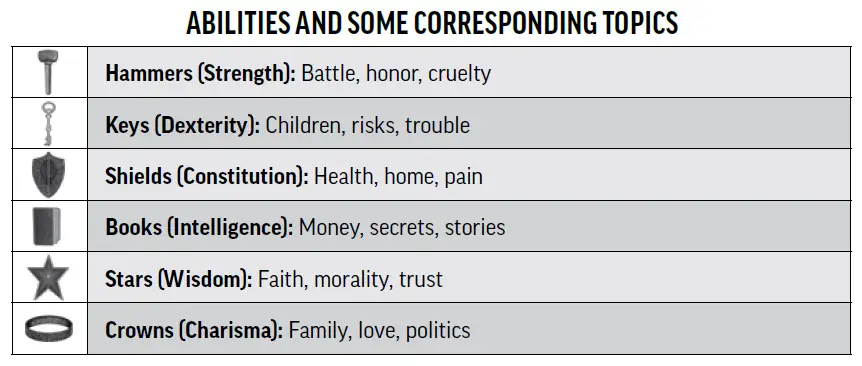
Remove the nine cards of the suit you have chosen from the harrow deck and shuffle those nine. Spread the cards you chose facedown in front of you. Instruct your subjects to each pick one card. The chosen card has a message for that person about their current place in the world and in relation to the question at hand. Using the descriptions on pages 9–14, interpret each card to define that subject’s role for the upcoming series of events.
If this card appears in the spread that follows, it applies most strongly to the person who chose that role and should be interpreted accordingly.
The Spread
Once each person knows their role, shuffle the cards together (including those just chosen) and then lay out a spread facedown. The spread is laid out in a three-by-three grid of nine cards.
When interpreting the cards, each one’s placement in the spread determines whether it relates to the past, present, or future. The placement also tells the harrower if the card should be interpreted in a positive, unclear, or negative light. The following table shows the placements and their alignments and meanings:
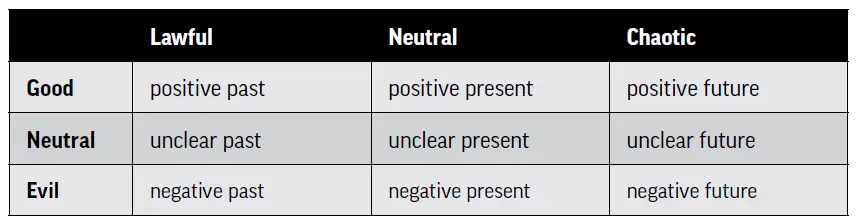
Any cards in the top (good) row are interpreted in a positive light, while cards in the middle (neutral) row are unclear, and cards in the bottom (evil) row are interpreted negatively. The lawful column represents the past, the neutral column denotes the present, and the chaotic column signifies the future.
For example, a card in the upper left placement refers to something in the past that was positive.
Reading the Cards
Turn over and read the cards one column at a time. Each column relates to a different period in the subjects’ lives.
Placement: The left column refers to past actions or events that affect the current situation. The middle column refers to actions or events that might happen now or in the very near future that affect the current situation. The right column refers to actions or events in the future that might happen to the subjects. The future can change, of course, but the results can give insight into what might be.
Turn all of the cards in the past column faceup first. Examine the cards according to the rules below, selecting one or more cards to interpret. After you finish with the past, turn the cards over in the present column. When you finish with the present, go on to the column representing the future. Select the cards to interpret in each column by looking for chosen cards and cards that relate to their placement in one of three ways, called matches.
Chosen Cards: Whenever a chosen card that was revealed by one of the subjects appears in a spread, it must be interpreted, because it is of great import to that subject.
True Matches
A true match occurs whenever a card appears in its “correct” placement in the spread (that is, in the placement corresponding to the position of its alignment symbol on the card). For example, if The Paladin appears in the upper left corner of the spread, that’s a true match, since lawful good is symbolized in the upper left corner of the card. Interpret the card based on its general meaning .
Opposite Matches
An opposite match occurs when a card is in the placement diametrically opposed to its alignment. Thus, if The Juggler (chaotic good) is in the lower left placement (lawful evil), that’s an opposite match. Interpret the card based on the opposite of its general meaning.
Partial Matches
A partial match occurs if a card matches only the correct row or column, but not both. So if The Cricket (neutral good) is found in the upper right placement (chaotic good), it is a partial match (matching good only). Interpret the card based on its general meaning, but with some aspect of its meaning altered (at your discretion).
Selecting Cards to Interpret: You can interpret any number of cards in a column, but you must interpret at least one per column. All role cards, true matches, and opposite matches are always interpreted. If none of those appear in the column, look for a partial match. If that doesn’t appear, then choose any one card in the column.
Cards in Misaligned Placements: If a good card, such as The Trumpet, appears in the bottom row, you should interpret it in its most negative light (see card descriptions for more details). Likewise, if an evil card, such as The Beating, appears in the top row, it should be given a positive interpretation. These cards are considered misaligned. (Cards which are neither good nor evil are never misaligned.)
When cards appear in the middle row, interpret them normally, unless the context of the reading suggests you should treat them as misaligned. Once you’ve interpreted each column, the reading is over.