Current situation
Il-Heban is a desert city located in Kildar’s southwestern reaches. Once little more than a modest trading post beside an oasis, Il-Heban grew rapidly over the years, first bolstered by an influx of skilled refugees from the former capital, Torrica, and later by the careful actions of its sultan during the Lords' Alliance invasion.
After the peace treaty, Il-Heban underwent many transformations. First of all, it could no longer rely on passing trade. The route to Brell was cut off by the thickening fogs of the Mistborne Mountains, while nearby Stormhaven lost almost all of its importance as a trading hub. Secondly, although the influence of the Lords' Alliance is weaker here than in most other cities, the local population chose to pursue technology rather than magic. Lastly, thanks to the agreements made with the goblins of Anfyn during the war, relations between the two regions grew even stronger, bringing new people and opportunities to Il-Heban. To this day, many find it remarkable that Il-Heban has become the most stable city in southern Kildar.
Layout
Il-Heban can be divided into three main areas:
The Northern Agricultural District
Here, near the life-giving oasis, halflings have established an advanced agricultural hub, using the finest farming techniques to make the desert bloom. This fertile district not only sustains the city but also transforms the harsh environment into a far more liveable place.
At its heart stand the Hanging Gardens—the pride of Il-Heban and a testament to halfling vision and dedication. Conceived, designed, and largely cultivated by halflings, they stand as a living symbol of their ingenuity and artistry. Gnomes lent their technical expertise to the irrigation systems, while orcs provided the strength needed for construction, but it was the halflings' leadership and creativity that brought the gardens into being.
This masterpiece ranks among the most beautiful landmarks in all of Kildar, producing an abundant harvest while distributing elevated water throughout the city.
The City Center
The market has always been the beating heart of Il-Heban, long before the settlement grew into a city. Most of the population lives and works here, trading goods from across Kildar and distant lands beyond. Alongside silks, spices, and exotic wares, the market has always been a place where information changes hands. Rumours, political whispers, and guarded secrets can all be bought, sold, or overheard in the shaded corners of its stalls. In earlier days, Il-Heban was also one of the region's foremost centres of magical item trade, attracting mages, adventurers, and collectors from far afield. Two distinct marketplaces flourished: the Il-Heban Souk—an open-air market for legal everyday and exotic goods—and the indoor Shadow Bazaar, a black market for enchanted artefacts.
However, magical item trade had already begun to decline before the Lords' Alliance invasion. Today, due to the severe penalties for trading magical items without permission, it has officially ceased altogether. Nevertheless, rumours persist that a handful of exceptionally discreet merchants still deal in magical items in the city's furthest alleys. Today, the Shadow Bazaar thrives for a different reason. The official explanation for its name is charmingly innocent: ingenious rooftop water channels feed cascades of greenery that drape over the narrow streets, casting the market beneath a lush canopy of shade. Yet everyone knows the name has another meaning—the market remains a shadowy haven for the trade of secrets and information. The halfling population, ever fond of tales and gossip, prefers to see it simply as a place for exchanging stories, blissfully—or perhaps wilfully—accepting the official explanation.
The Southern Heights
South of the market, atop a hill, rises the Clay Palace—home of Il-Heban's halfling sultan. Even in the settlement's earliest days, its leaders resided here, but recent decades have transformed the site into a resplendent seat of power. Built from sun-baked clay and enriched by the city's water system, the palace gleams with beauty, its terraces and fountains overlooking the desert and the gardens below.
Today, however, the palace shares the hill with another grand structure—the Grand Il-Heban University. It is a palace of its own, not for a sultan, but for science. Its purpose is immediately evident from the outside. The university is divided into five sections, one for each of its main departments. A towering observatory crowned with a massive telescope houses the Faculty of Astronomy. Water channels from the Hanging Gardens weave throughout the complex, supplying the university's research facilities, particularly those of the Agricultural Department. Another building, decorated with rare minerals, unusual stones, and depictions of alchemical apparatus, belongs to the Faculty of Alchemy. The remaining two buildings house the Departments of Archaeology and Architecture.
Population
The population of Il-Heban has always been remarkably diverse. Even more interestingly, its main source of newcomers has always been refugees. The first great wave of refugees consisted of three groups:
Halflings – Driven from Torrica by the events of the Crimson Dusk, halflings brought with them not only a deep-rooted love of trade, but also a cultural passion for storytelling and rumor-spinning. Their knack for gathering, weaving, and exchanging tales transformed Il-Heban into a hub for information exchange. It was also the halflings who pioneered the city’s agricultural industry, developing advanced farming methods that made life in the desert not just possible, but prosperous.
Orcs – Seeking a fresh start after the catastrophic turns in both their own history and Torrica’s, orcs arrived in Il-Heban without a clear role. Over time, they became master builders and formidable guards, lending their strength to the city’s growth and safety. Somehow, the halflings managed to tone down the orcs’ fierce tempers, fostering a calm, steady discipline that made them even more reliable allies.
Fortune Tellers from Brell – A small group, yet of immense significance. After the Crimson Dusk destabilized Brell’s magic, divination spells there became dangerously unpredictable. These seers fled toward Stormhaven, with Il-Heban as their first stop. Upon arrival, they performed a divination to decide their future—only to receive the clear message that they were meant to stay. Their presence gave Il-Heban yet another powerful tool for gathering and trading information, cementing its status as the desert’s information capital.
During the last ten years, following the Lords' Alliance invasion, two additional groups of refugees arrived:
Goblins and fey from Anfyn – Due to the severe instability caused by Anfyn's internal religious conflicts, many of its most peaceful inhabitants sought refuge in Il-Heban. Goblins found work primarily as information brokers, builders—especially during the construction of the new university—or, for those with the right skills and mindset, as merchants bringing goods from Anfyn. A number of fey also settled in this city surrounded by dunes, much to everyone's surprise, including their own. They are primarily involved in maintaining the Hanging Gardens, where their unique talents are invaluable. This migration was further encouraged by the agreements made between the Sultan and Anfyn during the war.
Former citizens of Stormhaven – Naturally, not everyone wished to leave Stormhaven for a city in the middle of the desert, but many had little choice after Stormhaven was devastated and later divided between the goblins and the Lords' Alliance. They came from many different backgrounds, but they share one thing in common: few of them regret making Il-Heban their new home.
The criminal landscape of Il-Heban is unusual. On one hand, it is obvious to everyone that information is often acquired through questionable, if not outright illegal, means. On the other hand, proving the illegality of most information sources is nearly impossible.
Still, anyone with half a brain quickly learns one simple rule: if there is something you truly want to keep secret, never speak it aloud and never commit it to paper. In Il-Heban, once a secret exists outside your own head, it is only a matter of time before it is bought, sold, and passed around like any other commodity.
Economy
From an economic perspective, IL-Heban is intersting for several reasons:
1) Information Trade
With Il-Heban lacking abundant natural resources, its most valuable commodity has become information—of every kind and quality. This can range from unreliable tales, legends, and rumours to precise and highly sought-after information, such as the exact location of a hidden site, the latest political developments, or even stolen faction reports.
The value of information is determined by several factors: reliability, relevance, accuracy, difficulty of acquisition, completeness (e.g. "on this island" versus "in the north of this island"), and more. In many cases, information can even be used as currency, paying for goods, services, or even a night's stay at a tavern.
Information reaches Il-Heban through several primary channels:
1) Professional Spies and travellers
Many individuals travel to distant regions with the sole purpose of gathering information to sell upon their return. Some operate independently, while many work under contract. Spies may serve the Sultan directly, act as subcontractors for other information merchants, or work within companies—selling information to Il-Heban as a profitable side business (usually without the anyone's approval).
2) Passers-by
The simplest source is travellers passing through the city. This was once one of Il-Heban's main sources of information, but trade has declined, and the flow of travellers has declined with it. However, there is still a steady movement of people between Anfyn and Il-Heban, so information from that region continues to arrive in this way.
3) Fortune Tellers
Fortune tellers are a distinct and highly respected class of information traders in Il-Heban—and across Kildar. Their predictions may not always be exact, and their services are costly, but they are the only reliable source for glimpses into the future. Clients range from the Sultan and city rulers to guild leaders, nobles, and adventurers.
They are also among the few groups immune to espionage. First, they can foresee attempts to spy on them. Second, they have a special agreement with the Sultan: no one is permitted to eavesdrop on their sessions, and the information they provide is strictly for the client. If the client later repeats it carelessly in public, that is their own problem. In return, the fortune tellers remain in Il-Heban, further cementing its status as Kildar’s information capital.
4) Science
This is a relatively new source of income, developed over the last ten years largely thanks to the establishment of the university. Realising that simply trading information would not be enough in the long term, Il-Heban decided not only to acquire knowledge from elsewhere but also to produce it.
All five faculties contribute by selling their discoveries to some extent, though the Faculty of Agriculture is by far the most successful. It assists other regions in improving their agriculture while being paid for its expertise. At present, virtually every city in Kildar has at least one ongoing project involving the university.
2) Agriculture
As mentioned earlier, the Hanging Gardens are vital to Il-Heban because they allow the city to feed itself. More interestingly, agricultural production has increased so dramatically in recent years that the gardens were able to provide aid to Stormhaven during the famines caused by the invasion, as well as to Anfyn during the shortages brought about by its internal civil war.
The Hanging Gardens could probably have supported either of these regions on their own, but helping both simultaneously proved far more difficult. Nevertheless, these efforts brought both wealth and prestige to Il-Heban's agricultural products, significantly increasing the city's influence even beyond southern Kildar.
3) Glass and Alchemy
One of the few resources found in abundance around Il-Heban is sand. Thanks to the expertise of engineers from many races—most notably gnomes and elves—the city has grown into one of Kildar's foremost centres of glass production. Initially, its workshops produced simple bottles and household glassware, but it was not long before elven artisans recognised the city's potential as a centre for manufacturing sophisticated alchemical equipment.
For many years, Il-Heban has been renowned for producing the finest alchemical apparatus in the realm. Much of this equipment is exported to Arland (and was previously exported to Stormhaven), where it is highly prized by alchemists. The craft continues to evolve, with engineers either developing new designs themselves or manufacturing equipment according to blueprints and specifications supplied by their clients. Interestingly, a small community of dragonborn from Eir Andusk has found an unexpected niche here—they are considered among the finest glassblowers not only in Il-Heban but perhaps in all of Kildar.
Previously, Il-Heban lacked the necessary alchemical resources to develop alchemy on a large scale. Today, however, the Hanging Gardens have expanded enough to include a dedicated section devoted to alchemically valuable plants. Chief among these is the mandrake root. The halflings are particularly proud of having bred a new variety of mandrake that sings lullabies instead of screaming. This naturally creates problems of its own, but it is considerably safer than the original plant.
Another factor behind the development of alchemy was the fall of Stormhaven. The market for alchemical ingredients collapsed, making it far cheaper for Il-Heban to purchase them. In addition, many alchemists from Stormhaven sought refuge either in Arland or in Il-Heban.
For now, alchemy itself does not generate significant profits, as Il-Heban still needs to expand its production capacity. However, it has a considerable impact on many other industries. One notable example is agriculture. Not long ago, Il-Heban's alchemists began producing small quantities of fertilisers capable of increasing crop yields or allowing crops to grow in harsher environments.
Government
Il-Heban is ruled by an elderly halfling sultan—a position that came about in a rather unusual chapter of the city’s history. In its early days as a simple trading post, Il-Heban had little need for formal governance. On rare occasions, disputes or important matters were settled by seeking the advice of the oldest and most respected traders, or the maintenance workers who lived on one of the southern hills.
However, as the settlement grew—especially with the influx of refugees—it became clear that some form of structured leadership was necessary. Proposals were put forward, but none satisfied all parties. Old rivalries complicated matters, for example the elves did not want orcs in government, and the orcs felt the same about elves.
Ordinarily, halflings are not known for seeking political power; they tend to adapt to whatever political system exists where they settle. But here, a power vacuum and a stroke of timing shifted events in their favor. Around this period, the halflings introduced a groundbreaking irrigation system and proposed the ambitious Hanging Gardens project. These achievements greatly boosted their popularity.
With no faction opposed to them—and, truth be told, no one able to recall a single serious grievance against halflings—the choice felt almost inevitable. They had never stirred political trouble, never taken sides in old disputes, and never done anything truly objectionable. This and with the city united in admiration for their contributions, it was decided that the halflings should lead, and the most respected among them—the chief architect of Il-Heban’s agricultural transformation—was chosen and named Sultan.
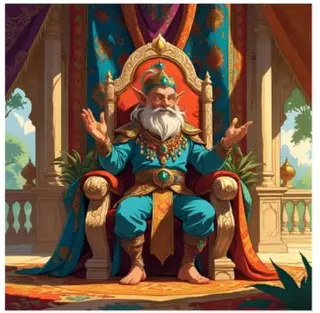
Sultan of IL-Heban
During the Lords' Alliance invasion, the Sultan managed to reach an agreement with the Alliance's allies, the goblins of Anfyn. They agreed not to attack the city in exchange for certain information. As a result, Il-Heban avoided becoming directly involved in the conflict and remained completely unscathed. It is perhaps, alongside Arland, the city that benefited the most from the invasion, although neither the Sultan nor the people are particularly pleased about the circumstances that made this possible.
Relations with the Lords' Alliance are generally good. Since magic has never been as dominant in Il-Heban as it is in many other cities, the Alliance has taken a more lenient approach here. Their presence is relatively small and focuses primarily on overseeing alchemical research. Since the halflings have little interest in dangerous experimentation and genuinely seek to help others, the Lords' Alliance rarely has much to do. Furthermore, relatively few of its members are eager to live in a remote city surrounded by desert.
There are, however, persistent rumours that members of the Alliance's intelligence department occasionally visit Il-Heban—not to supervise it, but to gather information.

Agricultural desert city meets halfling gossip spy network
Pavel, Rosalie