Current situation
Ironhold is a dwarven town nestled deep in the western mountains of Kildar. Shielded by rugged peaks from the pirate stronghold of Teristraz, separated by rolling hills from the fertile farmlands of Ishar, and facing across the sea toward the spell-shrouded city of Brell, it sits at a crossroads of land and legend. Though still recovering from the devastation of a demon incursion, the fiends have long since been driven deep into the mines, leaving the town itself restored to a steady rhythm of daily life.
Having previously held little political influence, everything changed with the invasion of the Lords' Alliance. Becoming the last Dwarvish Citadel of Kildar, while also being the only city that managed to successfully repel the Lords' Alliance siege, gave Ironhold an opportunity to take on the sad responsibility of looking after Kildar as a whole.
Layout
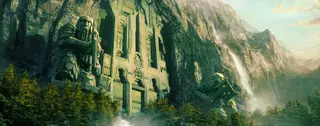
The town of Ironhold is built within a colossal cavern, a masterpiece of dwarven craftsmanship where every arch, column, and rune-carved wall reflects both pragmatism and artistry. Its structure is divided into three great levels, each with its own distinct role in the life of the settlement. The floors are connected by monumental staircases carved directly into the cavern walls, broad enough for entire companies of soldiers to march down. The steps are cut deep and steady, their edges polished smooth from generations of dwarven boots. Ornate runic railings line the sides, glowing faintly with everburning light, making the stairs safe and dignified for all who travel between the levels.
Ground Floor – The Foundations and the Forge
The lowest level holds the town’s warehouses and storerooms, where goods and raw ore from the nearby mines are kept under careful watch. Yet this floor is not only for storage—here, the heat of the forges burns day and night. Master smiths and apprentices alike work metal into blades, armor, and tools of unmatched quality, their hammers echoing like a heartbeat through the cavern. Many families also live here, close to their craft and trade. From this floor, heavy stone gates lead directly into the mines, where the wealth of Ironhold—gold, mithril, adamantine, and more—awaits extraction.
First Floor – The Market Hall
Above the forges rises the lively market, the heart of daily life in Ironhold. Stalls and shops cluster in the wide open square, where dwarves and travelers bargain for tools, weapons, food, and luxuries. The market rests upon the sturdy stonework of the first floor, supported by thick dwarven pillars engraved with runes of strength. From the cavern walls, four great bridges extend inward, connecting the homes carved into the rock with the bustling square, making it easily accessible for all citizens. From the second floor, stairways spiral upward to the heights of the palace and noble district.
Second Floor – The Seat of Power
High above hangs the King’s Palace, a triumph of dwarven engineering that seems to float within the cavern itself, anchored by hidden supports of stone and steel. From its grand balconies, the king can look down upon the market below, his speeches resonating across the cavern like rolling thunder. This floor is also home to the noble houses of Ironhold, their grand stone halls adorned with banners and gilded doors. One particularly imposing residence belongs to the Eldritch Inquisition, whose presence here is a reminder of both Ironhold’s scars and its vigilance. Together with the palace, these halls form the political and spiritual heart of the town.
The Mountain-Foot Village
Outside the cavern lies a settlement at the mountain’s foot, where the light of the sun touches Ironhold’s domain. This village serves as a gateway to the underground city, separated by a gorgeous stairway that climbs the rocky slope in wide, sweeping arcs. At the summit stand the tough outer gates of Ironhold, carved with reliefs of dwarves driving back demons and gilded with adamantine reinforcements. In the village below, horse stables and taverns welcome travelers, while a local market and a scattering of farms provide food and comfort. Many non-dwarves who find the caverns too stifling make their homes here, enjoying the balance of proximity to Ironhold’s wealth and the open sky above.
This village has grown considerably in the last ten years. The Lords' Alliance decided not to be involved very much in the city itself—only outside or in the caves during missions against the demons. This led them to invest in the village, making it more comfortable for their troops and for common folk who might want to come here. They discovered very quickly that Ironhold relies on food from other cities, so they searched for possibilities to grow more in these mountains. Together with the halflings of Il-Heban, their choice fell on olives and grapes. Now, the foothold of Ironhold is richer, both financially and in terms of its landscape.
Population
The population of Ironhold historically mostly consists of dwarves and those who feel comfortable living in a cave with hot air and who ideally like to craft something or mine minerals, such as rock gnomes or some tieflings.
The focus of the population here is mostly materialistic—to produce the best and most practical things in Kildar and excavate materials for this purpose. This stands in strong contrast to Rhyl, where people were less focused on wealth and material things and more on laws and ethics. They still respect the laws and ideas established in Rhyl, but they were usually considered pragmatically, as Ironhold always bore much more responsibility for its clients. Later, the war with the demons forced everyone to do their best not only to survive, but also to thrive. This mindset, together with the help of adventurers, helped Ironhold defeat the Lords' Alliance when they came to its doorstep.
Among the interesting traditions is compulsory conscription for male dwarves and voluntary conscription for other citizens of Ironhold. These recruits are called “Brass Coppers.” The name comes from two things. First, they wear brass armor, which oxidizes over time. When it is completely oxidized, which usually takes a couple of years in the caves of Ironhold, the dwarf finishes their conscription period. The second reason is that there are insects, which dwarves call “Brass Coppers,” that live in the local caves. They are usually seen near copper and zinc ores.
Brass Coppers (recruits) usually just patrol the city and serve as law enforcement. However, they usually have to go into the caves a couple of times to fight demons, although they normally do so with a squad of much more experienced soldiers. Some of the young dwarves continue their military careers after completing their conscription and change their brass armor for steel or something even better.
Other races and members of the Lords' Alliance mostly live in the mountain-foot village. They serve as a connection between Ironhold itself and the outside world, providing places to live and eat for those who visit it, while also organizing the transport of goods to other regions from Ironhold.
Economy
The economy of Ironhold is built entirely on mining and the production of weapons, armor, and other metal goods. With the latest advancements in the cave war, the dwarves have gained access to more materials, as well as a safer city. In addition, peace with the Lords' Alliance brought a new customer and new markets for Ironhold, bringing both economic and political influence to the city.
Right now, the main income of Ironhold comes from its contract with the Lords' Alliance—they are the main source of materials for magic suppressors produced in Brell. For the Lords' Alliance, the production of magic suppressors is a strategic interest, so they do everything possible to make sure that they are produced without delay. Some of the magic suppressors stay in Ironhold and help in the war against the demons.
The city has to import food and other natural materials that do not exist in the cave, such as wood. The reliance on food imports has decreased a little bit due to the growth of food production in the village and the help of the halflings of Il-Heban, but the need for imports cannot be eliminated completely.
One of the largest recent changes is that the Lords' Alliance allowed Ironhold to conduct mining excavations in the mountain range belonging to the neighboring Teristraz. However, they had to build a direct road between the two cities. This was accomplished, and today the travel time between Ironhold and Teristraz has been shortened so much that they have become the main trade route in the west of Kildar. Some merchants travel from Brell to Ironhold and then to Teristraz and find this route sufficient to be successful.
Demon Invasion and Current Situation
The Tide of Battle
The demon invasion occurred in 591 RKC and began without warning. In a small cavern within the mines, not very far from Ironhold, a sudden portal to the Abyss tore open, unleashing legions of demons. Many miners were slaughtered, and the guards only barely managed to shut the gates leading into the town. The defense did not hold for long, and soon the fighting spilled onto the lower level of Ironhold itself.
For a long time, no orders came from the king, so Sevetar Mason stepped forward to take command. He ordered makeshift fortifications to be built along the stairways, giving defenders the advantage of high ground. He also dispatched requests for reinforcements: to Rhyl, the nearby Eldritch Inquisition outpost, and Ishar. The Inquisition responded swiftly, sending messengers to Stormhaven and deploying a small strike squad to Ironhold.
As days passed, the demonic forces multiplied. By the third week, the ground floor of the town could no longer be held. Anticipating this, Sevetar had already ordered secondary fortifications on the next level, and this time he was joined in command by the dwarvish king. At the height of the siege, reinforcements from Rhyl finally arrived. With their help, the defenders reclaimed much of the town, though a counterattack was still impossible. The last hope lay with the promised reinforcements of the Eldritch Inquisition—and perhaps Ishar. In the fourth week, the Inquisition’s forces arrived, while Ishar chose not to send aid.
United at last, the dwarves of Ironhold, the king, Sevetar Mason, the warriors of Rhyl, and the Inquisition launched a counteroffensive. They pushed their way to the source of the invasion, though none knew what awaited them, as no survivor had ever reached the portal and returned. Together they fought through endless hordes until the Inquisition, combining arcane knowledge and divine power, sealed the portal with a great ritual.
Victory was celebrated, but it was soon discovered that the war was far from over. The deeper levels of the mines—stretching unimaginably far beneath the mountain—were overrun with demons. The Inquisition explained that demons, being creatures of pure chaos, had scattered when they first arrived: about half surged toward Ironhold, while the rest dispersed through the mines. In one sense, this saved the town, for had all the demons advanced together, Ironhold would have fallen. Yet in another sense, it left the dwarves with a lingering nightmare.
For some time, the Eldritch Inquisition helped to clean the caves, but now, with their exile, support in this task has been taken over by the Lords' Alliance. They are not able to spare as many soldiers as the Eldritch Inquisition could, but they try to compensate with technology, especially through their heavy reliance on magic suppressors, which make the most dangerous demons much weaker. According to dwarvish estimates, only about half of the caves have been reclaimed, and if no other invasions or major events in Kildar occur, the caves might be cleared by 650 RKC, though this is still a quite optimistic evaluation.
Military Test Site
Today, the war against the demons continues step by step, led by the dwarves of Ironhold and the Lords' Alliance. However, the conflict has also turned Ironhold into a proving ground for military innovation. Many adventurers, mercenary groups, and different organizations frequently take part, eager to test their strength and creations in real combat.
Engineers and mages from Brell, for instance, once sold a prototype golem at a reduced price just to see how it performed in battle. The results far exceeded expectations and served as powerful advertising for their craft. Alchemists use the campaign to trial experimental potions on willing volunteers. Smiths forge new weapons and armor, then see them tested against demonic foes. Generals and tacticians bring units here to train in cohesion, discipline, and survival against a relentless enemy.
Ironhold’s haunted mines have thus become more than a battlefield—they are a crucible where weapons, strategies, and warriors are forged and tested. Though the scars of the invasion remain, the town has found new strength in turning tragedy into opportunity.
Government
The government of Ironhold in a hiearchy consisting of a kongur, lairds, thanes and Yeomen. Ironhold has no grand standing army, its defensive and offensive force consists of smaller warbands under the command of the kongur or lairds.
The council of lairds convene daily to talk matters of state, advise the kongur and mete out justice to those who have tread the laws of Ironhold.
Kongur | The king of Ironhold. Has the largest military contingent of royal guards and guardsmen that partrol the streets of Ironhold. |
Council of Lairds | The governing body that advises the kongur in matters of state and handle the day to day activities. |
Lairds | Nobles, knights and other people of status that have earned a seat on the council of lairds. They have the authority to create their own warband that can be called to defend Ironhold or supplement the royal guard in times of need. |
Thanes | Underlings of the Lairds, roles vary. A thane can be responsible for a lairds household, be their right hand man, advisor or captain in the lairds army. |
Yeomen | They serve the crown directly. Have the smallest amount of power, but the most freedom. Can act as free agents under lairds, but always serve the best intrests of the kongur. |
In recent years, the nobility of Ironhold has been reduced somewhat. The reason for this is that many nobles of Ironhold were also high-ranking members of the Eldritch Inquisition. The Lords' Alliance agreed not to prosecute them, but they had to leave, together with Sevetar, for Eir-Andusk. In response, however, the Lords' Alliance promised to give autonomy to those who remained and would rule Ironhold.
Pavel, Gerard