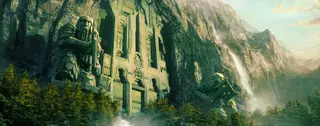
Ironhold is a dwarven town carved deep within a mountain, its heart a vast natural cavern reshaped into towering halls, forge-lined streets, and sturdy dwellings. A growing outer quarter lies at the mountain’s foot, where those less fond of underground life have settled among taverns, stables, farms, and vineyards. For centuries Ironhold was famed across Kildar for its riches and craftsmanship, its mines producing gold, diamonds, and other precious stones, as well as the rarest metals—mithril and adamantine. From these treasures the dwarves forged weapons and armor without equal.
That prosperity was shattered when a rift to the Abyss tore open in the depths. Demons poured through the mines and eventually into the city itself. The dwarves fought alongside the warriors of the Eldritch Inquisition, eventually sealing the rift and driving back the invaders. Yet vast sections of the mines were lost, and even today demons remain in the deepest tunnels. The ongoing war has also turned Ironhold into a proving ground for military innovation, attracting adventurers, soldiers, engineers, alchemists, and smiths eager to test their weapons, tactics, and creations against a real and relentless enemy.
Ironhold's history took another dramatic turn when the Lords' Alliance invaded Kildar. As the last Dwarvish Citadel to stand and the only city to successfully repel the Alliance's siege, Ironhold emerged with a far greater political responsibility than it had ever held before. The Alliance eventually made peace with Ironhold, choosing to remain mostly outside the city while supporting the war against the demons and investing heavily in its foothold.
The outer settlement has since grown into Ironhold's connection to the wider world. Alliance troops, merchants, travelers, and other races have settled there, while vineyards and olive groves cultivated with help from the halflings of Il-Heban have made the mountain slopes unexpectedly fertile. A new road to Teristraz has also transformed Ironhold into a major trade hub, connecting the western mountains with the wider regions of Kildar.
Ironhold's economy remains rooted in its mines and traditional craftsmanship. Rare metals and other materials are used to produce weapons, armor, and other goods, while the city's resources have become increasingly important to the wider war effort. At the same time, Ironhold still depends on imports of food and other materials that cannot be found within the mountain.
Today, Ironhold stands between its ancient traditions and its new responsibilities. It remains a city of dwarven craft, stubborn pragmatism, and immense mineral wealth, but it has also become a fortress, a trade hub, and an important political power in Kildar. Its people did not choose this responsibility, but having survived when others fell, they now have to decide what to do with it.
Pavel, Gerard