The History of Language
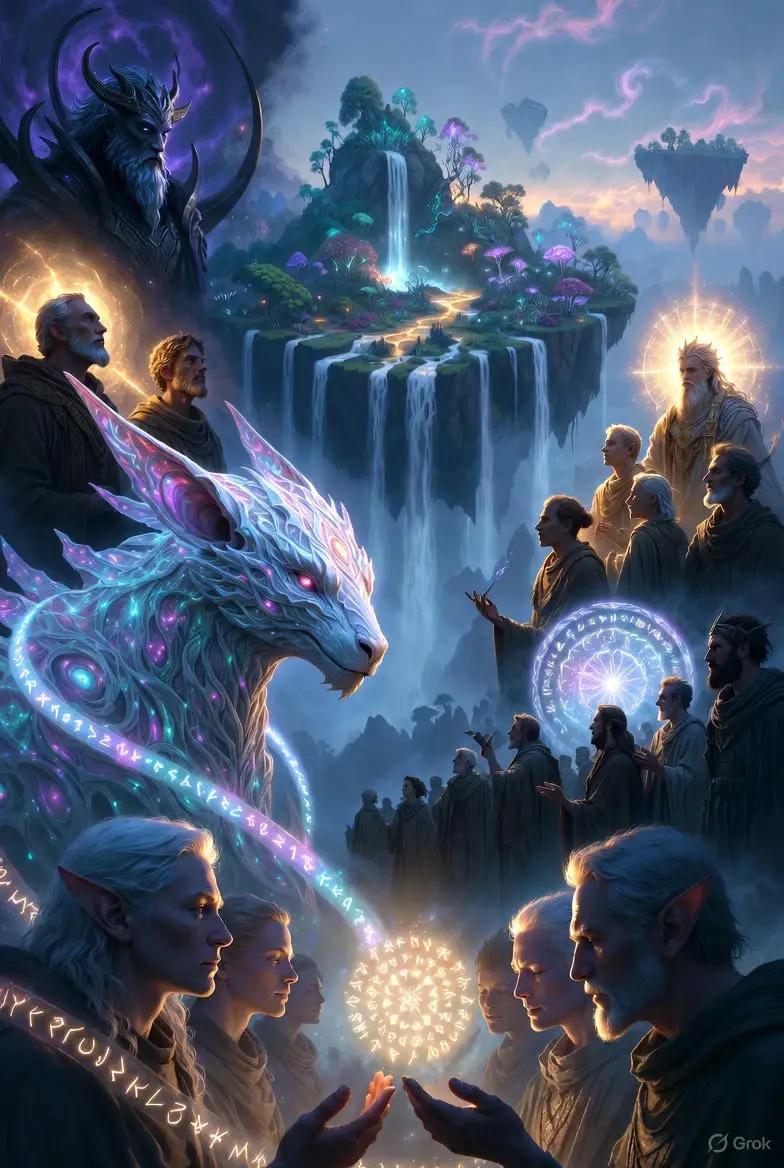
The Luvar Branch
1. The Luvar Deities and Panthea
The term “Luvar” refers to deities who arrived in Vitallia from a distant plane. Since the beginning of Vitallia’s history, these divine beings have influenced its fate. The first language of Vitallia during the First Age was Panthea, a divine tongue used by the Luvar to communicate their will to mortals. Panthea is often regarded as the ultimate form of language, imbued with an intrinsic magical power that ties it directly to the fabric of creation.
The goddess Theanivar is credited with teaching Panthea to the first mortals.
However, Panthea’s complexity and divinity made it difficult for mortals to fully master. This limitation led to the creation of Metea, a simplified form of Panthea that preserved its essence but was more accessible to the mortal mind.
2. Panthea’s Modern Influence
Though Panthea was largely abandoned by the mortal races, it persists as the language of high theology and magic, spoken among certain elite circles. These include:
The aristocracy of the Forklands, who use it as a mark of status.
The sorcerers of Rose, where it is essential for advanced spellcasting.
Scholars in Exotia, who seek to uncover its secrets.
Priesthoods in major temples, where it is preserved as a sacred tradition.
For those with access to its mysteries, Panthea allows communication with divine entities and grants unique magical insights. The decision to abandon Panthea for simpler forms like Metea reflects a profound cultural shift, with hidden consequences tied to mortal separation from the Sentinel’s original design.
Metea and Its Derivatives
Metea, a simplified form of Panthea, became the dominant language of Vitallia during the First and Second Ages. From it, numerous dialects arose:
Reyka: A simplified language spoken by desert tribes, introduced by the goddess Igrais.
Margo: A dialect of Metea adapted by Kargor the Smith, used to lead the Dwarves to Esgolithon.
Teyn: The most widely spoken language today, evolving as a practical, common tongue across Central Vitallia. Despite its simplicity compared to Panthea, Teyn retains a portion of its arcane origins, making it versatile for both communication and magic.
The Sentinel Branch
1. Sahri: The Language of Creation
The Sentinel, the great creator of Vitallia, gave its creations Sahri, the original language of the world. Sahri was a primal force of communication, not just among sentient beings but also between mortals, animals, and the world itself. It represented the primordial Word of Creation, binding all living things to the Sentinel’s will.
The abandonment of Sahri in favor of Panthea marked a pivotal moment in Vitallian history. This transition is believed to have been subtly orchestrated by the Luvar, who sought to sever mortals from the Sentinel and draw their faith toward the divine pantheon instead. Faith, being the source of the gods’ power, created hidden rivalries between the gods and the Sentinel.
2. The Forgotten Legacy of Sahri
Those who spoke Sahri gained a unique connection to the world, able to communicate with creatures and even influence nature itself. The Shanah race, now extinct, were the only beings to master Sahri completely. The elves, who also spoke Sahri during the First Age, developed their own variation: Sentin, a mellifluous language used for music, poetry, and magic.
The Role of the Gods
The gods’ introduction of Panthea to mortals was a deliberate attempt to steer faith and power away from the Sentinel. This divine rivalry persists subtly in Vitallia, as the gods vie for mortal belief to sustain their strength. Meanwhile, priesthoods and theological factions arise, often in conflict over the true nature of the divine hierarchy and their interpretations of faith.
Modern Uses of Sahri and Sentin
Sahri, though mostly forgotten, is still revered in legend as the language of the Sentinel. Its influence lingers in the remaining Shanah creatures and on the Isle of Miasel, where the descendants of ancient speakers reside. Sentin, a blend of Sahri and Metea, remains in use among the elves, preserving a fragment of the ancient connection to the Sentinel.