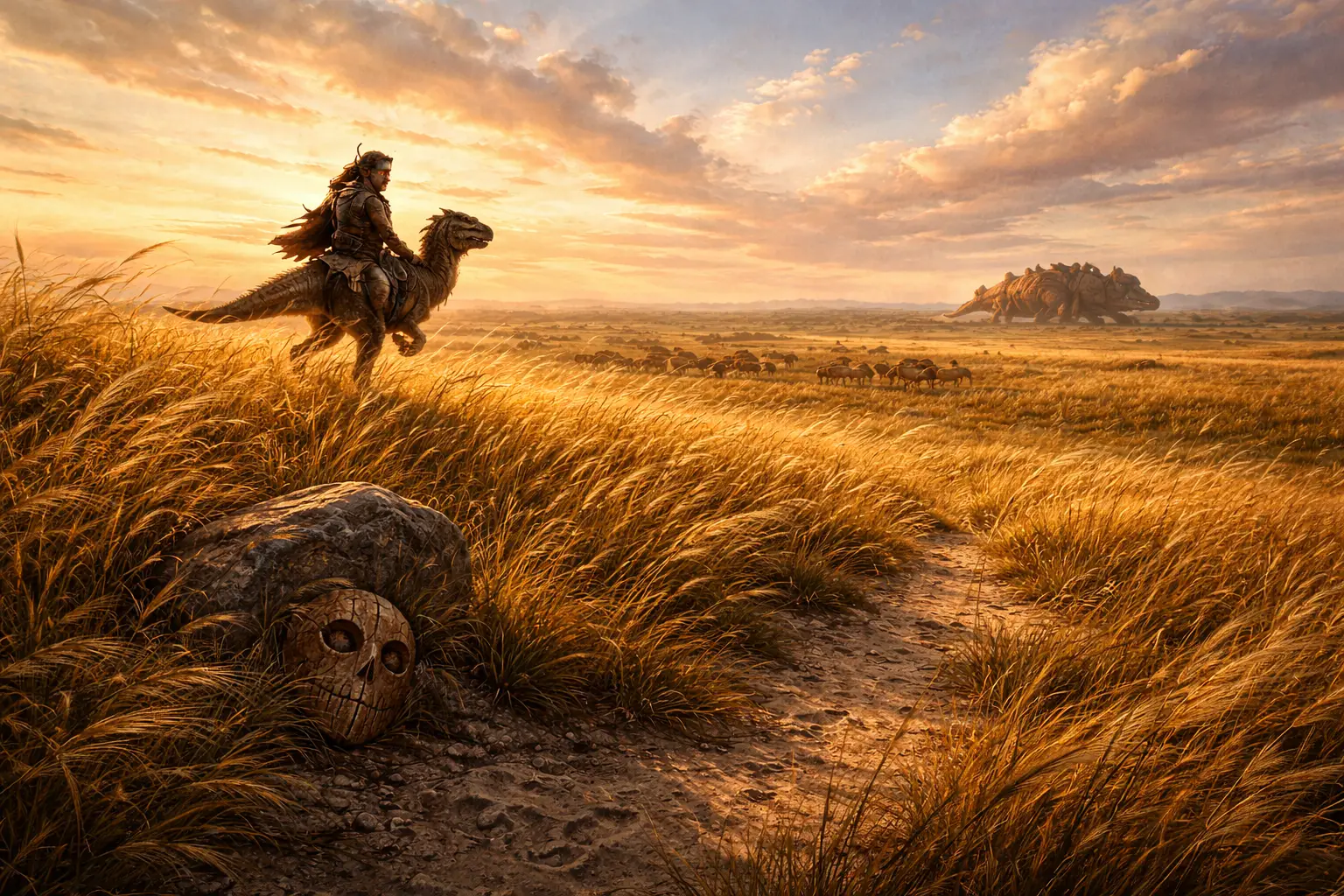
Talenta Plains
Capital: Gatherhold | Ruler: Lathon Halpum (nominal) | Government: Tribal confederation | Hallmarks: Dinosaurs, halflings, livestock, spirits
"A howling halfling warrior charging in on a clawfoot raptor? Most terrifying thing I've ever seen." — Sir Danton ir'Lain, Brelish knight
Somewhere east of Karrnath the farms thin out, the fences stop, and the ground opens into grassland so wide you can watch the weather come from half a day away. There are no towers here. Nearly no roads to speak of. The grass runs to the horizon in every direction, and somewhere in it — closer than you think — a halfling is sitting on a dinosaur, deciding what to make of you.
This is the Talenta Plains: homeland of the halfling people, birthplace of the Marks of Hospitality and Healing, and one of the least understood nations recognized by the Treaty of Thronehold. The halflings have been here since before Galifar, before the Dhakaani, before anyone started keeping records. They ride dinosaurs. They talk to their dead. They welcomed the dragonmarked houses into the world — Ghallanda and Jorasco both carry Talentan blood — and then watched those houses leave for the cities while the tribes stayed on the grass and kept riding.
The Talentan Spirit
A Talentan halfling is born into a tribe, raised in a camp that moves with the seasons, and taught three things before anything else: how to ride, how to listen to the spirits, and how to be generous to strangers. Hospitality is not a custom here. It is closer to a law of nature — you feed the traveler because the traveler might be carrying a spirit's attention, or because the plains are wide and lonely and no one survives them alone. The Mark of Hospitality appeared among a people who had already been practicing it for thousands of years.
But a stranger who mistakes generosity for softness will learn otherwise fast. The same halfling who offered you food this morning will put a javelin through your shoulder tomorrow if you let your horse graze on ground her tribe has claimed — not because she is cruel but because the land belongs to the spirits, and the spirits are watching, and she did not invite you to stay. Talentan warriors ride clawfoot raptors that are faster than warhorses and twice as mean. During the Last War, Talentan scouts serving as Deneith mercenaries earned a reputation that career soldiers from every nation remember with visible discomfort.
Riders and Spirits
Life on the Plains turns on two relationships.
The bond between a halfling and a dinosaur is sacred — not in a metaphorical, poetic sense, but in the way the halflings mean it: the spirits acknowledge the bond, the shamans bless it, and when the mount dies, the warrior carves a mask in its likeness and carries the spirit forward. Clawfoot raptors serve as war mounts. Fastieth carry riders across distances that would exhaust a horse. Glidewings scout from the air. House Vadalis has tried for decades to breed Talentan dinosaurs in captivity with only nominal success.
The spirit world is not a distant place the halflings believe in. It is here — layered over the grass, pooling in the hollows, thickening around the ruins the halflings will not enter. The Plains sit on a concentration of manifest zones tied to Dolurrh and Thelanis, and the result is a land where the dead linger, fey wander through the tall grass, and a shaman can sit down at dusk and have a conversation with her grandmother. Each tribe's shamans choose the migration paths, read the omens, and mediate between the living and whatever else shares the territory. Warriors and shamans both wear masks — a practice that looks decorative to outsiders and is not. The mask tells the spirit world who you are. A warrior in a clawfoot mask says I hunt. A shaman in an ancestor's face says I listen. To go unmasked is to go unannounced and the spirits may not look kindly on such anonymity.
Stories persist of ancient ruins that predate every known civilization — structures the halflings avoid, believing them haunted by fiends — and of a vast graveyard holding the bones of dragons. The halflings do not explore these places. They teach their children to walk around them.
The Shape of the Nation
Gatherhold is where the tribes come together and one of the only permanent communities in the Plains. The town sits on Lake Cyre's shore and serves as trading post, council ground, and the only place on the Plains where a foreigner can reliably find a bed, a meal, and a Sivis message station. House Ghallanda maintains it, but Gatherhold belongs to the people. The Wandering Inn — a Ghallanda caravan roaming the grasslands as a traveling fair — is the other fixed point in Talentan life, although "fixed" is the wrong word for something that never stops moving.
Crown and Council
There is no crown. There has never been a crown.
Under Galifar, the Plains were formally Karrnathi territory. The duchy of Vulyar collected tribute. The halflings paid — never enough to attract attention, never little enough to provoke a visit — and otherwise ignored the empire overhead. When the Last War broke out, the tribute stopped. Some tribes sided with Karrnath, some with Cyre, some signed on with Deneith and fought for whoever paid. The Valenar elves' seizure of eastern Cyre brought mounted warbands into Talentan territory, treating the grasslands as open ground for raiding and sport.
Lathon Halpum pulled the tribes together during the war — the first time in living memory anyone had managed it — and won recognition for the Plains at Thronehold. He talks about a nation of nations: tribes cooperating, Gatherhold as a seat of government, engagement with the wider world on Talentan terms. Holy Uldra, a shaman whose authority among the traditional tribes rivals Halpum's among the modernizers, says the opposite: close the borders, drive the outsiders out, go back to the old paths. Most halflings went home after the treaty and would like to be left alone. The argument between Halpum and Uldra is the only political question that matters on the Plains.
Postwar Pressures
The Plains are busier than they have ever been, and the halflings did not ask for the traffic. Settlers and merchants cross the grasslands on their way to Q'barra. Valenar warbands probe the borders. Horrors slip out of the Mournland. Dragonmarked houses circle Gatherhold, eyeing mineral deposits and dragonshard fields and herds that could be commercially exploited if the tribes (and resident spirits) would allow it. Karrnath wants to recruit the halflings as a buffer against the elves. Everyone wants something from the Plains. The Plains want to be left alone.
Whether that is still possible is what the next council at Gatherhold will decide — if the tribes can agree to hold one.
The Talentan Character
Two qualities define the Talentan temperament, and outsiders find them difficult to reconcile. The first is a generosity so natural it appears instinctive — the halfling who shares food with a stranger, offers shelter without being asked, and treats hospitality as a sacred obligation. The tradition that produced House Ghallanda is not an accident; the Mark of Hospitality appeared among a people who already practiced hospitality as a way of life.
The second is a ferocity so sudden it appears to come from nowhere — the same halfling who fed you last night riding a clawfoot raptor into your patrol this morning because you crossed a boundary she did not tell you existed. The Plains are not empty. They are full of people who are very good at not being seen until they want to be, and who consider their land sacred in a way that has nothing to do with fences and everything to do with the spirits that live in it.
"The halflings do not build walls. They do not need walls. They have dinosaurs, and spirits, and the knowledge that every empire that tried to own these grasslands is now ruins beneath the grass. The halflings are still here. The empires are not." — Zil trade correspondent, in a letter from Gatherhold