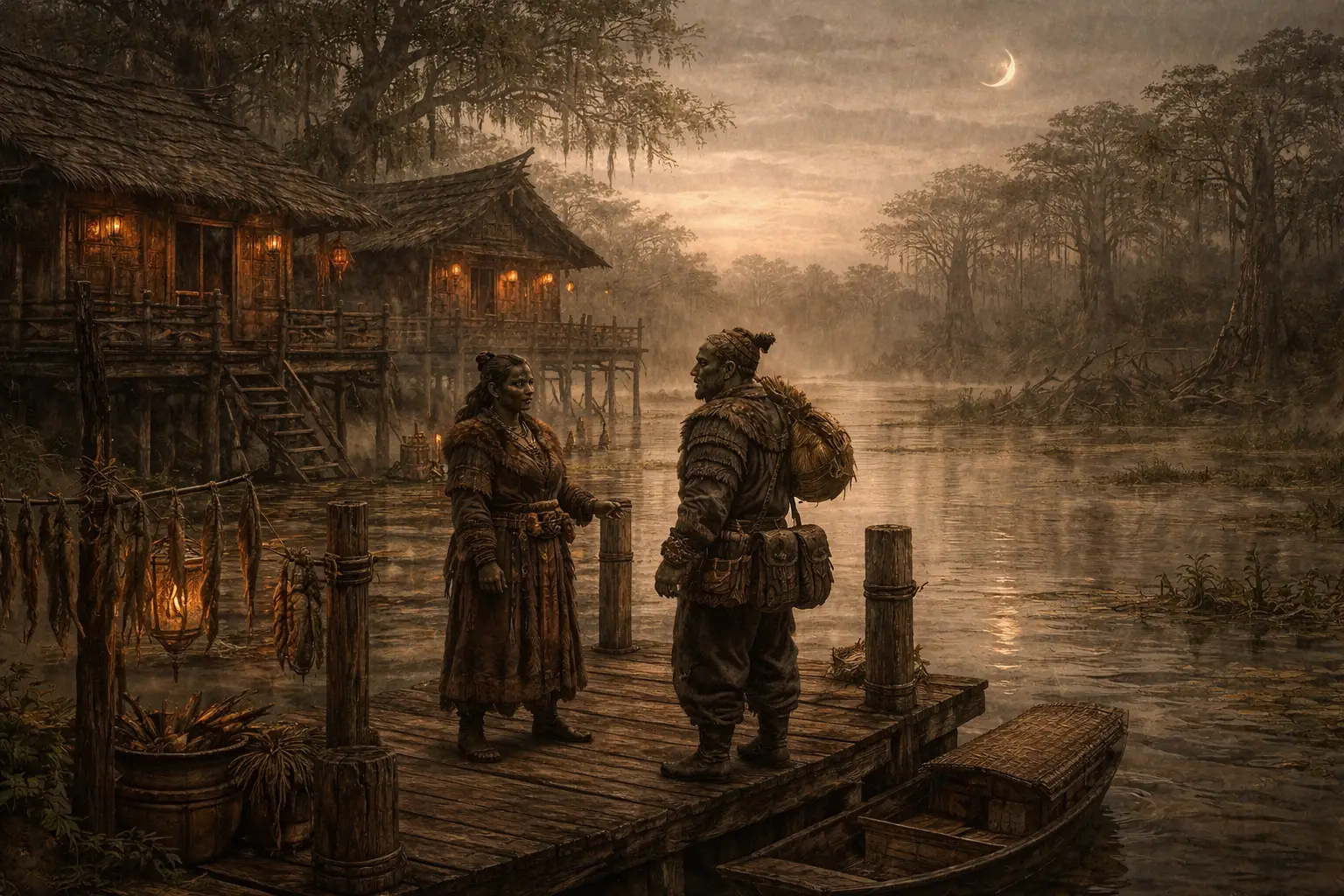
Shadow Marches
Capital: Zarash'ak (unofficial) | Ruler: None (House Tharashk holds greatest influence) | Government: None — loose collection of independent clans and tribes | Hallmarks: Eberron dragonshards, herbs, orcs, Gatekeepers, House Tharashk
"Every Marcher knows two truths. The first is that the swamp provides. The second is that the swamp takes. If you can't tell which one is happening to you at any given moment, you haven't been paying attention." — Aashta clan proverb
Sixteen thousand years before the first human set foot in Khorvaire, the orcs of the Shadow Marches were already old. They had already fought a war that nearly ended the world and won it with a magic no other mortal race had ever learned. They had already sealed horrors beneath the earth that would make the greatest war-mages of Galifar weep if they understood what was sleeping down there. And they had already gone back to their lives in the deep swamp as though none of it had happened, because that is what the Marches do to history — they swallow it whole and leave no trace on the surface.
The Shadow Marches occupy the westernmost reaches of Khorvaire, a vast stretch of swamp, moor, and tangled waterway running from the Byeshk Mountains to the shores of Crescent Bay. The terrain is brutally inhospitable. There are no roads, no lightning rail stations, and no Orien trade routes. Overland travel from the east means crossing Droaam or the Towering Wood of the Eldeen Reaches, neither of which is a casual stroll. Most outsiders arrive by ship to Zarash'ak, House Tharashk's port city, and go no further inland than they must. Beyond that port, the Marches sprawl in every direction: trackless bogs where the water is the color of old tea, dense stands of murk oak and swamp cypress hung with moss, open moor broken by ridges of pale stone, and everywhere the constant ambient sound of insects, frogs, and things that sound like frogs but are not.
The Shadow Marches are not a nation. The Treaty of Thronehold did not recognize them. There is no central government, no unified army, no tax system, and no one who speaks for the region as a whole. The single largest political force is House Tharashk, the youngest dragonmarked house, whose seat of power in Zarash'ak is the closest thing the Marches have to a capital. Beyond Tharashk's sphere of influence, the region remains what it has been for millennia: scattered communities following ancient traditions in the shadows of the swamp.
OVERHEARD AT A THARASHK HIRING HALL — Zarash'ak, Therendor 998 YK
"You want a guide into the deep Marches. Fine. But past the last Tharashk waypost, there are no laws. There are no rules except what the clan elder says, and half the time the clan elder is a toad. I don't mean that as a figure of speech. I mean there is a toad, and the locals believe it speaks with the voice of a dead druid, and they do what the toad says. You can laugh about that in Zarash'ak. You do not laugh about that in the deep Marches."
The Wound Beneath the Mud
The defining event in Marcher history is the daelkyr invasion. Over nine thousand years ago, the alien lords of Xoriat punched through the walls of reality, established footholds in Khyber, and unleashed armies of aberrations that destroyed the Dhakaani Empire. The orcs of the Shadow Marches — never conquerors, never empire-builders, driven into the swamps by the Dhakaani and largely forgotten — had one thing no other mortal people possessed: druidic magic, taught to them thousands of years earlier by the green dragon Vvaraak, who had foreseen the threat in her study of the Draconic Prophecy. Vvaraak's students — the first Gatekeepers — forged seals of extraordinary power, imprisoned the daelkyr in Khyber, and barred the gates between Eberron and the plane of madness. They saved the world. Nobody wrote their names down. They went back to work.
The scars of that war are still everywhere. The deep swamps are riddled with manifest zones tied to Xoriat and Kythri, pockets where time moves strangely, mundane creatures twist into unnatural shapes, and the boundary between sanity and madness thins. Daelkyr ruins lurk beneath the mud — structures of chitin, sinew, and fused bone that grow or decay according to principles no mortal scholar has understood. Aberrations still breed in the deep places. And the worst legacy is not physical but spiritual: the daelkyr sowed seeds of madness, and not every orc who heard the whisper of Xoriat had the strength to reject it. From those who embraced it grew the cults of the Dragon Below.
Two Peoples, One Mud
Roughly sixteen hundred years before the present, human refugees fleeing the wars of Sarlona crossed the ocean and settled in the Marches. They survived because the native orcs tolerated them, and over centuries the two peoples merged to a degree unusual in Khorvaire. Intermarriage produced the orc-kin population that defines the region, and the blending of customs created a hybrid culture the Marches have carried ever since.
The people of the Shadow Marches are divided into two broadly distinct cultures. The clans represent the blended tradition — communities of orc-kin living together, building permanent stilt-raised towns, working with steel, and engaging in trade. The clans are where House Tharashk draws its strength, and if you interact with anyone in the Marches, you are almost certainly dealing with a clan community. Their common tongue is Azhani, a hybrid language blending Goblin, Riedran, and traces of ancient Orc — close enough to standard Goblin for mutual comprehension, but carrying nuances outsiders miss.
The tribes are something older. Predominantly orcish, the tribes maintain traditions that predate human contact by thousands of years — semi-nomadic hunter-gatherers who do not work metals, fashioning tools from stone, bone, hide, and dense swamp-wood. Many tribal communities have never seen Zarash'ak. Some do not know the names of the nations beyond the swamp, let alone that those nations fought a century-long war.
FRAGMENT OF AN ORAL HISTORY — recorded by a Korranberg chronicler, source unidentified, 993 YK
"My grandmother kept a thing in the cellar. We were told not to look at it. She would go down there on certain nights and we would hear her speaking — not words, not any language, just... sounds. Like the frogs in the bog but wrong. She came up happy afterward. She always came up happy."
The Gatekeepers and the Cults
Two spiritual traditions dominate the region and have been locked in slow, grinding opposition for nine thousand years.
The Gatekeepers maintain the seals that keep the daelkyr imprisoned, patrol for aberrations, and study the moons and the Ring of Siberys for signs of planar disturbance. They are the oldest druidic tradition on Khorvaire — the Wardens of the Wood, the Ashbound, and the Greensingers of the Eldeen Reaches all descend from Vvaraak's teachings. In practice, the broad Gatekeeper traditions — the songs, the holidays, the superstition about blindfolding the dead so Belashyrra cannot use their eyes — are deeply embedded in Marcher culture, followed by people who think of them as "the Old Ways" without necessarily believing in the literal truth of any of it. The true Gatekeepers — initiated druids who actively maintain the seals and dispatch hunters into the deep swamp to track aberrations — are a much smaller and more secretive group, almost a hidden society operating within a folk religion.
The Cults of the Dragon Below are the mirror and the enemy. When the daelkyr invaded, some orcs were corrupted into worshippers of the very forces the Gatekeepers fought to contain. Their descendants persist in wildly diverse forms — a blanket term applied by outsiders to groups that do not see themselves as allied and often have nothing in common beyond devotion to forces buried in Khyber. The Whisperers keep gibbering mouthers in their homes and feed their dead to them, believing the departed live on in the mouther's gibbering. Outsiders call this madness. The Whisperers call it communion.
The critical truth about the Marches is that Gatekeeper adherents and cult followers live side by side, trade with each other, intermarry, and sit on the same Tharashk councils. This is possible because for most Marchers, spiritual allegiance is cultural tradition rather than active practice. The Daelkyr War was nine thousand years ago. The typical follower of the Old Ways knows the rituals without actively believing the daelkyr are real. The typical cult adherent follows family tradition without understanding what lurks at the bottom of it. The people who take these things literally — the true Gatekeepers, the cult leaders who knowingly serve the daelkyr — are a tiny minority on both sides, fighting an ancient war in the deep places while the rest of the Marches goes about living.
House Tharashk and the World Beyond
For most of its history, the Shadow Marches had essentially no contact with the rest of Khorvaire. That changed around 498 YK, when a House Sivis expedition reached the Marches and made two discoveries: the region contained rich deposits of Eberron dragonshards, and certain Marcher clans had manifested the Mark of Finding, a dragonmark previously unknown to the Twelve. Three prominent clans — the Aashta, the Torrn, and the Velderan — united under a new banner. House Tharashk was born, the youngest dragonmarked house and the only one to include orc-kin among its bloodlines. A Triumvirate drawn from the three founding clans governs the house from Zarash'ak.
Tharashk's rise transformed the parts of the Marches willing to be transformed. Zarash'ak, the City of Stilts, grew from a modest trading settlement into a genuine port city, built on massive murk oak pilings raised by Torrn druids. It is known for its cuisine — flavors drawn from swamp herbs, smoked fish, fermented roots, and spices that grow only in manifest-zone-touched soil — and its music, a percussive, rhythmic tradition that visiting critics have described as both hypnotic and profoundly unsettling. House Tharashk oversees the city, and its agents are the primary point of contact between the Marches and the outside world.
The dragonshard fields scattered throughout the Marches are the foundation of Tharashk's wealth and the primary reason the wider world cares about this region at all. Prospectors with the Mark of Finding can sense shard veins through layers of mud and stone, but dragonshard hunting means wading into territory tainted by manifest zones, populated by aberrations, and claimed by tribal communities who may not be friendly. Tharashk's expansion of mining operations has been a persistent source of tension with the tribes — and there is a real fear that digging in the wrong place could breach a Gatekeeper seal and unleash something meant to stay buried.
NOTICE POSTED AT A THARASHK WAYPOST — Eyre 997 YK
TO ALL LICENSED PROSPECTORS: Marshlands south and west of Glowfield Station are RESTRICTED pending Gatekeeper consultation. Seal-readers have identified subsurface anomalies consistent with warded sites. Prospectors entering restricted zones do so at their own risk and WITHOUT house insurance.
The Marcher Character
The Marcher who leaves the swamp carries something most citizens of the Five Nations do not — a bone-deep awareness that the world is older, stranger, and more dangerous than polite society acknowledges. Whether from a Tharashk clan or a deep-swamp tribe, Marchers share a mystical sensibility shaped by growing up in a place where the boundary between natural and unnatural is not theoretical but physical, where you can walk into a patch of swamp and feel time move differently around you, where the frogs stop singing and you know, with absolute certainty, that something is listening. This does not make Marchers superstitious. It makes them attentive — they read the world the way a sailor reads the wind, with practiced observation of forces that are real whether you believe in them or not.
The rest of Khorvaire, when it thinks of the Marches at all, thinks of Tharashk bounty hunters and backward swamp-folk. Nine thousand years ago, the orcs of this swamp saved every person on Khorvaire from a horror beyond imagination. Nobody said thank you then, either.
"People from the east come looking for dragonshards. They find the shards, go home rich, and think they understand this place. They don't. The shards are not the treasure. The treasure is that the ground is still here for them to stand on." — Maagrim Torrn d'Tharashk, Triumvir