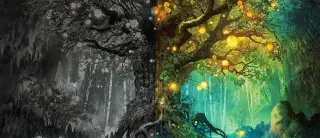
The Feywild and the Shadowfell are both two sides of the same plane, sometimes collectively called Mirrorworld. They are both reflections or echoes of the material plane of Abmarah, all together forming the Primerealm. Often considered separate planes, they are actually connected through various border zones called the Shadow-Wild or the Fey-Fell.
The Feywild acts much like the Feywild as described in the standard cosmology of the Dungeon Master's Guide or other sourcebooks, with the exception that the plane is connected to the Shadowfell which acts similar but much different to the traditional D&D cosmology. The shadowfell and Feywild are two sides of the same coin, and you can essentially walk from one to the other.
The Feywild
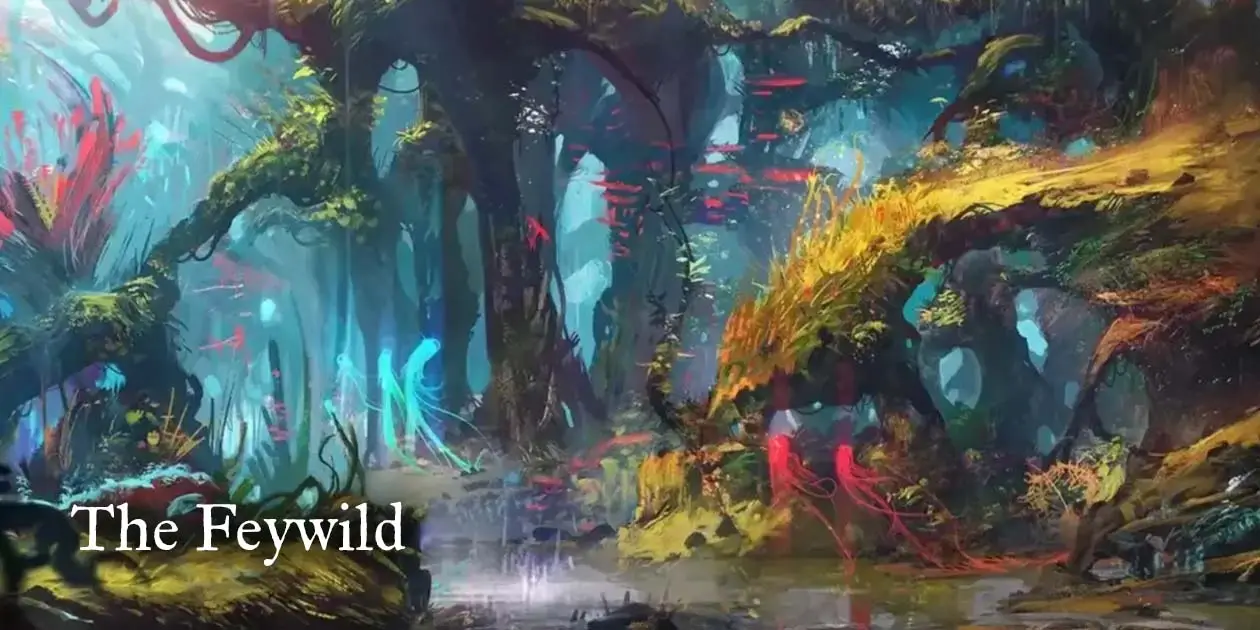
The Feywild was a place of unrestrained and awe-inspiring natural beauty. The 'positive' and 'light' reflection, it is the plane from which fey originated and is the original homeland of the Elves. Governed by Archfey divided into Seelie and Unseelie courts, the Feywild is considered to be overflowing with magic. Many gods govern the Feywild, such as Deltus, Nosos, Serenox, Aklim, etc. There are countless settlements of fey and non-fey alike within the plane, such as Summermeet, Thither, etc.
The plane is always bathed in twilight of the setting (or perhaps rising) sun, with lanterns and fireflies providing additional, haunting lights. Visitors to the plane found that all sensations, both sensory and emotional, were heightened. Smells were stronger, colors were more vivid, and sounds were clearer, but at the same time shadows were darker and impulses were harder to control. Strong emotions even altered the landscape of the Feywild itself, wilting flowers trailed the despondent or furious and carefree animals traveled alongside chipper and cheerful individuals.
As an "echo" of the Prime Material plane, its geography was similar although not entirely identical to that of Abmarah, but the natural landscape was markedly more dramatic and beautiful in the Feywild, with mountains standing straighter and sharper, rivers flowing clearer and faster, flowers bloom brighter and more fragrantly, and weather manifesting in supernatural ways. While most Prime locations and landmarks had analogues in the Feywild, sites of civilization in the Prime could be so unimportant in the Feywild as to be easily missed, while natural landmarks might be significantly more majestic or extreme. A large exception to this rule is the city of Summermeet, often said to be a direct mirror of the city of Sombus. Navigating the Feywild was further complicated by the fact that distances did not always make sense. While two landmarks might be the same distance apart as in the Prime when travelling in one direction, they might be inexplicably further or closer on the return trip.
Further complicating any visit to the plane was that time did not flow the same in the Feywild as on the Prime. While any visitor would experience time flowing as normal, it was often the case that more time was passing in the Prime, sometimes on the order of weeks, months, or years longer than expected, although it was also possible for little or no time to have passed instead. More concerning, leaving the Feywild could have dire consequences. Lost time could suddenly "catch up" to a mortal, sending them into fits of exhaustion or hunger, or even killing them instantly if many years had passed. At the same time, those with no fey ancestry might find their memories of time spent in the Feywild going hazy, if not vanishing altogether.
The Shadowfell
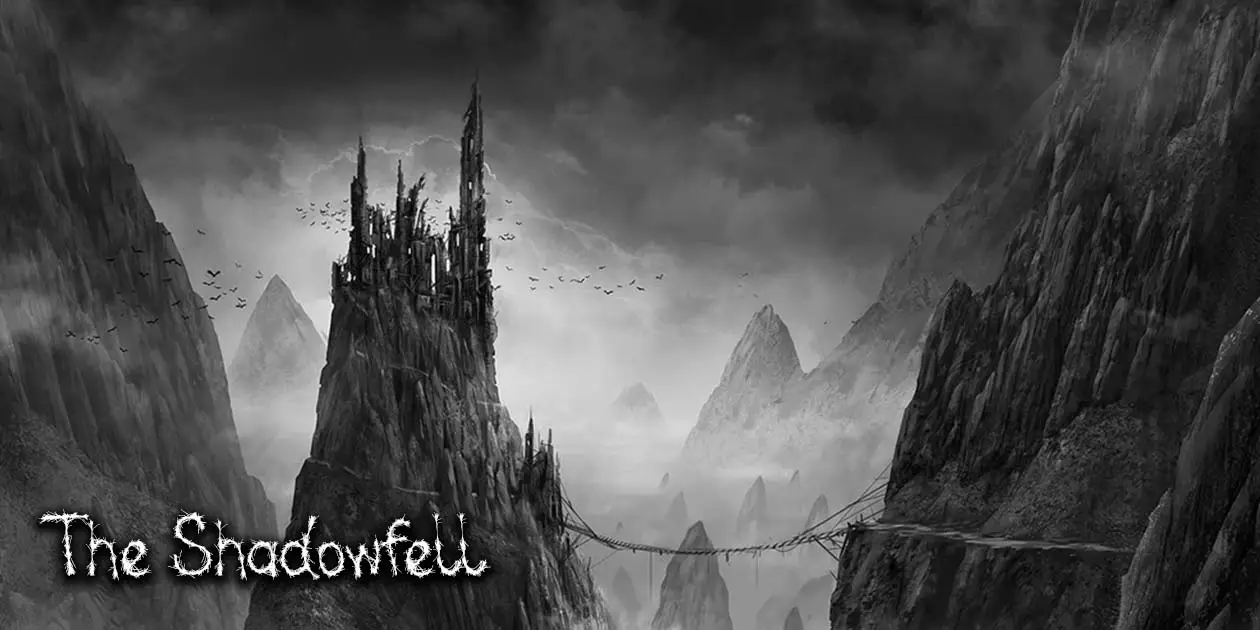
The Shadowfell existed as sort of a counterpart to the Feywild, in the sense that it was a reflection, or "echo", of Abmarah. Unlike the Feywild, it was a bleak, desolate place full of decay and death. Dark, dim, gray, it leeches color out of reality. It isn't simply a lair of evil, it hosts good and bad much like the Feywild does. It's defining feature is the lack of hope and overwhelming despair that pervades its entirety. Corrupted fey, undead, shadow-elves, and lost souls all make their homes in this plane. Many gods hold influence over it, such as Morgariel, Nosos, Gammus, etc.
During the churning chaos of the Realmshatter when realms merged and mixed, an eladrin witch discovered the pure darkness. She sought to corrupt her brethern to the darkness as well, and many minor gods and elves alike followed her dark witchcraft. With the power of the pure dark, she became its herald, now called Morghos. She focused the darkness into an artifact, a scepter, with which she started to cast her ultimate spell. Around the cauldron of darkness, she and her followers started to corrupt the Feywild itself and ascend Morghos into godhood. The armies of the Seelie court intervened, aided by many gods with the key ones being the elven creators, Deltus and Serenox. With the two major gods commanding the battle, the witch's forces lost, and the spell was interrupted. With her powers, the lady Serenox cut off the half-corrupted half of the Feywild, and essentially created the Shadowfell. Lord Deltus bound Morghos in great divine chains, sealing the witch away within the heart of this new Plane of Shadow. Additionally, the archfey elders broke her scepter into three halves, for they could not destroy its darkness. Half of Morghos' followers joined the Unseelie, while the other half remained in the Shadowfell, becoming Shadow-Elves. Morghos still has her followers, often called the Dark Hunt.
The most striking and immediate impression a visitor to the Plane of Shadow experienced was the lack of color and light; no sun, moon, or stars adorned the vault of the inky black sky, and all things looked as if the color had leeched out, leaving nothing but black and white, which in the dimness were more like "dark black" and "light black". A light source only illuminated half the distance it normally would, flames and fires put out less heat, and spells that dealt with light or fire were less predictable and prone to failure, whereas shadow spells were enhanced. On the other hand, although it would not illuminate as far, any light source on the plane could be spotted at a distance of up to ten times its normal range of illumination, such was the contrast to the constant gloom, similar to a star in the night sky.
Gravity and time were the same on the Shadowfell as on the Prime, but because the Shadowfell was magically morphic, the landscape was a dark, twisted echo of what existed on the Prime. Landmarks were usually recognizable but altered in some bizarre way: buildings might be constructed in a different style, built with different materials, at a different location, and/or in any condition from dilapidated ruins to its normal appearance, for example, or otherwise strange and distorted. Tall mountain ranges on Abmarah are eroded into hills in the shadowfell. Great rives become struggling streams, forests become fields of dead trees. Reefs of dead coral, volcanoes with no lava, skies without suns or stars, the shadowfell is an overwhelming pit of despair moreso than evil. Similar sites were sometimes called "shadow-analogues". Due to the ever-changing landscape, the Shadowfell was subject to relatively frequent but very small earthquakes called shadow quakes. Some areas seemed to have an affinity with the Negative Plane and life-draining undead such as shadows, ghosts, and vampires. These "darklands" caused unprotected visitors to immediately feel the life force being sucked from their bodies—unless they exited the darkland quickly, all that was left of them was a pile of ash. Someone with protection from negative energy could stop and admire the utter desolation in an otherwise forlorn landscape, and perhaps make the acquaintance of the truly inimical undead. Thankfully, no natural vortices opened into darklands regions, preventing the unwary from stepping through into almost certain death, and keeping the creatures that thrived there from having easy access to other planes. Material Plane locations such as desecrated burial mounds, haunted battlefields, and necromantic foci frequently had a darkland echo on the Shadowfell.
The morphic nature of the Shadowfell could produce strange effects, mainly in areas like the Black Rift that were especially morphic, and with events that had a particular affinity with the plane, like death. For example, a pile of bodies caused more skeletons to appear, until there were thousands. More bizarre were the strange biers upon which dead bodies spontaneously appeared, apparently drawn from wherever they rested, anywhere in existence, only to disappear after a few seconds, presumably to wherever they'd come from. Stalactites in a cave dripped ephemeral shadowstuff, which was reabsorbed into the plane rather than form a puddle. Even common mushrooms bore realistic humanoid faces, capable of twitching or blinking. More significantly, forests of grasping tendrils sprouted from some surfaces and reached for passersby victims.