Elves are generally similar to their regular D&D counterparts as found in the Player's Handbook.
Elves are a magical people of otherworldly grace. Elves love nature and magic, art and artistry, music and poetry, and the good things of the world. With their unearthly grace and fine features, elves appear hauntingly beautiful to humans and members of many other races. They are slightly shorter than humans on average, ranging from well under 5 feet tall to just over 6 feet. They are more slender than humans, weighing only 100 to 145 pounds. Males and females are about the same height, and both rather feminine.
Elves' coloration encompasses the normal human range and also includes skin in shades of copper, bronze, and almost bluish-white, hair of green or blue, and eyes like pools of liquid gold or silver. Elves have no facial and little body hair. They favor elegant clothing in bright colors, and they enjoy simple yet lovely jewelry. Their eternally adaptable nature has given rise to numerous subraces, more so than most other races as they fit in to any environment.
In Abmarah, Elves have a lifespan of around 400 years, some of them even living up to 750 given magical means. This gives them a broad perspective on events that might trouble the shorter-lived races more deeply. They are more often amused than excited, and more likely to be curious than greedy.
They tend to remain aloof and unfazed by petty happenstance. When pursuing a goal, however, whether adventuring on a mission or learning a new skill or art, elves can be focused and relentless. They are slow to make friends and enemies, and even slower to forget them. They reply to petty insults with disdain and to serious insults with vengeance. Like the branches of a young tree, elves are flexible in the face of danger. They trust in diplomacy and compromise to resolve differences before they escalate to violence. They have been known to retreat from intrusions into their homes, confident that they can simply wait the invaders out. But when the need arises, elves reveal a stern martial side, demonstrating skill with sword, bow, and strategy.
Elves take up adventuring out of wanderlust. Since they are so long-lived, they can enjoy centuries of exploration and discovery. They dislike the pace of human society, which is regimented from day to day but constantly changing over decades, so they find careers that let them travel freely and set their own pace. Elves also enjoy exercising their martial prowess or gaining greater magical power, and adventuring allows them to do so. Some might join with rebels fighting against oppression, and others might become champions of moral causes.
Elves of Abmarah
The elves of Abmarah were originally called the “Alves”, or “Alfs”. They were Eladrin of the Feywild, created either from a cloud of Elder Kosmos’ own gaseous body full of cosmic primordial energy, or by the elven creator gods Deltus and Serenox. Most elves on Abmarah hail from the “Imperium Alvanum Aeternum”, the elven homeland on the planet from where they spread and diversified into the various lineages. Their eternally adaptable nature has given rise to more lineages than most other species as they fit into any environment. The first High-Elves of Abmarah later diverged into the Sun-Elves and the Moon-Elves. Later still, groups of elves would diverge to form the Wood-Elves, the Dark-Elves (Drow), Sea-Elves, Astral-Elves, Sand-Elves, and so on. They believe in the entire pantheon (and as such venerate Jakuna as their prime goddess) but choose Deltus and the late Serenox as their patron deities.
An Elf character has the same traits as found in the SRD or the Player’s Handbook, with the following lineages added/changed:
Lineage | Level 1 | Level 3 | Level 5 |
|---|---|---|---|
High Elf (Sun & Moon Elves) | You know the prestidigitation cantrip. Whenever you finish a Long Rest, you can replace that cantrip with a different cantrip from the Wizard spell list. | detect magic | misty step |
Wood Elf | Your Speed increases to 35 feet. You also know the druidcraft cantrip. | longstrider | pass without trace |
Drow | The range of your Darkvision increases to 120 feet. You also know the dancing lights cantrip. | faerie fire | darkness |
Sunless Drow | Once per short rest as a reaction, you can give a creature within 30 feet of you Disadvantage on any D20 Test. You can choose to do this after the result of their initial roll. You also know the light cantrip. | sanctuary | web |
Sand Elf | You have advantage on Constitution saving throws made to avoid exhaustion as a result of extreme heat. In addition, you do not have disadvantage on Wisdom (Perception) checks in sandstorms. You also know the minor illusion cantrip. | silent image | blur |
Snow Elf | You gain Resistance to Cold damage. In addition, you have Advantage on Constitution saving throws made to avoid exhaustion as a result of extreme cold. You also know the ray of frost cantrip. | ice knife | gust of wind |
Sea Elf | Friend of the Sea. Aquatic animals have an extraordinary affinity with your people. You can communicate simple ideas to any Beast that has a swimming speed. It can understand your words, though you have no special ability to understand it in return. | N/A | N/A |
Shadow Elf (Shadar-Kai) | Blessing of the Shadowfell. As a Bonus Action, you can magically teleport up to 30 feet to an unoccupied space you can see. You can use this trait a number of times equal to your proficiency bonus, and you regain all expended uses when you finish a long rest. Starting at 3rd level, you also gain Resistance to all damage when you teleport using this trait. The Resistance lasts until the start of your next turn. During that time, you appear ghostly and translucent. | Blessing Upgrade | N/A |
Star Elf (Astral Elf) | Astral Fire. You know one of the following cantrips of your choice: dancing lights, light, or sacred flame. Intelligence, Wisdom, or Charisma is your spellcasting ability for it (choose when you select this race). | N/A | N/A |
They have many subraces seen across the world of Abmarah:
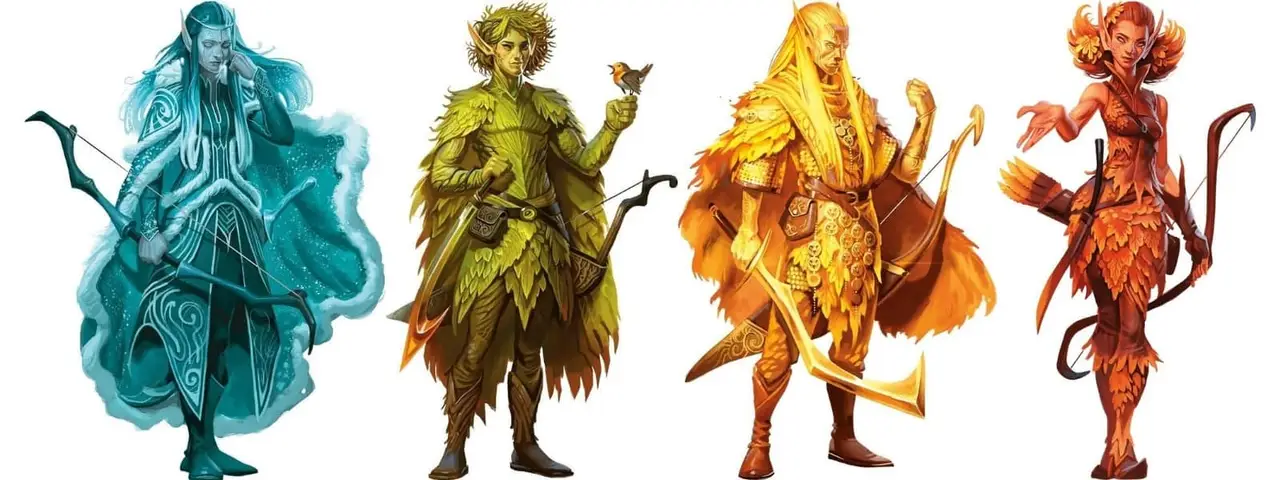
Eladrin (Alves). The original Elves from the Feywild, they are also known as the Alves. Eladrin can step from one place to another in the blink of an eye, and each eladrin resonates with emotions captured in the Feywild in the form of seasons- affinities that affect the eladrin's mood and appearance. An eladrin's season can change, though some remain in one season forever. They use the Eladrin statistics as presented in Monsters of the Multiverse.
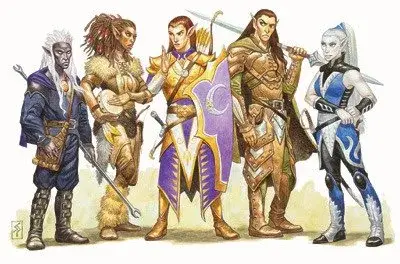
High-Elves (Sun-Elves & Moon-Elves). Often considered to be the 'default' elf, the High Elves are actually two different subraces. Sun-Elves or Gold-Elves are haughty and reclusive, believing themselves to be superior to non-elves and even other elves. Moon-Elves or Silver-Elves are more friendly and mix well with others, known to be good natured and joyful. Both of them call the Aeterian Islands their homelands but have spread across Aurial and the rest of the world.
Wood-Elves. Generally reclusive, Wood-Elves are found in woodlands and jungles across the planet. They have keen senses and intuition, and their fleet feet carry them quickly and stealthily through their native forests. They see themselves as the guardians of their enclaves, and unlike high-elves they don't view themselves as a people apart from the rest of Abmarah. Though some wood-elves may be found in any forest, most of their society is clustered in the Olymbian Woodlands, the Xoenni Peninsula, the Goldheim Rainforest, and a few minority groups in Teer.
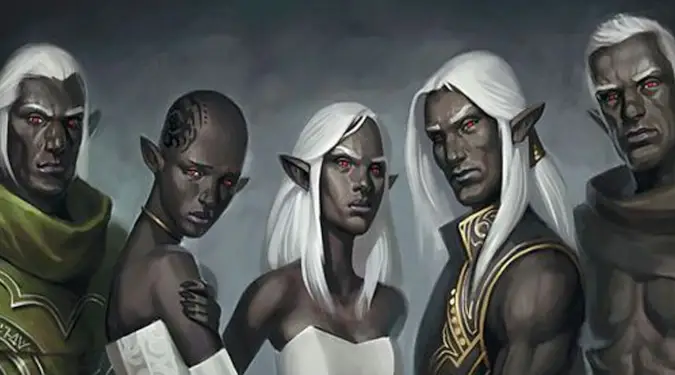
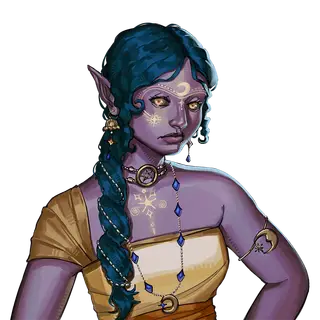
Dark-Elves (Drow). Infused with the magic of the Underdark, the moon-elf followers of Serenox became the Dark Elves. They are at home in shadows and, thanks to their innate magic, learn to conjure forth both light and darkness. They follow a harsh matriarchal society and are generally distrusted on the surface. That being said, in Abmarah there are two different subraces of Drow: The classic 'Moonless-Drow' and the 'Sunless-Drow'. The Moonless-Drow or the Under-Drow, usually simply just called Drow, are the stereotypical and most common of the two subraces found across the Aurian Underdark. The Sunless-Drow or the Court-Drow are a distinct branch of dark-elves who dwell in the arid badlands and cave systems of eastern Eteru and northern Eqos with a minority population in Teer. Unlike their subterranean kin, the sunless-drow are adapted to life on the surface and have developed unique customs and traditions. The continent of Eteru once had an Underdark like any other land, until part of the surface collapsed into the Underdark during the cataclysmic omniborn crisis. This turned much of the continent into badlands, and exposed the drow there to the harsh surface. Their foreign society, known as the “Mourning Court”, developed a new culture of venerating the moons and scorning the sun. Many of these new surface-dwelling drow migrated to northern Eqos, spreading across the Undead Sands, the Km’mala Peaks, as well as the Kav’orra Desert. Despite their reputation as reclusive and insular people who practice dark magic, the sunless-drow are obviously not inherently evil. They value community and cooperation, and work together to protect their newfound lands and traditions. While they do venerate spiders, they do so simply as a lasting remnant of the wider drow culture that persisted in the ancient times. Over time, the sunless-drow have intermingled with the sand-elves and gained many of their characteristics such as facial hair on males and a resistance to the desert. Their society is organized around individual families. While matriarchal and culturally esoteric like other drow societies, the sunless-drow integrate well into other cultures. However, many make them feel more like a migrant immigrant community within Eqos even after a thousand years of assimilation. They have a rich artistic tradition, with skilled weavers, potters, and jewelers creating intricate works of starry art that reflect the beauty and richness of their customs. In recent years, the sunless-drow of the Kav’orra have faced discrimination from the Church of the Black Sun for their veneration of the moons.
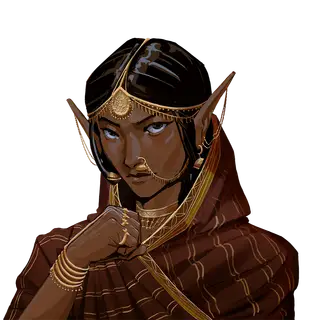
Sand-Elves. The Sand-Elves are a lineage descended from high-elves that dwell in the deserts of Eqos. They are found from coast to coast, from the Undead Sands through the Kav’orra Desert and the Vyzum Wastes down to the Ashen Coast. Their skin tones range from rich bronze or mahogany to darker earthen browns. Their hair is typically dark, ranging from black to deep brown often decorated with intricate braids, beads, and jewelry. Unlike most other elves, it is common to see light facial hair and rugged features on male sand-elves, as the harsh environment is ill-suited to the typical soft elven skin. They usually dress in lightweight, flowing garments of silk and cotton, decorated with colorful embroidery and intricate patterns. Despite the challenges of living in such a harsh environment, the sand-elves are a resilient and resourceful people. They are able to traverse the desert sands with ease and strike their enemies from a distance with deadly accuracy. Their societies are found primarily around oases and rivers where they maintain the fragile ecosystems of the dunes. Deeply spiritual, they worship the natural world and the spirits of their ancestors. While the desert seems barren to human eyes, it has an interconnected web of life that the sand-elves help maintain. Many of them are skilled in divination, able to read the signs of the desert and interpret the movements and fates written in the stars. The sand-elves are by far the most common lineage of elves on the continent of Eqos, and are not monolithic in their culture. Their culture is that of the cities and nations they call home, even if they might have their own rituals and traditions on top. A sand-elf from the Ashen Coast might have a more arabian-inspired culture, while one from Kasaaq would feel distinctly indian-inspired.
Snow Elves. Generally found in the cold, northern continents of Skion and Teer as well as a few in northern Aurial, the snow-elves are a rather isolated lineage of elves and relatively less populous. Once numerous, they were one of the hardest hit during the Realmshatter and the Omniborn Crisis. Now, their populations are trying to restore their rustic and harsh way of life, clinging onto their northern culture and trying to not let their practices be replaced by that of other elves or the humans that they share their continent with.
Sea-Elves. These elves fell in love with the wild beauty of the ocean in the earliest days of the cosmos. Aquatic elves are the least magical of the elven subraces and have fewer innate magical gifts. However, they are deeply in touch with their environment, even more so than other elves. Today these elves can be found wherever oceans exist, as well as in the Elemental Plane of Water. Most sea elves on Abmarah are found in the Aethian Dominion alongside Tritons. They use the Sea Elf statistics as presented in Monsters of the Multiverse.
Shadow-Elves (Shadar-Kai). Elves who chose to stay in the Shadowfell after its creation, they have been corrupted into a strange state between life and death. Eladrin and shadow elves are like reflections of each other: one bursting with emotion, the other nearly devoid of it. They are rarer on Abmarah, where they are often confused with Drow. Many of them have bound themselves to the service of the goddess of corruption, Nosos, or the chained beast, Morghos. They use the Shadar-Kai statistics as presented in Monsters of the Multiverse.
Star-Elves (Astral Elves). Long ago, groups of elves ventured from the Feywild to the Astral Sea to be closer to their gods. Life in space has imbued their souls with a spark of divine light. That light manifests as a starry gleam in an astral elf's eyes. Because nothing ages on the Astral Plane, astral elves who inhabit that plane can be very old, and their longevity gives them an unusual perspective on the passage of time. They use the Astral Elf statistics as presented in the Astral Adventurer's Guide.