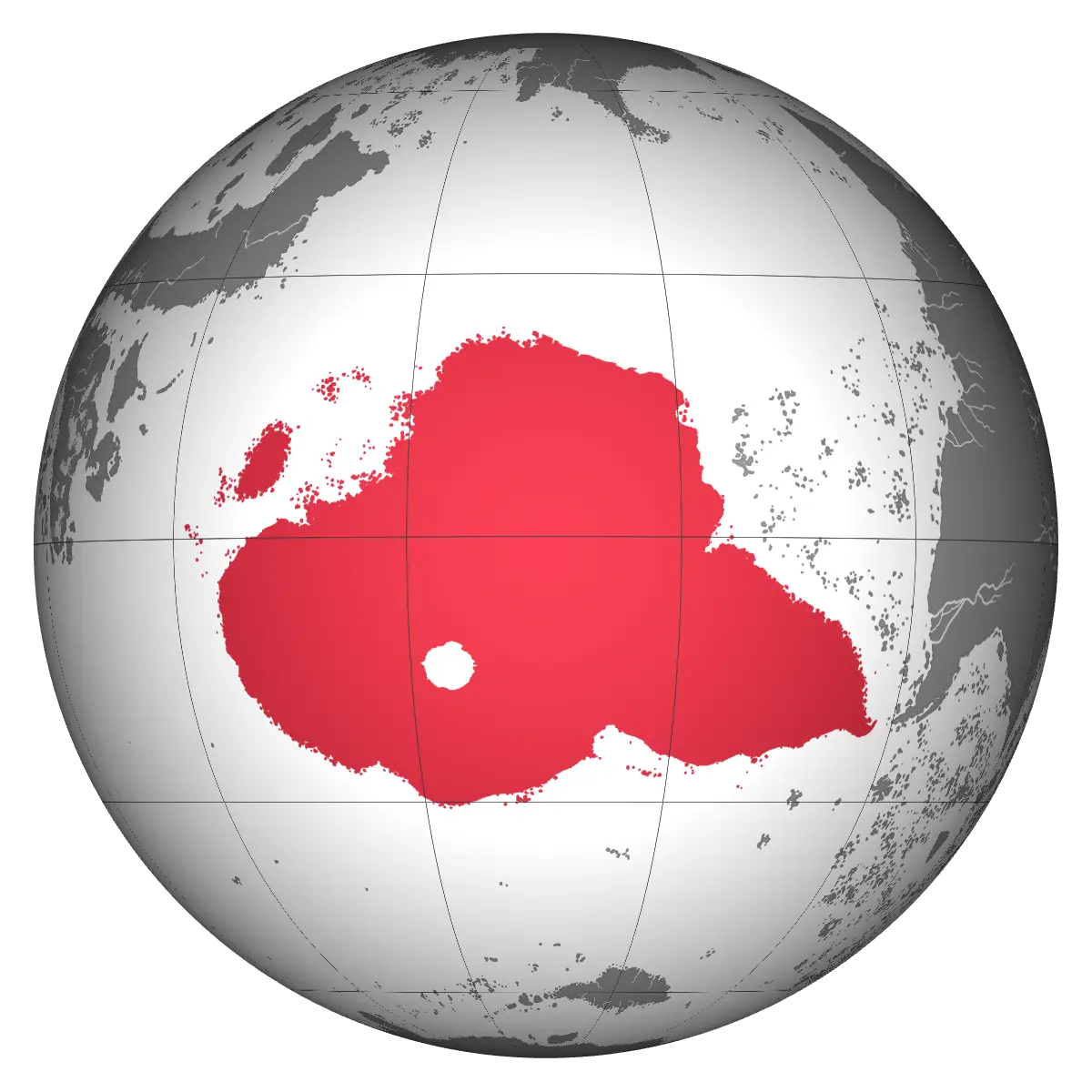
Eqos (Ikos, इकोस, ایکوس, ইকোস, ꯏꯀꯣꯁ, ཨེཀོས, ਈਕੋਸ, ഇകോസ്, ஈகோஸ், ᛂᚴᚮᛌ, Экос) is one of the main continents on the world of Abmarah. As one of the most widely diverse continents in Abmarah, Eqos has rich traditions and beliefs not found elsewhere on Abmarah. Often considered to be the ‘western’ continent of Abmarah due to aurio-centrism, Eqos has often been described as the birthplace of mortalkind. It features vast swathes of grasslands and savannahs known as the Edeni Expanse, as well as harsh deserts such as the Kav’orra Desert and the Vyzum Wastes. In its east, it contains the large supervolcano Kazarin Peak, while the western Goldheim Rainforest of Eqos is divided from the rest of the continent by the towering Km’mala Peaks. Most cultures and places on Eqos have been inspired by african, middle-eastern, and south asian sources, but do not aim to be an accurate representation of real-life beliefs and customs.
Climate and Seasons
Much of Eqos lies in the equatorial and tropical latitudes of the planet, which makes the continent hotter than others. Half of the continent is covered in wastelands and deserts, while the other half is a wide expanse of savannah. The only exception to this is the tropical Goldheim Rainforest on the other side of the mountainous Km'mala Peaks.
The different regions of Eqos all experience seasons differently, with the tropical southwestern rainforests having frequent monsoons, while northeastern deserts suffer from mostly dry seasons. The Kav'orra Desert has cool to cold winters and hot summers, with very little rain. The Edeni Expanse has generally two extremes between wet and dry seasons that vary along its length. The Goldheim Rainforest has horrible heat in the summers depending on the elevation, with humid and sticky coasts. It has a harsh monsoon with heavy rainfall, leading into a cool and pleasant winter. The Km'mala Peaks tend to stay cool and arid, with the temperature only getting too cold in the winters.
Holidays
The different regions of Eqos celebrate different holidays, but many of these festivities are common across the continent and beyond such as holy days. Some of the notable holidays in Eqos include the following:
First Rise. Celebrated on the first day of Dialosi, it marks the beginning of the new year and is considered to be an occasion to spend with family or loved ones. Often lumped into Hearthlight festivities in the modern day, it used to be a holy day of the goddess Tauma.
Cometrise Festival. Celebrated on the 8th of Skyfall, it marks the appearance of the annual meteor showers in the skies of Abmarah. With consistent meteorite and comet impacts onto the planet, this marks a holy day for the worship of the goddess of stars, Saedevi. It is considered extremely important for the safeguarding of the realm, and even priests of other gods are expected to follow through and organize Cometrise prayers.
Shadowsky. The 16th of Skyfall is regarded as a dark day remembering when the forces of the Shadowfell invaded the skies of Abmarah more than five centuries ago. It is important to the fey and those who worship shadow.
Seedfey. The 14th of Greenrise is considered to be the first day of spring in the northern hemisphere of Abmarah. While it does not affect the Kav’orra as much, it is still a notable holiday in the Rethi Riverbank for many farmers.
Lunar Independence. Celebrated on the 12th of Freki, it is an important holiday in the Lunar Kazarin Protectorate as on this day in 3E223 the Lunar Collective won its independence from the Crimson Empire after the decisive Battle of Titanigrad and wrote their constitution.
Vyzumaza. Similarly, the 28th of Freki is celebrated by the people of the Vyzum Wastes as the day they gained their independence from the Kasaaqi Hukumat in 3E429, only a few decades ago.
Kasaaqi Artisans Fair. Held annually for a few days starting on the 10th of Vani, traders from across the world gather in the streets of Chaadar Chowk in the city of Kasaaq for the fair. While it has many festivities, it is primarily a trading festival in which nobles and merchants gather to exchange cultural goods from all over the world.
Midsummer Festival. Celebrated on the 2nd of Midsummer, it marks the titular middle of the summer season. With the harsh deserts and humid forests of Eqos, summer is an especially harsh month that everyone is keen to get through. This festival is celebrated with cold drinks and communal gifting to enjoy the fact that they're halfway through the worst season of the year.
The Seven's Carnival. Held in the month of Midsummer every eight years in the city of Kasaaq, the Seven's Carnival travels through seven cities each year across the Ashfall and Blood Seas. They take a year of break in between each cycle, leading to the carnival only coming to the continent of Eqos once every eight years.
Highsun. Celebrated on the 4th of Sigmosi, it is the summer solstice in the world of Abmarah. It is given significant respect in northern Eqos, as it is considered the holy day of Sol Sultana, the goddess of the sun. The Church of the Black Sun organizes a great feast and sacrifice to Sol's name every year, awaiting the release of their imprisoned goddess.
Rethipuja / Tidemeet. On the 17th of Raintide, most coastal settlements in the world celebrate Tidemeet, the holy day of Sigdev, the god of the seas. It’s a day of familial celebration and partying for coastal communities as many sailors return home or enjoy drunken tavern celebrations wherever they are at the moment. In the Kav’orra, the day is celebrated as Rethipuja, in which people venerate Sigdev and the Rethi River as a whole. Celebrations and partying happens only after most people take a dip in the holy river and pray for less floods.
Noshmipuja / Nosalia Harvest Festival. Celebrated on the 26th of Nosali, it is the fall harvest festival in the northern hemisphere. It involves offerings and prayers to the malevolent fey goddess Noshmi, praying for her to not curse farmers with her blight and plagues. This festival is mostly held in farming communities across the world, and usually involves showcasing the best produce of the season. In the Kav’orra, it is mostly celebrated in the river cities where it’s called Noshmipuja.
Ashrest. Celebrated on the 20th and 21st of Duni, Ashrest Day and Ashrest Celebration are twin festivals that revere the ancestors and the dead. It is the only day in which people openly worship the gods of death such as Therahti and Raasha. Ashrest Day is a solemn day remembering all those who have passed away, with offerings to the dead. In case of war, the day often has mass funerals. It is followed by a day of celebration, in which people paint themselves in bright colors like the god Raasha and celebrate their ancestors and communities.
Jakusia. Celebrated on the 8th of Etasi, it is the holiest day for the worshipers of Jakuu. As the de-facto leader of the pantheon, she is one of the most important gods and is given a lot of respect. This day marks her victory over the forces of the hells long ago, and many plays are organized to showcase this mythological event. This also serves as a day of disrespect to Krros, as many idols of his are built and burnt in celebration.
The Valkani Games. Held on the 25th of Ekalos in one of four locations in the world, once every four years this gladiatorial and multi-sport tournament comes to the city of Kasaaq in Sol’s Sandpit. Named in honor of one of mythology’s greatest knights, the angel Valkan Zuriel, it sees the best of the best athletes fight for top spots in their fields. It is increasingly becoming a point of honor for nations to send their best fighters to gain the top spots.
Sitara Divas. The 5th of Varkosi marks a festival specific to Ashtadharma, Sitara Divas. It is a holy day for the worship of all the celestial gods like Saedevi, Mutreva, Sol Sultana, and even Koshmo Mahadev. After the ritual prayers, people light candles in their homes and then set diyas float in the Rethi River, making the river look like a galaxy at night.
Varkosi Arcanos. Celebrated on the 18th of Varkosi, it is the holy day of Varkayan, the blood god of magic and life. Much of the world which considers him to be evil despises the day, but it is celebrated with grand sacrifices and fairs in the holy city of Varkunast in Eqos. Magic seems to be stronger on this day, as the god of magic seems to fuel all mages on this day dedicated to him.
Hearthlight. Celebrated on the 19th of Deepfrost on the day of the winter solstice, it is a festival of family and blood bonds. People stay in their homes by their hearth's light, and celebrate getting halfway through the winter season. While winter is generally not too cold in Eqos, people still celebrate Hearthlight with zeal, as it is a day dedicated to spending time with loved ones.
Cultures & Languages
The following are the most prevalent and largest ethnic groups to be found in Eqos during the last two millennia. These mostly refer to human ethnicities, but contain many others of the various species found on the planet. Specific species subcultures are also stated here as well, though. Eqos has many languages unique to the cultures of its people. Instead of going for a single common language or species-based languages, we’ve opted to use regional languages instead inspired by real world languages. All the typical languages of 5e found in other books are also used and allowed in Eqos, such as Draconic and Primordial.
Old Eqosi / Edeni. Dark-skinned peoples found in Eqos, often said to be one of the first humans to exist. They are more likely to be the origins of modern humans, and many of them migrated over time into Aurial and Eteru. They spoke an old Primordial language long ago, but nowadays they are found across the Edeni Expanse and speak various real-life african inspired languages, although the most common one we use as a basis is Swahili, here called Edeni, written using the Arabic or Latin scripts due to nearby influences.
Rethori. Brown-skinned peoples found near the banks of the Rethi River in the Kav'orra Desert & Edeni Expanse. They have farmed in the floodplains for millennia, and have diversified greatly. They include the Kasaaqi, Rethvi, Dibayadi, Kav'orri, and Kaitzuri cultures in the modern day. The largest of these is the Kasaaqi culture based around the titular city, who speak the language Kasaaqi based on real-life Hindi-Urdu. The Rethvi speak the language Rethvi based on real-life Bengali, the Dibayadi speak the language Dibayadi based on real-life Persian, the Kav’orri speak the language Kav’orri based on real-life Marathi, and the Kaitzuri speak the language Kaitzuri based on real-life Punjabi. Kasaaqi and Kav’orri are written using the Devanagari script, Dibayadi and sometimes Kasaaqi are written using the Perso-Arabic script, Rethvi is written using the Bangla script, and Kaitzuri is written using the Gurmukhī script.
Ammban. Influenced by the nearby Rethori culture group, the Ammban people are mostly darker-skinned desert-dwarves and humans that reside around the city of Ammba. They are well adapted to the harsh sun and rugged terrain, and are famous for their cuisine. Far different from typical dwarves as found in other lands and realms, they are inspired by real-life Rajasthani cultures and speak a language called Ammban, based on real-life Marwari written using the Devanagari or Dwarvish scripts.
Varkosi. Brown-skinned peoples found on the southern coast of Eqos, mostly within the Varhamsat Khadumate. They speak a language calledVarkasi, based on real-life Arabic written using the Arabic script. Loosely connected to Varkosi but on the entirely different side of Eqos, the Shhaian subculture is a mysterious peoples found on the dark northern coasts of Eqos near al-Fahim.
Swarnan. A brown-skinned peoples named after the Swarna Authority, they are found within the Goldheim Rainforest of western Eqos. Inspred by the real-life dravidian cultures of southern India, they speak the Wesalam language, based on real life Malayalam written using the Malayalam script. They are also connected to the Vedar culture of Vanadweep, where the mostly vedavin population speaks a language called Vedar, based on real-life Tamil written using the Tamil script.
Magran. An ancient culture still followed by the dragonborn and humans of the Km’mala Peaks, they influenced the nearby Dibayadi and Varkosi cultures. A tribal culture used to the harsh mountains, they are said to protect the realm from invasion by the Elemental Plane of Fire. While they used to speak the classic Draconic language, these days they speak the Magran language based on real-life Tibetan written using the Tibetan script. A subculture in the northern peaks is known as Koorjei, based around the valley of Koorjing. They speak the language Koorjei based on real-life Meitei written using the Meitei script. Many of the dune-orcs who migrated to Eqos from Eteru adopted the culture of the peaks.
Kazareth. A hardy dark-skinned peoples, found in the ashen Edeni around the supervolcano Kazarin Peak. They are said to have descended from the Edeni peoples long ago. They have a subculture called Casaran, which is the group that expanded into the Ashfall Isles and adapted into a more seafaring tradition. They speak a language known as Casthic, based loosely on real-life turkic languages. A newer group called Zolan formed from the rapid colonization of the Casaran people by the Lunar Collective. Their culture, identity, and language have been forever changed under colonial rule.
Jamran. A mixed-species culture formed out of the largest city in the world, Jamre. The melting pot of culture, although originally Edenian, has formed a new identity separate from the rest of the Edeni Expanse. They speak various languages, although the most common one is called Jamran, based on real-life Zulu.
Vurmese. A fusion culture born when the varangian teerian adventurers from Jördheim invaded and settled down in the western coast of Eqos, and slowly merged with the local cultures within the Vurmark Raj. They speak a language called Vurmish based loosely on both Nordic and Burmese languages. It is written using either the Malayalam script, the Burmese script, or even the Runic script.
Vyzumi. A migrant culture of varying skin colors, formed by the settlers, refugees, and colonists that fled Aurial during the Great Aurian War and settled down in the Vyzum Wastes of Eqos amidst natives. They generally speak most nearby languages as well as Lunarian, the language of the Lunar Collective based on real-life Russian and Ukrainian, written using the Cyrillic script. They have a unique subculture known as the Junkers, who formed out of the city of Newhope where the Vyzumi residents started to believe in the scrapyard beliefs and inventive culture that the city is famous for.
Religion
While ancient Eqos had its own native religions that are still followed today such as Ahbara, Atakasi, and the Draconic religion, these faiths were mostly replaced or assimiliated into the Pantheon of Eights. That being said, Eqos does not follow traditional Jakunism, and is instead divided amidst Ashtadharma and Varkaniyyah. Smaller sects such as Solism and the Cult of Omegus also find their homes here.
Golden Triadism was brought to the continent in the third era by Lunar colonists and refugees alike, and has slowly spread across eastern Eqos within the Lunar Kazarin Protectorate and even the central Vyzumi Republic.
Currency
While all the different nations mint their own coins with figures and designs, all regions use platinum, gold, silver, and copper coins. While platinum is not used in everyday life, many richer merchants would readily accept it. While spending ancient coins gained from ruins might be a waste of their value in a collector's eye, gold is gold.
Electrum coins and other currencies are not minted in Eqos, but could be considered valid tender here if convinced. It is suggested to not use electrum coins in a Kasaaqi campaign.
Technology
The level of technology in Eqos is generally consistent with the rest of the world, and is set in a renaissance time period. Steam trains co-exist with horse-drawn carriages, and gunpowder is used in warfare alongside bows and arrows. It is suggested to use the firearms rules presented in the Dungeon Master’s Guide, using renaissance firearms such as pistols and muskets. It is also suggested to use the Artificer class from Eberron: Forge of the Artificer.
Technology continues to be improved upon, especially by Lunar and Vyzumi engineers. Advanced prosthetics, steam-powered war engines, and other such steampunk technology is available in cities such as Newhope and the markets of Kasaaq. Guns and explosives are seen as a way for mundane soldiers to combat spellcasters in war.
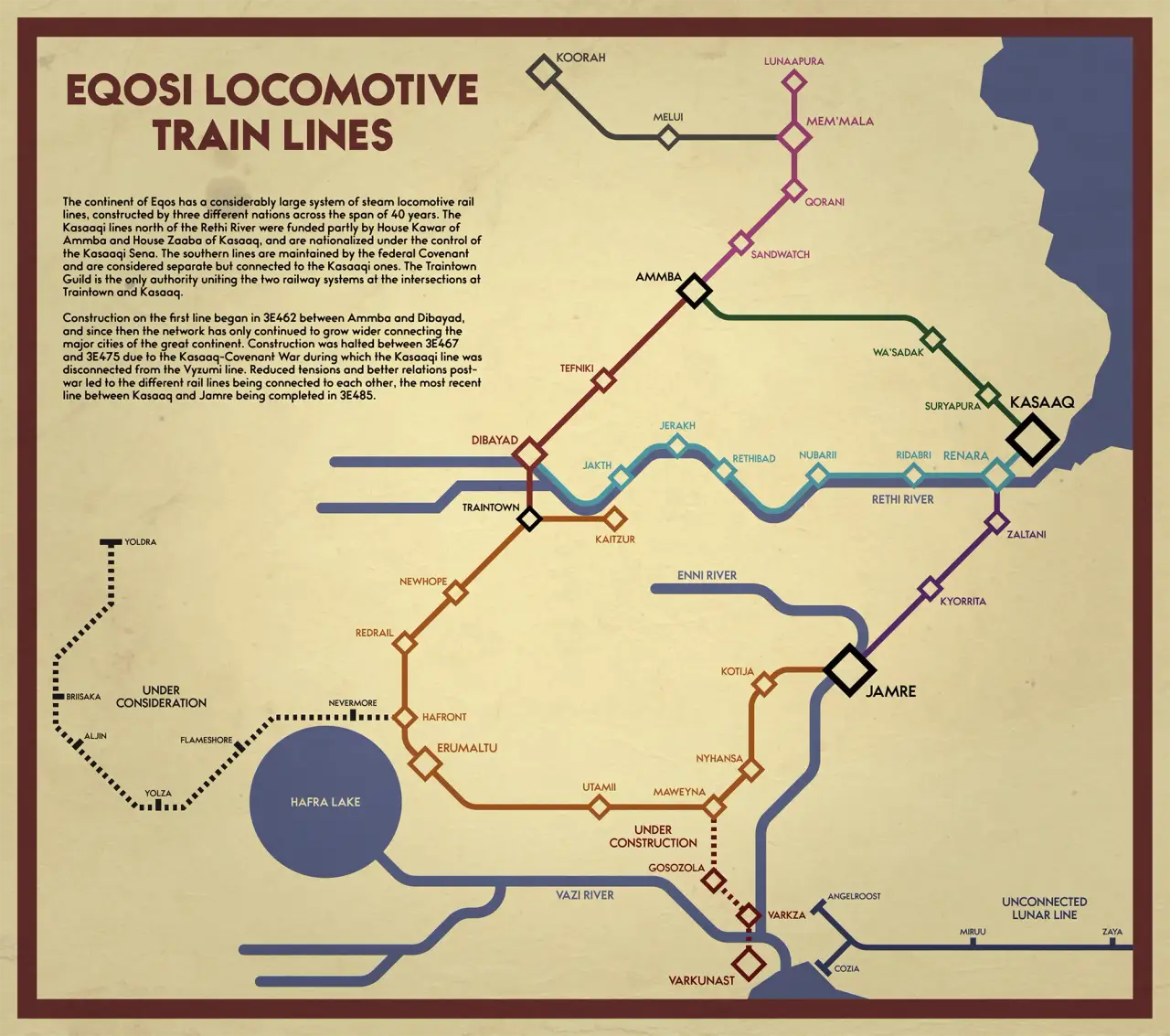
The continent of Eqos has a considerably large system of steam locomotive rail lines, constructed by three different nations across the span of 40 years. The Kasaaqi lines north of the Rethi River were funded partly by House Kawar of Ammba and House Zaaba of Kasaaq, and are nationalized under the control of the Kasaaqi Sena. The southern lines are maintained by the federal Covenant and are considered separate but connected to the Kasaaqi ones. The Traintown Guild is the only authority uniting the two railway systems at the intersections at Traintown and Kasaaq.
Construction on the first line began in 3E462 between Ammba and Dibayad, and since then the network has only continued to grow wider connecting the major cities of the great continent. Construction was halted between 3E467 and 3E475 due to the Kasaaq-Covenant War during which the Kasaaqi line was disconnected from the Vyzumi line. Reduced tensions and better relations post-war led to the different rail lines being connected to each other, the most recent line between Kasaaq and Jamre being completed in 3E485.
A third railway system exists within the Lunar Kazarin Protectorate, which is not connected to the other two systems and maintained only by the Lunar colonial government. This line was built in 3E472 connecting Furukiri on the east coast to the westernmost extent of Lunar territory near Angelroost.