
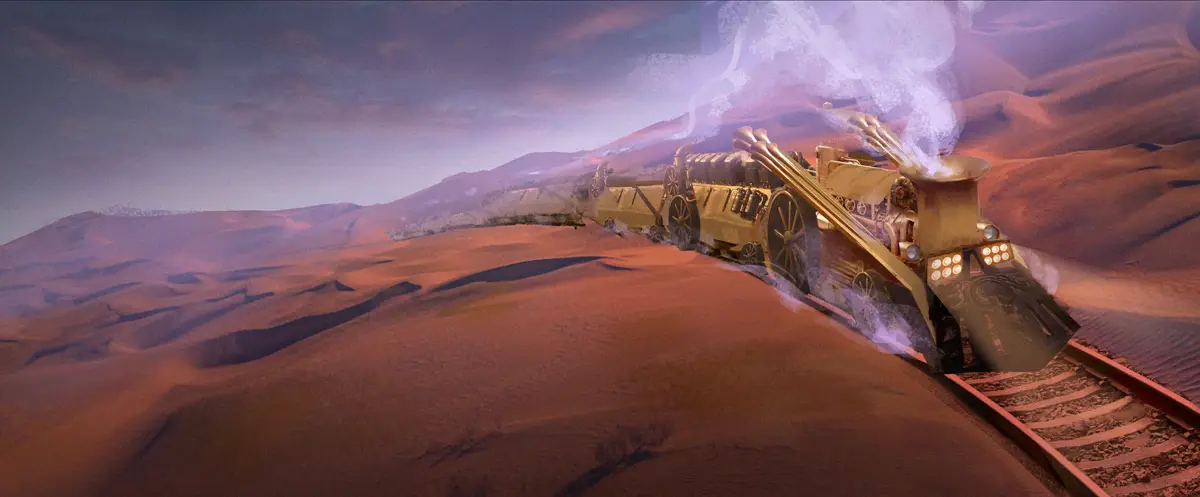
The Kav’orra Desert (कवोरा मरुस्थल or कवोरा रेगिस्तान) is a vast expanse of arid wasteland that covers almost the entirety of northern Eqos. It is a land of shifting sands and unrelenting heat, where the sun beats down mercilessly on all who dare to cross it. In contrast, night brings sheer cold and freezing temperatures. In daytime, the Kav’orra stays above 100°F (37°C) but has even gone up to 140°F (60°C) in select locations. At night, the temperatures drop to 25°F (-3°C) or lower. This desert is primordial, dating back to a time long before even the most powerful empires of the world existed. The sands of the Kav’orra Desert are said to be incomprehensibly old, unchanged and mostly uncharted with only a few relatively safe roads charted through it. Many who have tried to explore its endless sands have never returned, lost to the merciless dunes that seem to shift and move at will. It is a place of great danger, where even the most experienced travelers can quickly succumb to dehydration, starvation, or worse. Legend says that one day, as the sun continues to burn, these dunes will cover the entire world. Whether this is true or not remains to be seen, but the Church of the Black Sun preaches this apocalypse as a possible end of the world. They push for “desert pride” in the people who live in the Kav’orra, as they are hardy and are “born of the Sun”. This sentiment has been spreading as of late.
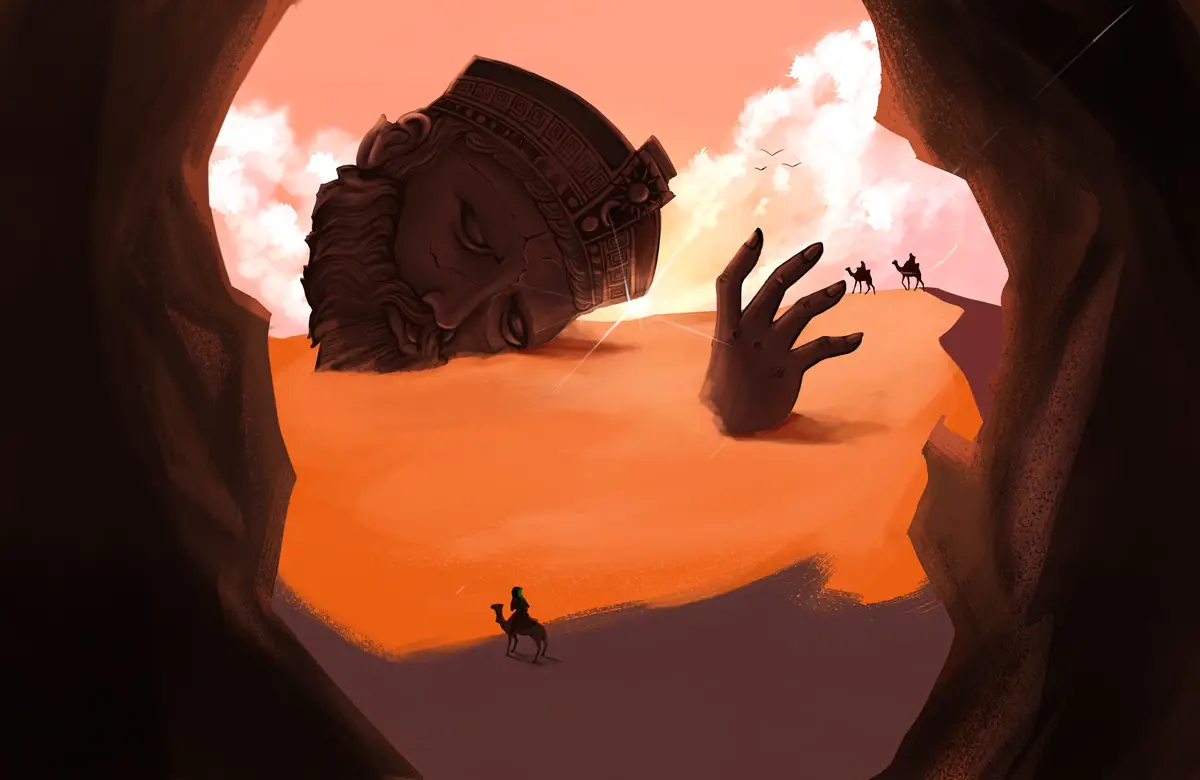
(Art credit: Jouweria)
Many divided nation-states have ruled over the Kav'orra, but most of the empires to control the desert were centered around the city of Kasaaq, originally known as Makhet. Some of these nations that we know of are:
The Kingdom of Namhet (1931 BR - 810 BR, 1121 years)
The Empire of Makhet (810 BR - 1E227, 1037 years)
The Surya Sultanate (1E227 - 1E898, 671 years)
The Suryag Sultanate (1E898 - 2E523, 602 years)
The Kasaaqi Dynasty (2E523 - Present, 583 years)
In opposition to these eastern empires, the western Kav'orra was ruled by:
The Kingdom of Namhet (1931 BR - 810 BR, 1121 years)
The Kingdom of Diburuk (810 BR - 1E287, 1097 years)
The Surya Sultanate (1E287 - 1E898, 596 years)
The Dibayadi Empire (1E898 - 3E205, 907 years)
The Kasaaqi Dynasty (3E205 - Present, 278 years)
The borders of the Kav’orra Desert are marked by natural landmarks. To the south, the Rethi River serves as a natural barrier, while to the west the Km’mala Peaks loom high in the distance. To the east, the Ashfall Sea provides a stark contrast to the endless “sea” of sand. At the heart of the Kav’orra Desert stands a lone mountain, known as Absorya Parbat (अबसोर्य पर्वत). Now housing the great city of Ammba within it, the mountain is one of the few visible landmarks that stands out in the desert from nearly anywhere. There is a smaller mountain to the north of the Kav’orra that separates it from the Undead Sands, the Ablunaa Parbat (अबलुना पर्वत) which is connected to the Km’mala Peaks via the Veiled Wall. If we view Absorya Parbat as the center of the desert, the western half of the Kav’orra is much less sandy and a lot more hilly & rocky as compared to the eastern half.
Despite its harsh and unforgiving environment, the Kav’orra Desert is not without life. Many creatures have acclimated to its scorching heat, including intelligent species such as Sand-Elves and Desert-Dwarves. Vicchus, Dune Orcs, and Bronze & Blue Dragonborn have also made their homes in the desert, creating small tribes amidst the dunes. In addition to these intelligent species, the Kav’orra Desert is also home to a variety of wildlife, from sand gazelles and giant scorpions to the legendary sandworms. These creatures have adapted to the extreme conditions of the desert, developing unique traits and abilities that allow them to thrive in this otherwise hostile environment. Deep within the Kav’orra Desert, there are also ancient gates and ruins that once led to the Feywild or the Shadowfell.There are some permanent roads connecting the various cities, and serve as the primary mode of transportation over land. Caravans of merchants and travelers use horses, camels, as well as rhinos as their mounts across the arid land. Airships sometimes fly overhead, and House Kawar has started to build steam train lines across the desert to better connect the cities to each other.
The species most commonly found within the diverse desert are: Humans, Sand-Elves, Desert-Dwarves, Dune-Orcs, Sunless-Drow, Dragonborn, Fire-Genasi, Tieflings, Panshera, Saurians, Vanara, Vicchus, Vedavin, Ursines, Minotaurs, Haanari, Khenra, and Aven. Less commonly you can also find Halflings, Gnomes, Aasimar, and other species within some cities.
Race Name | Kav'orri Name |
|---|---|
Farishtaar (फ़रिश्तार) | |
Garudi (गरुड़ि) | |
Alfi (अल्फि) | |
Dragon | Azhdar (अज़दर) |
Azhdav (अज़दव) | |
Kumbhar (कुम्भर) | |
Haanari (हानारि) | |
Vamanar (वामनर) | |
Vrshbhnar (वृषभनर) | |
Urukh (उरूख) | |
Pansher (पंशेर) | |
Maghar (मघर) | |
Danavin (दानविन्) | |
Bhallav (भल्लव) | |
Vanar (वानर) | |
Vedavin (वेदाविन्) | |
Vicchu (विच्छू) |
History
"These sands are ancient. Ancient beyond belief. They’ve been here since the sun was rejected, and love turned into dust. These sands were primordial even to the old empires, and they’ve outlasted the Realmshatter, my ancient Surya Sultanate, the war against the gods and the Cometfall that ended it, and now these sands watch the rule of the Kasaaqi Hukumat. Unchanged, uncharted."
—Sol Sultana, Goddess of the Sun
In the primordial era, the Kav'orra was a harsh and lifeless wasteland controlled by the Kingdom of Namhet, said to be ruled by Fire Giants. These Namheti Giants built great cities that have now been lost in the sands, buried and forgotten by civilization. When the Realmshatter started and the dragons and other species of the world started to appear, the Giants were challenged and their cities destroyed. The ancient Namheti were erased, replaced by the Makheti Empire and the Kingdom of Diburuk.
The Empire of Makhet was centered around the city of Makhet, which would one day be called Kasaaq. Instead of the indic culture that permeates the land today, it had a culture inspired by ancient egypt. They built great pyramids and temples along the river for their mighty panshera Pharaohs. Makhet lasted for more than a thousand years through four dynasties, although much of the continuity of this civilization is debated as records from the primordial era are full of holes and missing pages. Their religion mainly revolved around the worship of the Ancient Eqosi Gods, but the Pharaohs themselves claimed descent from the god Maaset, now called Murudev or Magmus. Makhet was rivalled in the west by the Kingdom of Diburuk. Centered on the legendary city of Diburuk (now Dibayad), the two cities were on the two opposing ends of the Rethi River. Dibayadi culture was more inspired by sumerian and later persian cultures in their aesthetics and beliefs, and was ruled by a line of minotaur lugals and shahs.
The line of Makheti Pharaohs was finally disrupted in the first era by the rise of Sol Sultana. A fiend-elf born with the name “Shhaya Surya”, the priests of Ahbara considered her to be a reborn avatar of the sun primordial, Sorya. The then-Pharaoh of the Makhet Empire, Mathep IX, had Shhaya raised in his court. She grew up like a sister to his son, Masret V, and taught by the legendary high priest of the city, Wakhotep the Serpent. Sol was almost deified by the local population and the other nobles within Mathep’s court, and eventually the praise, preferential treatment, and expectations started to get to her. She slowly developed a god-complex, and her ambition grew unchecked after the death of Mathep IX. Wakhotep taught her dark magic, and Masret V had him arrested and mummified alive for “demon-worship”. A nokrborn priest named Karkhai would later feed into Sol’s delusions of grandeur, and provoke her into rising up in a rebellion against her brother. She made a pact with the Titan of the Hells, Krros, and gained the control of his fiendish armies.
Seeking power, Shhaya would rise to become Sol Sultana. She waged a fiendish war against her former “brother”, Pharaoh Masret V. She caused an uprising of religious fervor centered on her, eventually murdering him herself as well as the rest of his family. Sol crowned herself as the new god-empress of a new Sultanate, and marked the end of the Makhet Empire. One of her first decisions was to rename the city of Makhet to Kasaaq. She started to bring in indic beliefs similar to the Varkunasam Forest in the west, and created the kasaaqi language replacing most of the old makheti influence over the region. She renamed the city as the indo-vedic culture started to truly replace the egyptian roots of the land. Taking over much of the continent in her conquest, Sol opened the eqosi gate to the elemental plane of fire, commanding legions of fire elementals and fiends alike. She even managed to subdue the Kingdom of Dibayad in her conquest. The omniborn crisis eventually reached her Sultanate as well, as she started thinking of herself on the same level as gods. She supported the omniborn in their rebellion against the gods who refused to acknowledge her divinity, and fought her armies for many decades.
The god-empress was prophesied to be taken down by an avatar of the moon, Lunaa. She destroyed the western kav’orran Queendom of Stearra, a magical city inhabited by moon-worshiping nokrborn, in an attempt to prevent the prophecy. Somehow, she died soon after during the crisis. Some speak of the god Murudev taking her down, or a betrayal by a close loved one similar to the primordial story of Abara and Sorya. Some say that Krros realized that she would never honor their pact and join him in the hells, and turned against her. Whatever the truth may be, she was sealed away by the gods into a demiplane prison for eternity—never to be reborn, as she had once wished. However, her worship continued to grow even as the Sultanate fell, and the Church of the Black Sun reveres her as their prime goddess to this date.
After Sol Sultana’s Surya Sultanate fell along with her at the end of the first era, control of the city of Kasaaq passed onto some of her remaining loyalists and family. A sand-elf named Zehir ud-Din Suryag claimed descent from Sol, and with his family’s money managed to take control of the city. He founded the Suryag Sultanate, proclaiming it to be the true successor state. However, it was only a city-state, instead of a continent-spanning empire. He founded the Mahaan House Suryag that would rule for five centuries to come. Like the rest of the world, the Kav’orra was now split amidst many individual city-state kingdoms. Creating much of the grandeur of the city, House Suryag flourished in this chaotic separation of the city-states with great infrastructure built by thousands of slaves. Kasaaq’s key location on the mouth of the great Rethi River allowed the city to flourish, as traders and merchants made the city an economic hotspot. The city’s location also allowed them an upper hand in trade relations with the rival upriver city of Dibayad. The Kasaaqi Artisan’s Fair was also established under the Suryag rule, an annual trade festival in which merchants from across the world gather. In this second era of history, the city became known for its luxury, spices, artisans, competitions, as well as the slave trade.
The history of the desert following the rise of the Zaaba Hukumat is noted down in the history section of the Kasaaqi Dynasty.