
Dibayad (दिबायाद or دیبایاد) is an ancient city that dates back to the earliest days of civilization. Situated on the western banks of the Rethi River, it was once a thriving legendary city that served as a hub for trade and commerce. It used to be the rival city to Kasaaq, but now is only a shadow of its former glory with most of its population wiped out. While more than hundred thousand residents is considered to be a large city already, it once housed nearly two hundred thousand residents much like Kasaaq at that time. The ancient city, once called Diburuk, was founded by minotaur kings called “Lugals” of the Dur dynasty. They ruled for over a thousand years until the city was taken over by Sol Sultana and incorporated into her Surya Sultanate. Later in her reign, she made a minotaur family, House Dabull, “Shahs” of Dibayad as her vassals. After her fall, they would then rule the Dibayadi Empire as “Shahanshahs”. However, after many years of wars and conflicts, the city fell under the control of the Kasaaqi Hukumat, and was ultimately razed to the ground by Mahataraja Kretu II during the Blackpowder War a century ago. Despite the devastation wrought upon it, the city of Dibayad remains a site of great historical and cultural significance, and efforts to rebuild and restore its former grandeur are slowly underway under the leadership of House Vokiro, its new rulers.
While much of the city still lies in ruins, there are signs of progress, with many of the city’s once-great buildings and monuments slowly being reconstructed. The funding for this rebuilding is also provided partly by the Church of the Black Sun, as it has created a significant presence in the city. The city’s architecture is inspired by persian and sumerian cultures, with grand ancient ziggurats and towering new temples dominating the skyline. The largest structure of the skyline is the ruins of the Labyrinthian Tower. The tower was once the seat of House Dabull and one of the wonders of the world, but after its ruin it was converted into a temple of the Church of the Black Sun. The winding streets are lined with shops and markets, and the riverfront is a bustling hub of activity, with boats and barges transporting goods and people up and down the Rethi River. Despite the years of conflict and destruction, the people of Dibayad remain proud of their city and its rich history. They are determined to restore it to its former glory and make it once again a center of culture, trade, and innovation. Its location has made it a hub for the steam railways that are spreading across the Kav’orra. With the train line connecting down south across the river into the Vyzum, as well as northward to the city of Ammba, the city is more connected than ever before and there is a plan to connect the city to Kasaaq in the future. There are many internal struggles though, especially between the native minotaur population and the newer panshera population that has immigrated into the city. With the destruction of House Dabull still fresh in the minds of many minotaurs, the two groups have an intense rivalry. Humans are definitely the minority in this city, and have had little to no influence over the course of its history.
Crime is a big problem especially in the ruined outskirts of the city that haven’t yet recovered from the destruction. Thieves’ guilds and organised crime groups run unchecked within the ruins, infiltrating into the alleys of the congested city and getting back out through secret passageways and tunnels. Despite that, the city is still safer than some of the other places in the Kav’orra as the city houses the largest Senaghar of the nation. A military complex, it has more than a thousand soldiers stationed at any given time with military presence only increasing as war looks likely with the Calamity Covenant. The city’s economy relies on trade and fishing, although mining and metalworking are a considerable industry within Dibayad due to the nearby mountains. Dibayad is famous for its “Dibayadi Steel”, which is forged similarly to the wootz steel of the Swarna Authority. It has developed a reputation for being tough, resistant to shattering, and capable of being honed to a sharp, resilient edge.
Areas of the city include:
(Art credit: DaoYi Chen)
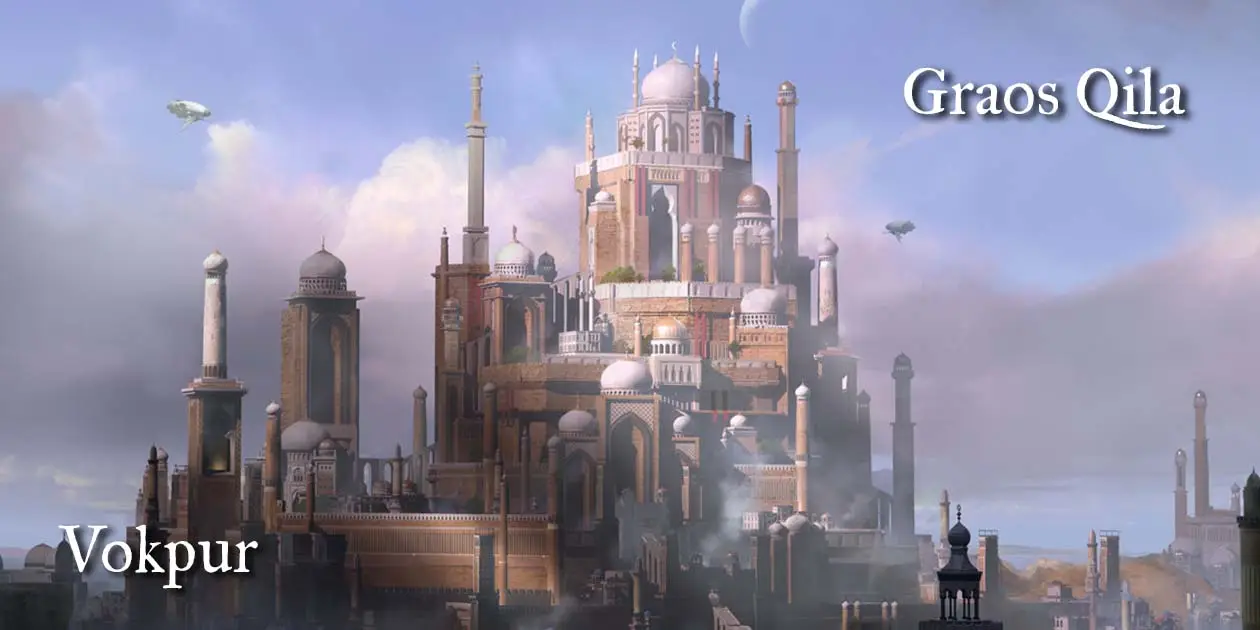
Vokpur. Situated atop a hill and within the walls of the city, Vokpur (वोक्पुर) is the aristocratic neighborhood and the center of power for House Vokiro, the new rulers of the city. It has been built in a somewhat more kasaaqi architectural style as compared to the rest of Dibayad. The district is home to the grand new palace of House Vokiro called Graos Qila which overlooks the rest of the city. While tall, it still isn’t as tall as the Labyrinthian Tower even after its ruin.
(Art credit: Raphael Lacoste)
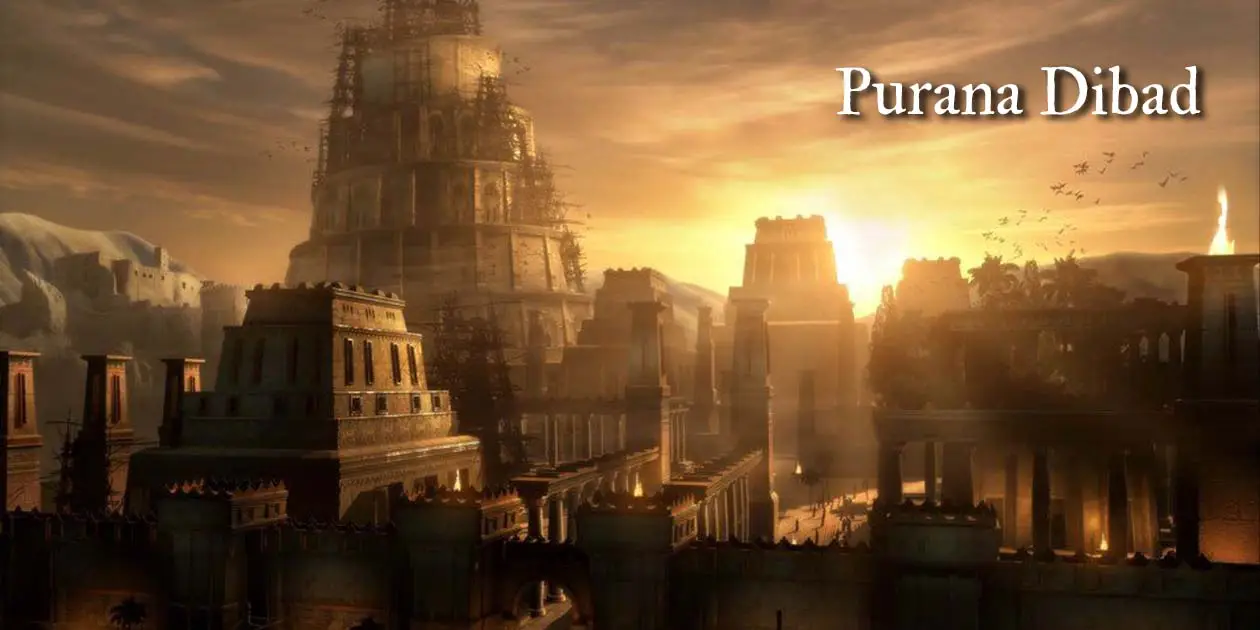
Purana Diburuk. The winding streets of Purana Diburuk (पुराना दिबुरुक) make up the old city and include the destroyed Labyrinthian Tower, which was once the seat of power for House Dabull. It still looms high above the city walls, visible from every direction. Since its destruction, the low-class neighborhood has been controlled by the Church of the Black Sun, who have taken on the task of helping to rebuild the city to further their influence. Some locations of interest include:
The Labyrinthian Tower, also known as the Burj Maaz (बुर्ज माज़ or برج ماز) is a gigantic tower going up towards the heavens. Once 800 feet tall in its prime, it used to be the tallest structure on the continent but only stands at about 500 feet tall after the destruction of the city. Once the palace of House Dabull, it is now a holy church of the Black Sun. Reconstruction by the church is in progress but incredibly slow and expensive. It was and sometimes still is considered to be one of the Eight Wonders of the World.
Dobundham, a decrepit temple dedicated to Dobun Mahadev, the elder god of doom and destruction. It was disuse for many generations even before the destruction of the city. Only maintained by a few priests, it has seen better days.
(Art credit: Borisut Chamnan)
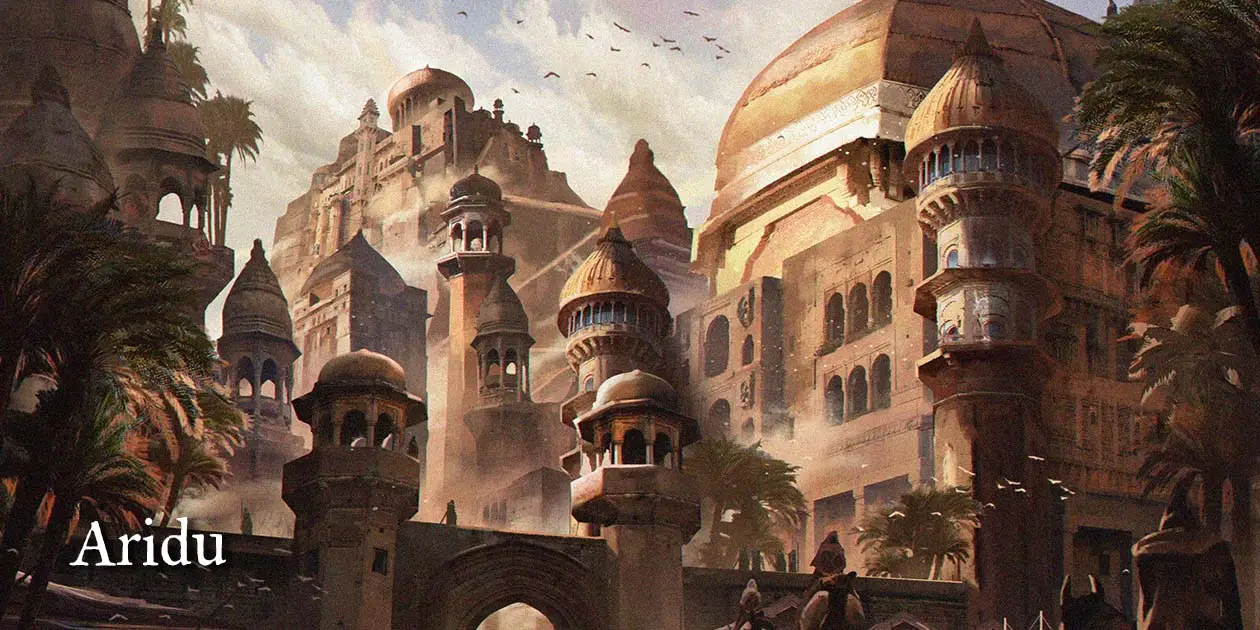
Aridu. The newer district of the city, rebuilt after the razing of Dibayad. Aridu (अरिदु) is a melting pot of cultures and is heavily populated by the panshera people, who have migrated to the city in large numbers having pushed the native minotaur population to Purana Diburuk. The area is home to many shops, inns, and schools, and is always bustling with activity. Some locations of interest include:
The Shere Khana, a large inn famous for its spicy food. It is owned by a simhari panshera named Sherdeep, who used to be a native of Kaitzur.
Jadughar, a magic shop owned by a famous family of minotaur wizards. It is currently owned by the minotaur Anahita Jerii. She is one of the richest of her kind in the city in the modern day, and has a considerable amount of political power.
(Art credit: Benjamin Parker)
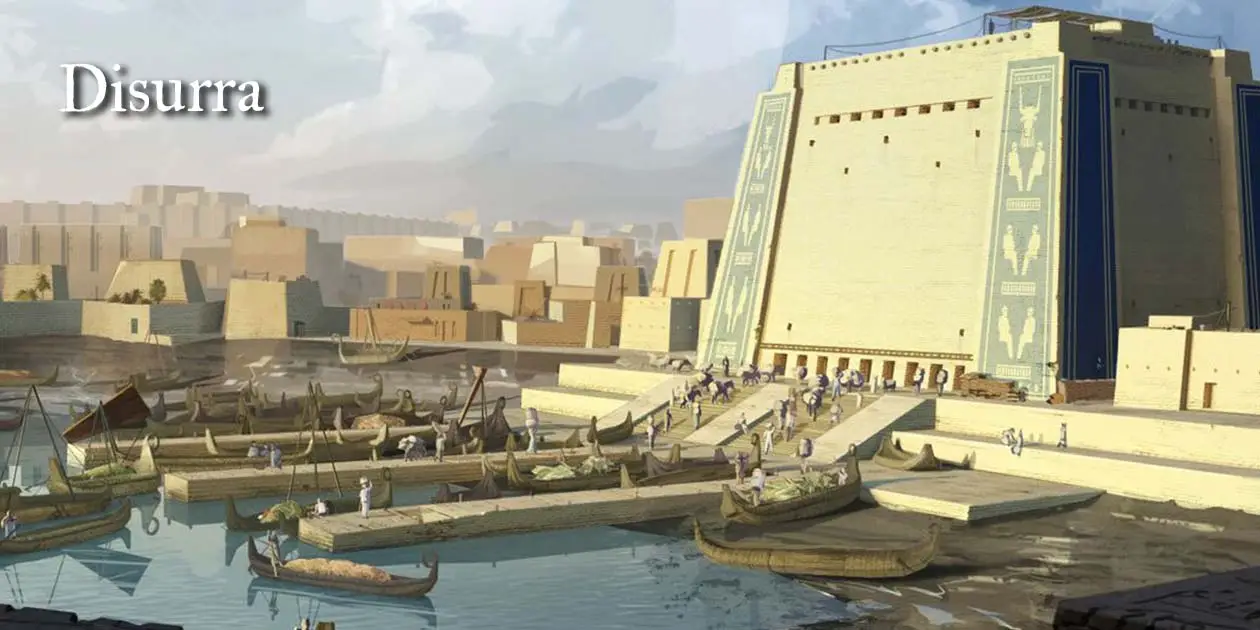
Dissura. The bustling docks of the city, the district of Dissura (दिसुरा) has many ancient grand ziggurats and is located on the banks of the Rethi River. It is a hub of commerce, with the local markets always busy with merchants selling their wares. The district also has a strong military presence, with guards stationed at the docks to ensure the safety of the city. Some locations of interest include:
The Senaghar, which is the primary military and guard center of the city. The Kasaaqi Sena has barracks and personal ports in this military complex along with a jail, as all security operates out of here.
Dobuna Bridge, which is an ancient bridge built out of stone that crosses the Rethi River. Named after the elder god, it has stood the test of time and has a sumerian-inspired architectural style.
Kretu’s Bridge, named after Mahataraja Kretu II who razed the city. He then used the city as a launching point for his invasion of the Vyzum Wastes, and built this bridge out of steel and stone. It is now used as a train bridge for the steam railway.
Dibad Ruins. Completely razed down a century ago, the outer district of Dibad (दिबाद) is now nothing more than a collection of ruins and rubble, serving as a reminder of the devastation that the city has endured. In addition to destroyed houses lies the rubble of the former outer walls of the city. Much of the ruins are slowly being rebuilt and reincorporated, but many criminals and homeless folk alike make their residence in these ruined buildings to hide away from the authorities.