The Kasaaqi Dynasty (कसाकी हुकूमत), also known as Kasaaqistan (कसाकिस्तान) or the Zaaba Hukumat (زابا حُكُومَت), is a large kingdom encompassing most of northern Eqos. The desert nation is one of the largest maritime trade hubs in the world. After a slave revolt in 2E523, Rakash Zaaba I took over the city of Kasaaq and eventually he and his descendants managed to take over all the remaining city-kingdoms of the Kav'orra Desert to form the nation. They earned the title of ‘Mahataraja’, which means ‘Maharaja of Stars’.
House Zaaba has ruled for more than five hundred years since then, into the third era and the present day. Due to the sheer magnitude of the nation, the name 'Kasaaq' has come to refer to both the capital city as well as the entire desert as a whole becoming a synonym. Mahatarajas of the dynasty are all expected to have two concubines in addition to their married wife in accordance with the three moons. The dynasty is primarily male-hereditary, but there has been a Mahatarani that ruled the land once when her father had no male heirs.
In the present day, the dynasty is ruled by Mahataraja Azani Zaaba III. He holds the nation together with tough efficiency, putting down any dissent violently. However, he is not very expansionist, and isn't trying to expand south of the Rethi River as many of his predecessors have tried and fought to do. Over time, the Dynasty has wiped out and replaced almost all signs of the previous nation it usurped, which was called the Suryag Sultanate. Its rapid expansion and conquest of neighboring city states has been heavily militaristic, leading to bad blood with most of the nations to its south.
In addition to Common and existing D&D languages, they speak a unique language called Kasaaqi, which is an equivalent to a Hindi-Urdu in Abmarah. Many other languages are also spoken within the nation, such as Rethvi, Dibayadi, Ammban, Kaitzuri, Kav'orri, Koorjei, and Magran. Immigrants have also brought the usage of the Edeni, Lunarian, Varkasi, Swarnan, and Vedar languages.
The races most commonly found within the diverse nation are: Humans, Sand-Elves, Desert-Dwarves, Dune-Orcs, Sunless-Drow, Dragonborn, Genasi, Tieflings, Panshera, Saurians, Vanara, Vicchus, Ursines, Minotaurs, Haanari, Khenra, and Aven.
Currently, the Kasaaqi Hukumat is politically divided into seven distinct regions:
The Raj of Kasaaq, ruled by the Mahataraja or Mahatarani of House Zaaba directly. Besides the city, the region is further divided into:
The Sarkar of Wa’sadak, formerly ruled by the Nawabs of House Zehir and currently under direct rule of House Zaaba.
The Raj of Renara, ruled by the Raja or Rani of House Rethi. Besides the city, the eastern river region is further divided into:
The Sarkar of Nubarii, ruled by the Nawabs of House Mahawala.
The Raj of Ammba, ruled by the Rana or Rani of House Kawar. Besides the city, the central desert region is further divided into:
The Sarkar of Tefniki, ruled by the Thakur or Thakurani of House Kayari.
The Raj of Mem’mala, ruled by the Raja or Rani of House Mathii. Besides the city, the northern desert region is further divided into:
Qila of the Veiled Wall, controlled directly by the religious order of the Veiled Guard.
The Raj of Koorjing, ruled by the Ninghou or Leima of House Anganba. Besides the city, the region is further divided into:
The Sarkar of Keningjei, under direct rule of House Anganba.
The Raj of Dibayad, ruled by the Raja or Rani of House Vokiro. It was formerly ruled by the Shahs and Shahanshahs of House Dabull. Besides the city, the southern mountain region is further divided into:
The Sarkar of Ajmiraad, ruled by the Nawabs of House Gshin.
The Raj of Therah, ruled by the Prince or Princess of House Aylarov. It was formerly ruled by the Rajas of House Majhii. Besides the city, the coastal islands region is further divided into:
The Sarkar of Janaghat, ruled by the Thakur or Thakurani of House Rakhaa.
The Sarkar of Suneb, ruled by the Nawabs of House Narayu.
Any villages, towns, or forts not mentioned here are assumed to be under the direct control of whichever house is closest, with the exception of Rethibad which is currently claimed by House Mahawala instead of House Vokiro.
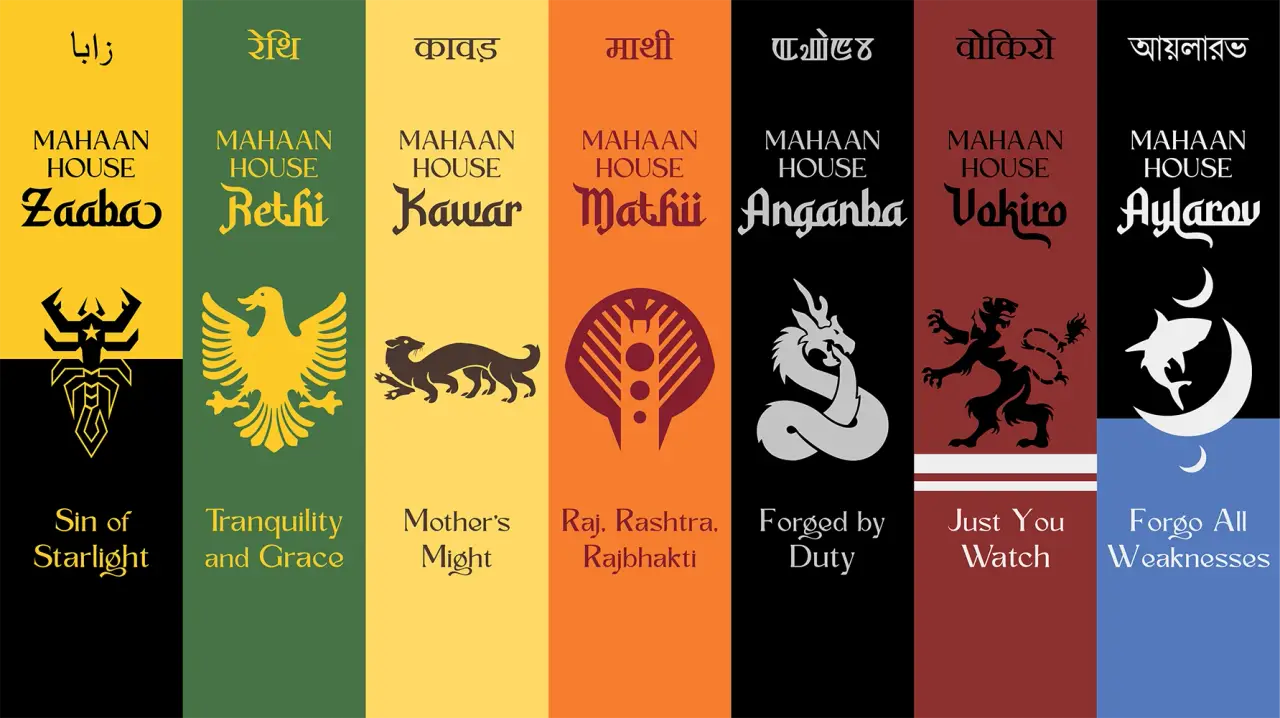
The desert is still vast and dangerous to traverse, the dunes separate each of the cities by months of travel. As such, the nation is quite decentralized, as many different noble ‘Mahaan Houses’ control different Rajyas of the Hukumat. The Mahataraja has been funding the construction of steam train lines across the desert in hopes of reducing both the figurative and literal distance between the cities. The Mahaan Houses are:
Mahaan House Zaaba of Kasaaq.
Mahaan House Rethi of Renara.
Mahaan House Kawar of Ammba.
Mahaan House Mathii of Mem'mala.
Mahaan House Anganba of Koorjing.
Mahaan House Vokiro of Dibayad.
Mahaan House Aylarov of Therah.
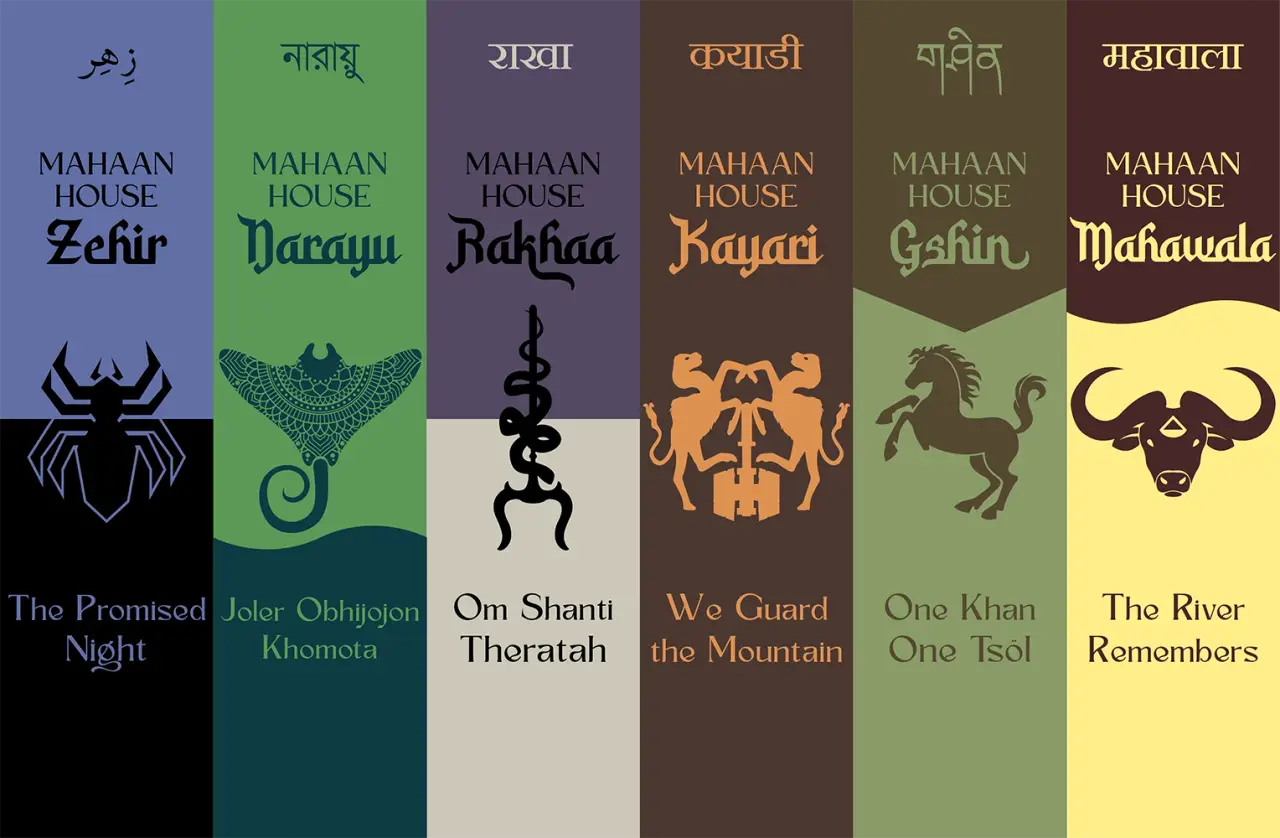
In addition to the seven mahaan houses, there are six smaller families that control many of the smaller towns and areas, similar in ranking to aurian counts. These are:
Mahaan House Zehir, former rulers of Wa'sadak and a cadet branch of House Zaaba.
Mahaan House Narayu, rulers of Suneb and a cadet branch of House Majhii.
Mahaan House Rakhaa, rulers of Janaghat and a cadet branch of House Mathii.
Mahaan House Kayari, rulers of Tefniki and a cadet branch of House Kawar.
Mahaan House Gshin, rulers of Ajmiraad.
Mahaan House Mahawala, rulers of Nubarii and a cadet branch of House Dabull.
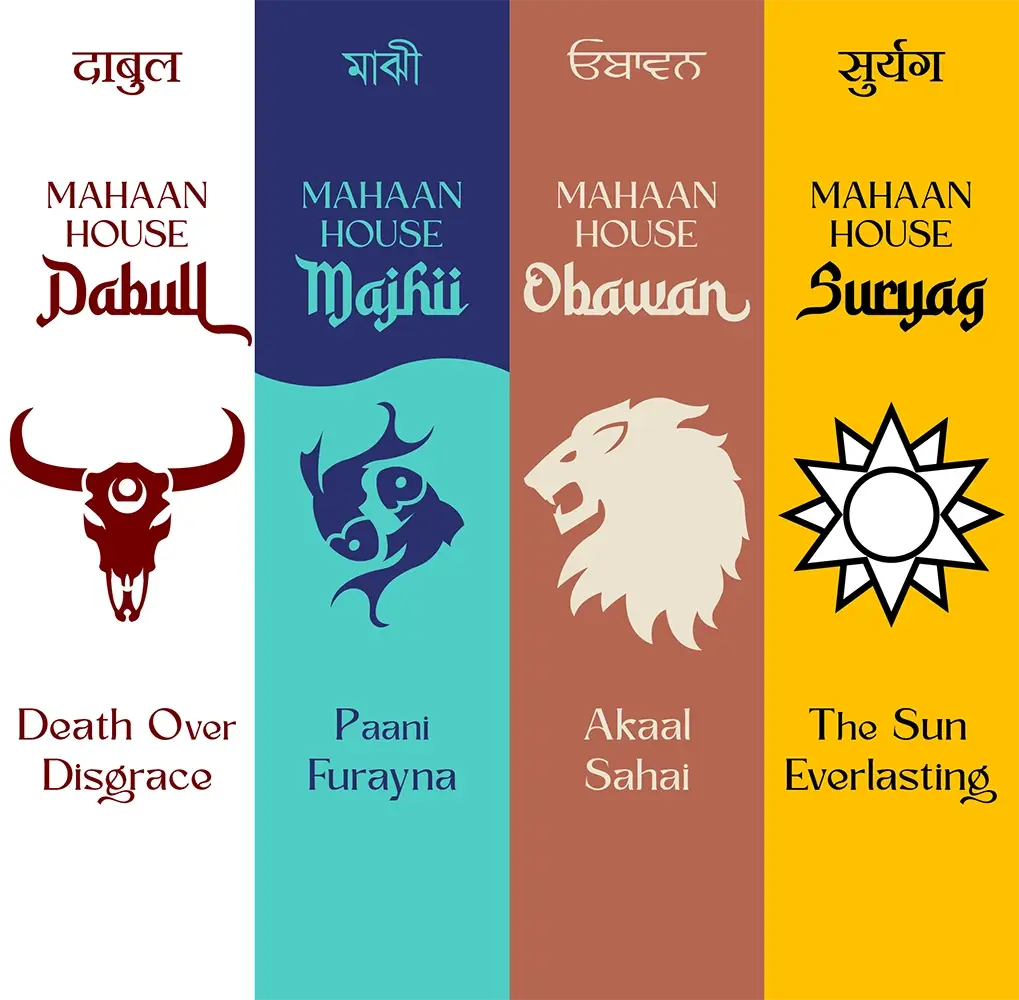
Lastly, there have been three Mahaan houses that no longer exist within the Kav'orra but whose traces in the history of this nation are impossible to erase. These houses are:
Mahaan House Dabull, former rulers of Dibayad.
Mahaan House Majhii, former rulers of Therah.
Mahaan House Obawan, who ruled Kaitzur while it was a part of the nation, and have lost their nobility since within the Vyzumi Republic.
Mahaan House Suryag, former rulers of Kasaaq.
All the rulers of the Kav’orra have their own titles that they prefer to use. There are common titles that most rulers of the same ranking use, as well as regional variations based on the culture or language of the area. Generally, the titles of nobility in the Kav’orra Desert have been:
Emperor tier: Mahataraja, Mahatarani, Maharaja, Maharana, Maharani, Shahanshah, Banbishn, Sultan, and Sultana.
King or Independent tier: Raja, Rana, Rani, Shah, Banbishn, Sultan, Sultana, Ningthou, Khagan, Khatun, Pharaoh, Prince, and Princess.
Lesser Vassal tier: Thakur, Thakurani, Nawab, Nawab Begum, Khan, Khatun, Subahdar, Jagirdar, and Zamindar.
Goals
The Dynasty’s goals shift from ruler to ruler. They’ve been tyrants, they’ve been conquerors, they’ve been protectors, and all manners of goals have come and gone. As it stands, with House Zaaba leading the other Mahaan houses in the current age, one of the primary goals of the Dynasty is to keep itself together. Many of the houses are fiercely independent, and with the Kav’orra Desert making travel between the cities difficult, the sena has standing orders to maintain order and squash down any rebellion against Kasaaqi rule. As compared to some of the other eqosi nations, the Dynasty is staunchly anti-slavery. Due to House Zaaba having origins in slavery, it has been banned across the desert. They aim to root it out and destroy it wherever possible, even if it leads to internal or external tension.
Another goal for the Dynasty is to build steam train tracks between the cities, in order to make desert travel easier for both the people and the troops alike. Mahataraja Azani III believes that connecting the cities well is the only way to maintain the Dynasty’s internal peace, and has worked with the Ranaji of Ammba to fund these under-construction train lines. The first of these lines connecting Ammba and Dibayad has been completed and is operating.
Relationships
The Dynasty has a good trade relationship with almost all foreign factions. The city of Kasaaq is regarded as one of the largest trade hubs in the western hemisphere, and hosts the “Kasaaqi Artisans Fair” annually in the month of Vani. This trade relationship extends to the Swarna Authority in the west, with their guilds having a big presence across the Kav’orra. The Lunar Collective is the largest exception to this friendly attitude. The Dynasty has been adversarial with the Collective over the past century, and maintains a delicate peace with them in the current age. Being one of the only nations to resist the Collective’s colonization, they’ve managed to keep Lunar meddling out of their borders for the time being, and are wary of their promises. Similarly, the Dynasty is wary of al-Shhubus in the north.
The Dynasty prepares itself for war against the Calamity Covenant. The Covenant formed in the Edeni as a direct response to both Kasaaqi and Lunar occupation throughout history. There is a lot of bad blood still, with Mahataraja Azani III’s father and grandfather being directly responsible for controlling the cities that formed the covenant.
Military
Allied with indigenous military knowledge and equipped with advanced naval ships and airships, the Kasaaqi army is known for its swift curtailment of insurgencies and expansionist tactics. It is a large standing military created through all of the vassals, together called the “Kasaaqi Sena”. It consists of well-trained cavalry, camelry, infantry, musketeers, and elephantry. The basic soldiers are equipped with daggers and talwars made from the metals mined in Ammba. Over the past two centuries, gunpowder and cannon artillery has been often utilized for the war efforts. Light artillery like swivel guns are carried on camel-back. The advanced use of heavy cavalry and shock charge is a key battle strategy for the Sena.
Under the administration of the Blood Queen, the Kasaaqi Sena underwent military changes as a new system of loyal corps was created and the old feudal system was disposed of. It also serves as the police force of the cities, keeping law and order across the Kav’orra Desert in the Mahataraja’s name. Every city has a dedicated “Senaghar” which ranges in size from a single building to an entire military compound. The Kasaaqi Navy became one of the first modern navies to have active patrols to monitor maritime and oceanic trade routes. Naval expeditions and the construction of Fort Starwatch proved to be beneficial in establishing the nautical supremacy of Kasaaq, as the Kasaaqi Navy has been one of the few powers to push back against the foreign Lunar fleets.
There are stone forts strategically located throughout the desert to serve as watchtowers. The Kasaaqi Sena also employed mercenaries across their former colonies in the southern regions, the biggest historical example being the “Lightning Lords” of the Vyzum Wastes. Tribal forces were often enlisted to support the army as well, bringing in diverse combat techniques, tactics and reconnaissance. This added a rather cosmopolitan touch to the sena over time, as all the different combat techniques of the Kav’orran cultures started to be used together. Much of the Kasaaqi military structure was modeled and named after aurian militaries. The structure is:
Kasaaqi Sena | Uniform |
|---|---|
Senapati | High Command |
Senakha / General | High Command |
Bakshi | High Command |
Qiladar (Fort Commander) | Command |
Lieutenant General | Command |
Brigadier General | Command |
Colonel | Command |
Sipahsalar | Troop |
Naik | Troop |
Captain | Troop |
Regiment Commander | Troop |
Sipahi / Sepoy | Troop |
Paik | Troop |
Kasaaqi Navy | Uniform |
|---|---|
Nausenapati | High Command |
Nausenakha / Admiral | High Command |
Rear Admiral | High Command |
Commodore | Command |
Captain | Command |
Commander | Command |
Lieutenant Commander | Command |
Sub-Lieutenant | Troop |
Midshipman | Troop |
Chief Officer | Troop |
Petty Officer | Troop |
Sipahi / Sepoy | Troop |
Naavik | Troop |
Soldiers within the Kasaaqi Sena serve as both enlisted army men as well as town guards. They come from all over the Kav'orra, and are all loyal to the Mahataraja in Kasaaq. There are some who might be more loyal to their home cities, but in the end their salaries come from the capital.
For Kasaaqi Sena player characters, this is the mechanical background:
Ability Scores: Choose any +2; choose any other +1
Origin Feat: Tough
Skill Proficiencies: Your choice of two of the following: Athletics, Intimidation, or Survival
Tool Proficiency: Smith’s Tools
Equipment: Choose A or B: (A) Medallion signifying your Rank, Soldier’s Uniform, Talwar, Dagger, Pouch, 25 GP; or (B) 50 GP
You are, or were, a member of the Sena (Army) of the Kasaaqi Dynasty. Perhaps you worked for the sena independently, or under one of the many Mahaan Houses of the Kav’orra Desert. You are recognized as a current (or former) member of the sena anywhere you go, and you can easily use this limited authority to gain access to senaghars and barracks across the country as well as force civilians or lower ranked soldiers to follow (some) orders. Work with your GM to determine your current relationship with the sena, and what your speciality was: Were you part of the cavalry, were you a city guard, a healer, a scout, or even an officer?
History
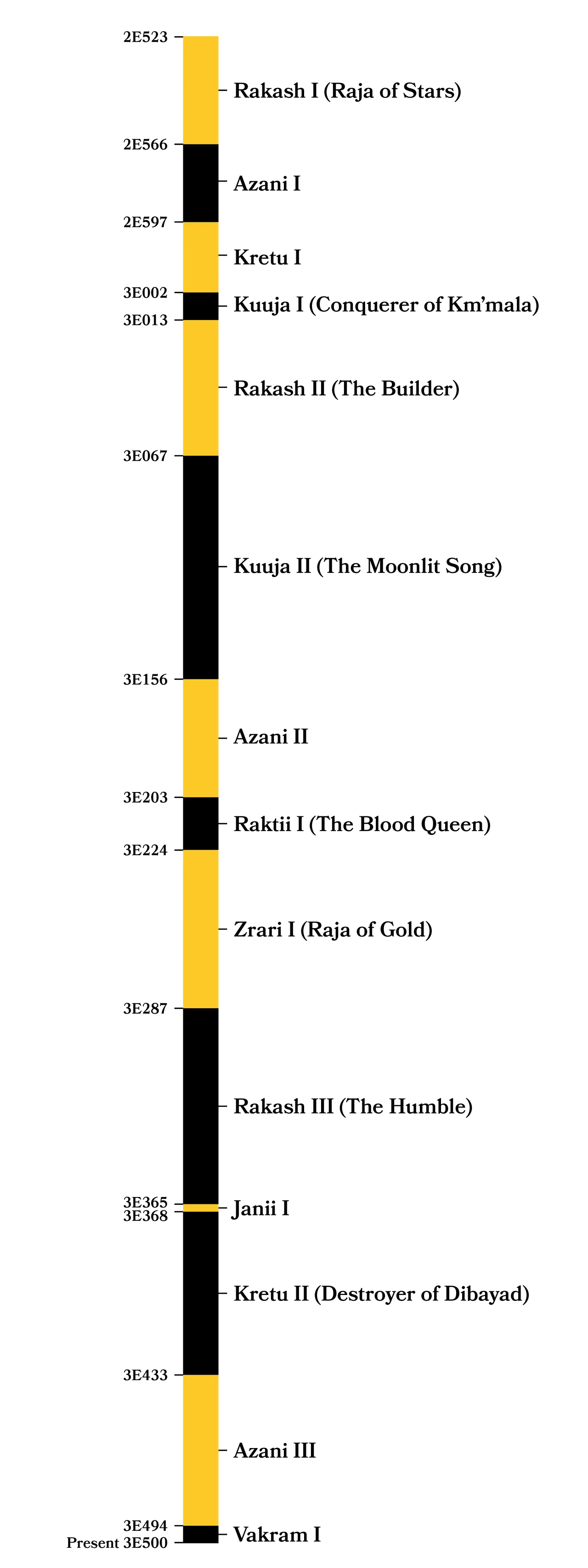
In the nearly six centuries of their rule, there have been thirteen rulers of the Dynasty. Only the rulers are given the title of 'Mahataraja' or 'Mahatarani', their spouses are always given the titles of 'Maharaja' or 'Maharani' to denote them as consorts and not rulers.
Rule | Ruler Name |
|---|---|
2E523 - 2E566 (43 Years) | Mahataraja Rakash Zaaba, Raja of Stars (Died Aged 64) |
2E566 - 2E597 (31 Years) | Mahataraja Azani Zaaba I (Died Aged 50) |
2E597 - 3E002 (28 Years) | Mahataraja Kretu Zaaba I (Died of sickness in a war campaign Aged 44) |
3E002 - 3E013 (11 Years) | Mahataraja Kuuja Zaaba, Conqueror of Km'mala (Died in Battle Aged 31) |
3E013 - 3E067 (54 Years) | Mahataraja Rakash Zaaba II, the Builder (Died Aged 60) |
3E067 - 3E156 (89 Years) | Mahataraja Kuuja Zaaba II, the Moonlit Song (Half Moon Elf, Died in Battle Aged 109) |
3E156 - 3E203 (47 Years) | Mahataraja Azani Zaaba II (Died Aged 95) |
3E203 - 3E224 (21 Years) | Mahatarani Raktii Zaaba, the Blood Queen (Abdicated to her son at 47, Died Aged 78) |
3E224 - 3E287 (63 Years) | Mahataraja Zrari Zaaba, the Raja of Gold (Died Aged 83) |
3E287 - 3E365 (78 Years) | Mahataraja Rakash Zaaba III (Died Aged 104) |
3E365 - 3E368 (03 Years) | Mahataraja Janii Zaaba (Died via Poison Aged 43) |
3E368 - 3E433 (65 Years) | Mahataraja Kretu Zaaba II, Destroyer of Dibayad (Died Aged 80) |
3E433 - 3E494 (61 Years) | Mahataraja Azani Zaaba III (Died aged 82) |
3E494 - Present (4 Years) | Mahataraja Vakram Zaaba (63 Years Old, Came into Power Aged 59) |
Rise of the Zaaba Hukumat
The Slave Revolt
Through most of the second era, the Kav’orra Desert was being controlled by individual city-states and different factions. The largest city near the end of the era was Kasaaq, followed by Dibayad close behind. However, over the centuries, the Suryag Sultanate had stagnated in their growth and the city-state was primarily focused around trading, purchasing, and selling of slaves.
Rakash was born a slave in the year 2E502 to unknown parents, lost in the system as one of many undocumented slave children. Eventually, at age 6, he ended up being bought by a noble named Mutrevarin Jisoni, an elderly man who was the last of his family line. Rakash was taken into Jisoni’s household alongside a few other slaves to aid the old man, and was given a scholarly education alongside martial training. Jisoni was an astrologer and a historian, and regaled Rakash of the stories of Sol Sultana and the omniborn crisis. A devout follower of Saedevi, Jisoni foresaw a great “golden” destiny for Rakash in the stars, and nicknamed the teenage boy “Zaaba”, which meant gold in ancient omnikarn. As Rakash was the only one of the slaves who was interested in the childless Jisoni’s stories and work, he took a strong liking to Rakash. Jisoni was far from the richest noble, and yet he promised to free Rakash in his will upon his eventual death.
By 2E523, unrest and political tensions were flaring up within the city, especially after a considerably dryer year which left food scarce for the masses. The ruling Sultan Nazeem ud-Din Suryag had failed to address any of these problems, and was also an adherent of Solism while the masses now mostly followed Ashtadharma. Slavery was looked down upon in Aeterism now, but the practice had been followed in the Kav’orra as far back as history went. An ashtadharmic vedavin priest named Athira began to preach to the populace of the city that the Sultan prayed for more drought, as to bring in the fury of the sun foretold by Sol Sultana. He incited a large slave revolt, which quickly devolved into a mass civil war within the city as the slaves outnumbered the guards and both sides were equally malnourished. Even though Jisoni had promised Rakash his freedom, Rakash ended up becoming one of the leaders of this rebellion. With his knowledge of old military tactics and histories, some sources even claim that Rakash was the one who told Athira to preach the rumors in the first place, knowing that it would incite a riot. Athira had popularized Rakash as a voice of the people, preaching that Rakash was a promised savior as written in the stars by Saedevi herself. While there were numerous leaders on both sides of this month-long conflict, the slaves were essentially being led by three figures—Rakash himself, another young rethvi man named Rajiin who was nicknamed “Majhii”, and an older slave named Saeram Bhatialli who had once served the Sultan. Bhatialli was the only voice of experience and reason amidst the charged rebels, and the two young men respected his advice.
Eventually, the conflict ended when the rebels finally broke through into the Sultan’s palace. Bhatialli lost his life during this final day of the conflict, but the two young leaders reached Sultan Nazeem and held him hostage. Nazeem gave up his control of the city, and was forced to abolish slavery as his final act of power. He was then imprisoned for the rest of his life, as executing him would’ve alienated a lot of the remaining nobility. Rakash freed himself before his former owner’s death, and with Athira and Jisoni’s blessing, he took the family name Zaaba, and was crowned the “Taraja” of the city. Rajiin would also take the family name Majhii, and both the men would marry the two daughters of Bhatialli. It’s said that Rakash’s first act of power was a promise to build a High Temple of Saedevi for Jisoni, with Athira becoming the first High Starseer of Sitaradham Mandir. Athira would go on to write the Saeveda, one of the most prominent sacred texts within Ashtadharma. The Saeveda is also one of the strongest legitimizing tools for the Zaaba Dynasty, as it was written under their patronage.
Rakash I - Raja of Stars
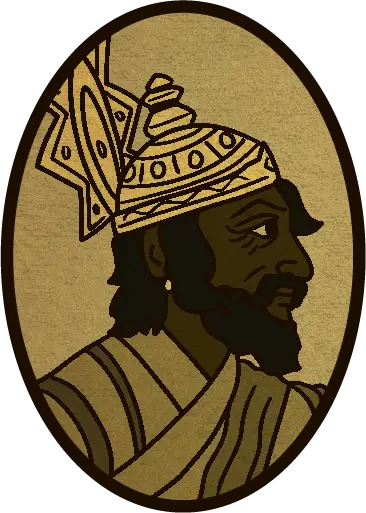
After taking control of the city of Kasaaq, Rakash I had to rebuild the stagnated city from scratch through economic reformation and military consolidation. The slave revolt had left the country starving and in desperate need of reconstruction, but the populace had admired Rakash’s leadership in the slave revolt and looked up to him as a promising ruler. Given Kasaaq’s strategic location along the river and coast, Rakash’s ambitions to expand naval routes would have been crucial to the consolidation of his powers. He put Rajiin Majhii as the “Nausenapati” (Admiral) to monitor naval warfare and oceanic-riverine trade links. Around the year of 2E528, Rakash concentrated his military efforts towards conquering the riverlords and Ammba. The city of Renara was an important political venture because of its fertile lands and general control over the Rethi River, and the riverlords were a powerful and autonomous mercantile group who thrived on exploitation and the slave trade. Under the banner and command of Rakash and Rajiin Majhii, a formidable naval army and infantry was organized. The situation was tense and hostile for a while as a series of conflicts proved to be a brunt on the fiscal and military matters on both sides.
Rakash’s ambitions and short-sightedness resulted in him attacking the mineral-rich, underground dwarven city-state of Ammba while simultaneously waging war on the riverlords. The city of Ammba is a haven for innovation, creativity, and trade, hosting an underground river that fed their mountain population in the middle of the desert. Rakash’s venture towards Ammba was fuelled by the desire for the riches the dwarven city held within which would serve as a key factor in solidifying his powers. The journey towards Ammba from Kasaaq was long, leading to the exhaustion and weakening of his army. The difficulty in sieging the mountain city combined with the resilience of the dwarven army led to a defeat. Additionally, a war on two fronts depleted Rakash’s resources drastically, ultimately deciding the tides of the battles on both grounds. After losing the war on both fronts, Rakash sought a diplomatic deal with the Riverlords, offering concessions like tax cuts and protection of their territories and goods. In return, The Kasaaqi Hukumat now had control over the city of Renara and the riverlords would abolish the slave trade.
In 2E532, Rakash founded the town of Wa’sadak over the ruins of older settlements to fortify his army. The town was built around a natural oasis which served as a rest stop between cities, crucial as it served as a staging ground for his second attempt at conquering Ammba. With Fort Wa’sadak built, Rakash now had a solid footing in the Kav’orra Desert to attack Ammba. With a strong camelry and a large army under his command, he marched towards the city across the vast desert. After a difficult fight, he emerged victorious in the second siege of Ammba, claiming control of the dwarven city state and proclaiming himself “Mahataraja”. The victory at Ammba increased the wealth and power of the Kasaaqi Dynasty profoundly as he made House Kawar his vassals.
For the rest of his reign, Rakash mostly focused on building a strong land-distribution system to bring stability and agrarian modernization. The war effort had severely stagnated food production with much of the common folk facing food crises and starvation. With the fall of the Suryag Sultanate, an abundance of land was created which Rakash distributed among former slaves. He worked to improve the irrigation channels and modernize agricultural systems to improve the quality of food, as well as constructing granaries to store grains. One of the most remarkable contributions of Rakash I was the construction of the Sitara Qila, his center of government, which he built over the ruins of the Suryag Castle. Situated over the cliff now called Rakash’s Hill, Sitara Qila overlooks the Starshine Bay and is the hub of the Hukumat’s political and bureaucratic activities.
Azani I
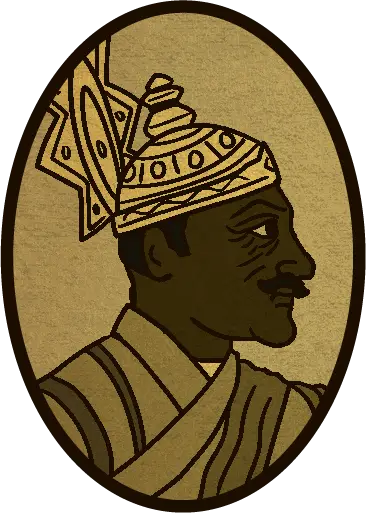
Kasaaq witnessed forty-three years of military conquests coupled with modern reforms under Rakash’s reign. After his death, the throne was succeeded by his son, Azani Zaaba, who ruled the Kasaaqi Hukumat for thirty-one years. A man of grit and determination, Azani followed his father’s footsteps in conquering strategic locations, but his lack of experience in leading an army led to multiple failures. One of his military conquests was targeted towards the city of Dibayad, now a rich commercial capital ruled by the powerful minotaur family, House Dabull. Dibayad had long been a rival city to Kasaaq, and held a lot of influence over the river. However, his inexperience and the superior military and logistical power of the dibayadi army crushed his siege quickly, forcing him to retreat. This “First War for Dibayad” was short and embarrassing for Kasaaq. The defeat at Dibayad struck a huge blow to Azani’s legitimacy, and to consolidate power he invested a lot more in diplomacy. He used marriage alliances to create a network of strong and loyal vassals in his reign. House Majhii was elevated to a prestigious position in the royal court after Azani and his sister Sivii Zaaba married their cousins, Debii Majhii and Palkii Majhii respectively. Additionally, he integrated House Mathii and the city of Mem’mala into the Hukumat through a promised marriage of their princess to his infant son, Kretu.
Azani’s reign might be characterized as comparatively peaceful and stable, owing mostly to the efforts of the aging High Starseer Athira. The city of Kasaaq thrived as crime rates decreased greatly owing to the presence of a strong network of spies and the new Sena. The royal treasury prospered because of the strengthening of oceanic and riverine trade as well as the improving quality of artisanship in the market area of Chaadar Chowk. Azani passed away at the age of 50, leaving the regime under the rule of his first-born son Kretu Zaaba I.
Kretu I
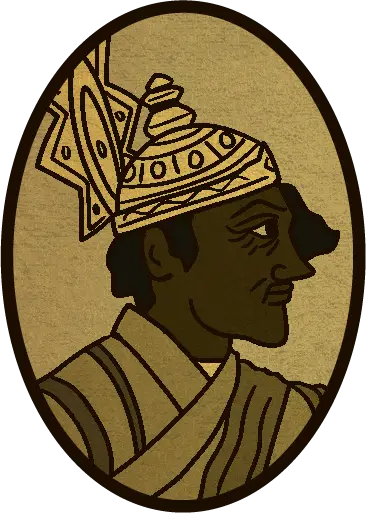
Kretu Zaaba ascended the throne after a period of relative peace. A military tactician proficient in the art of warfare, Kretu aimed at expanding the boundaries of the Kasaaqi dynasty overseas, with his first target being the timber-rich tropical island of Therah. After subduing the powerful tribal chieftains of Therah, he put House Majhii in charge of the island, making them a true Mahaan House.
With the ascension of Kretu Zaaba came a remarkable change to the laws governing the monarchy. Kretu’s brother, Zavii Zabaa, became the High Starseer of the city. As a religious leader, he started the ‘Rule Of Three’ in which the Mahataraja could take two concubines in addition to their married wife which was in accordance with the three moons of the sky. Some believe that this was done to save Kretu from his loveless marriage instead of a truly devout act. Any children that the ruler would have with the concubines would be recognized as Zaabas, but not stand to inherit anything.
In the final years of his reign, much more emphasis was given on mobilization of troops with the introduction of conscription for the war effort justified by a rhetoric of being surrounded by enemies. The timber-rich areas of Therah proved to be valuable in accelerating expansionism and transportation.
War of Km'mala
Kretu was a seasoned sailor, having expanded the Kasaaqi Navy and conquered many islands. Despite his naval prowess, he set his sights on conquering the mountainous Km’mala Peaks. He started the “War of Km’mala”, beginning a campaign against the tribal cities of Keningjei and Koorjing. However, not too long after starting the war, he fell sick in his mountain army camp near Keningjei. The mountains did not suit him, yet he pressed on alongside his son and generals for perceived glory. That is right up until he ended up dying to whatever “cold” that he had caught, something that the superstitious soldiers of his camp called a dragonborn curse upon their leader.
Kuuja I - Conqueror of Km'mala
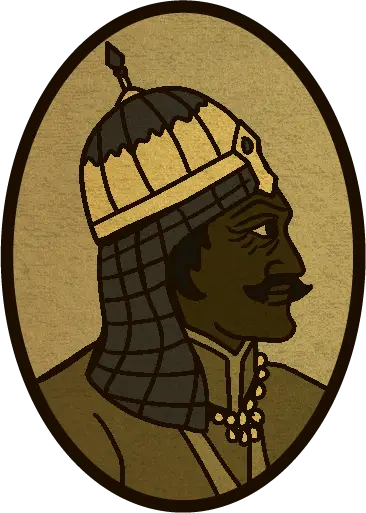
Kuuja Zaaba I was crowned as the Mahataraja mid-war, in an army camp situated atop an unremarkable hill, with the enemy forces gearing up for battle nearby. The sudden death of his father put all responsibility of the war and the kingdom onto him, and his first official action was to head into battle. He led a great host to the city of Keningjei, and through overwhelming force, managed to tear down the city’s defenses and break through the defenses of the dragonborn who lived there. There, he met the chieftain of Keningjei, and gave him the choice to lay down his weapons or die. The chieftain refused, and the city of Keningjei was razed to the ground, its ancient monasteries and forts left to ruin. He returned back to Kasaaq for a few months for the official funeral of his father as well as a ceremonial coronation, but returned back to war quickly. Kuuja’s host marched onwards through the mountains towards Koorjing, the smaller city to the north. They would face a lot of resistance by the unorganized tribals, and this war would end up lasting nine more years as he got closer and closer to Koorjing. Although his army suffered a lot of attrition through the desert mountains, they made steady progress towards Koorjing, but the smaller city’s forces did not yield.
He left his wife Maharani Ainii Wamaa in charge of the country, as well as his infant son Rakash. Ainii was a foreigner, belonging to an edeni noble house south of the river. While Ainii was only the consort regent, she is widely regarded as the true ruler for most of Kuuja’s rule and beyond. Despite most of the economy funneled into the endless war, she kept order and control over Kasaaq and the rest of the desert. Even during the few months Kuuja would return to the capital, he would let her make all the important decisions for him. Many historians consider her to be the true first female monarch of the Hukumat in all ways but name.
Eventually, in 3E012, they had mustered enough native forces to finally beat the dragonborn forces and take control of Koorjing. Kuuja proclaimed himself as the “Conqueror of Km’mala”, but his control over the city was tenuous. He temporarily moved his residence to Koorjing to be closer to the action and to reign in the dragonborn rebels that still resisted him. However, the guerrilla tactics of the rebels would be his ultimate end, as a year later during a parade through the streets, he was killed with an arrow by an unknown assassin. His son was only an infant, and the regency of Maharani Ainii would continue for many years to come. Her first act after the death of her husband was to finally negotiate with the rebel dragonborn clans. The rebel leader Anganba Mungam stepped forward to negotiate with Ainii, not having taken credit for the death of Kuuja. While no one is sure of what discussions took place in the negotiating tent, the two stepped out after many hours with an agreement. The eastern Km’mala Peaks including Koorjing, the remains of Keningjei, as well as all of the many villages contained within would formally join the Kasaaqi Hukumat. The area would be controlled by a new native ruler, Ningthou Mungam Anganba, who would become a vassal on par with the other rajas. He and his family traveled to the city of Kasaaq to swear everlasting loyalty to the child Mahataraja and the Maharani Regent, and the newly created Mahaan House Anganba has not broken that oath to the present day. Many locals were not satisfied with their fellow natives so easily accepting these terms after the destruction of one of their cities, but in some ways the decision prevented an inevitable future loss.
The Long Peace
Rakash II - The Builder
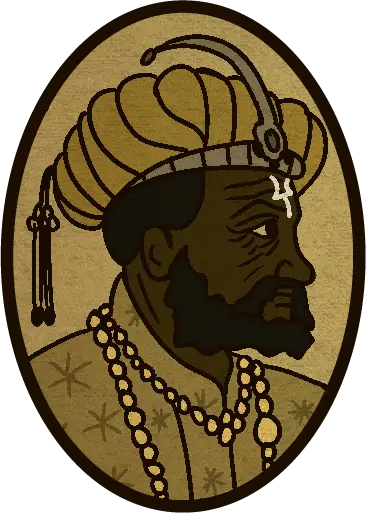
Crowned at age 6, Rakash II spent the first ten years of his rule under the continuing regency of his mother Ainii. She kept power from slipping away from the child Mahataraja at arguably the weakest moment of House Zaaba thus far. Once he came of age, at first he tried to claim some more land south of the river to follow in the footsteps of his father. However, these small skirmishes led to nothing, and his people did not wish for another extended war. Early on in his reign, Rakash II met Lanniel of Aeteria, a moon-elf who had been traveling across the world in her spiritual journey. Utterly fascinated by her, he would claim that it was love at first sight. He convinced Lanniel to marry him, much to the displeasure of his advisors as the marriage secured no alliances. Fortunately, Lanniel’s positive influence on the nation could not be overstated. Her pacifist ways took deep root within Rakash II, and there would be no more wars or skirmishes in his long reign. He focused most of the military economy into building infrastructure not just within the city of Kasaaq, but all across the desert. They say that he loved her so much, he refused to take any concubines.
Rakash II introduced many economic reforms, including the easing of tariffs on upriver trade and fostering better relations with Dibayad. He became well known as a patron of the arts, and he introduced the long-lasting culture of drama and theater into the capital city. Much of the beautification of the city is attributed to his efforts even now, especially the colossal paintings within Sitara Qila that he commissioned. Rakash II was also a devout follower of Therahti, the goddess of the afterlife. He made frequent pilgrimages to the town of Janaghat, and cracked down on necromancy and the dark arts. Foreign dignitaries came to his court with paintings and gems that fascinated him, especially from Aeteria, Lanniel’s homeland.
Perhaps what he is best known for is building the Veiled Wall. A series of black marble forts constructed in a line to the north of Mem’mala, they connected the Km’mala Peaks to the lone Ablunaa Parbat and separated the Kav’orra Desert from the Undead Sands of al-Fahim. He created the order of the Veiled Guard, a holy order that served Therahti and would not let any undeath cross into Kasaaq. Some historians speculate that the wall was only built after Rakash II and Lanniel made a diplomatic pact with the undead rulers of al-Fahim, although there is little proof of this supposed meeting.
Kuuja II - The Moonlit Song
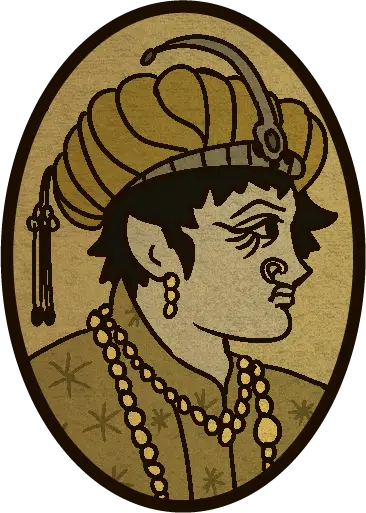
Following the long and peaceful rule of Rakash II, his only son Kuuja II would ascend the throne in 3E067 at age 20. He was the first true half-elf of the Zaaba bloodline, and as a half moon-elf he was expected to live and rule for up to two centuries. Kuuja II was deeply influenced by his mother Lanniel throughout his life, and held onto her pacifist ways much like his father. He was known to be a skilled bard, having been trained in classical music and a variety of instruments, most known for playing the sitar. Kasaaqi silver coins minted during his reign featured the half-elf ruler playing his sitar, and have become somewhat of a collector’s item in the modern day. Widely popular throughout the land, Kuuja II was already known as the “Moonlit Song” a few years into his reign. His initial policies were simply continuations of Rakash II’s such as the promotion of the artisan’s fair, making his nation seemingly run like clockwork without the need of much input from him. However, there were many rumors of his promiscuity, and he had also cycled through many concubines. Kuuja II ended up having four “official” children that were well-known, and three of them were born to concubines. His eldest son, Zoran Zaaba, was born to a sunless-drow concubine named Zo’lhin Zehir.
While Kuuja II was known to have loved all his children equally, Zoran’s grandmother Lanniel was less than thrilled to have a half-drow grandson. The tensions between high-elves and the drow had always existed, and many speculate that Ranimaa Lanniel did her best to influence Kuuja II to not let Zoran inherit the throne under any circumstances. Whatever his reasons may be, in 3E108 Kuuja II declared to the world that his desired heir would be his youngest infant son, Azani, who was born to his noble wife. This caused his eldest son, Zoran, to rebel against his father. Zoran was already 31, and had expected the throne to pass to him all his life. He found supporters within the various different mahaan houses, but before this could escalate into any actual war, Kuuja II decided to negotiate with his son. After a challenge from Zoran, they decided to duel one-on-one. After a tense fight in the middle of Sitara Qila, Kuuja II ended up besting his son, winning by disarming Zoran. Kuuja II still loved his son though, and decided to meet him halfway. He made Zoran the Nawab of Wa’sadak, which was quickly developing into a major town. He gave him the ownership of the fort there, and let him make his own cadet house, “House Zehir”. Zoran Zehir accepted these terms and made peace with his loss, and did not rise up against his father again.
In 3E151, the long peace was finally shaken, as a border dispute regarding the town of Jerakh escalated tensions between the Kingdom of Dibayad and the Kasaaqi Hukumat. After failed negotiations, Shahanshah Zarius Dabull IV of Dibayad insulted Kuuja II and his mother, and spat on kasaaqi soil. This started the five-year long “Second War for Dibayad”, despite Lanniel’s calls for peace. Kuuja II led the war effort himself, and eventually brought the war directly to the gates of Dibayad in 3E156. However, during the initial days of the siege, the dibayadi forces attacked the kasaaqi army directly during the night. Both Kuuja II and Zarius IV were on the field, and famously faced off against each other. Unfortunately, Kuuja II lost this duel when the minotaur Shahanshah cut him into two halves with his greataxe. After the loss of their Mahataraja, the Sena retreated, and the war came to an end. A distraught Lanniel would disappear from Kasaaq, never to be seen again.
Azani II
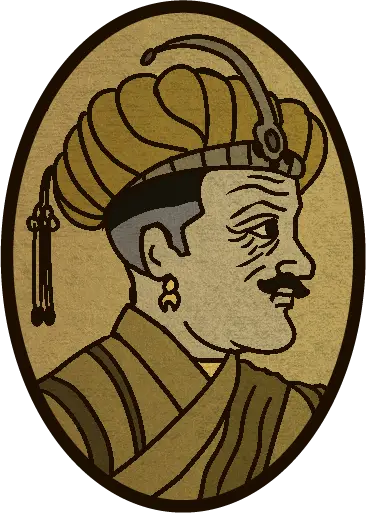
Azani II inherited the throne at the age of 48. He saw his father die in front of him, and he sought to not repeat those mistakes again. Once again focusing on rebuilding the nation, he wanted to emulate the success of his grandfather, Rakash II. However, recovery was much slower this time, and there was a lot of dissent despite the peace. Azani II put his foot down and violently ended any who would challenge the law, building up a lot of resentment within the empire. Azani had two daughters with his wife, Airina Mathii. In 3E189, House Mathii tried to break free and rebel from kasaaqi control. The oasis of Mem’mala was running low on water after a particularly bad drought, and yet Azani II refused to help them out. The Sena ended this rebellion before they even mobilized, killing half of the Mathii forces and jailing the rest. It’s said that Azani II also kicked the disabled Raja Kirina Mathii I down from his wheelchair, although this might be propaganda against Azani II. Whatever the case may be, Azani II was married to Kirina I’s sister, Airina Mathii, who left Kasaaq and went back to Mem’mala. She refused to see her husband’s face ever again, and the two would never meet again.
For the rest of his reign, Azani II put on a lot of weight as he stopped leaving Sitara Qila altogether. His servants would talk about how he would complain about his estranged wife and women in general, and that he just kept eating all day. Azani II was also put into a precarious position, as he only had two daughters and no male heir. The laws of Kasaaq at the time did not let women inherit the throne, and he would controversially change these inheritance laws near the end of his rule. Even if his eldest daughter Raktii was to inherit, she was controversial herself due to rumors of her using dark magic and witchcraft, having gone on trips to al-Fahim and beyond. She even married against Azani II’s will to a lesser noble from al-Fahim, named Enzii. She also had a half-vedavin bastard daughter out of wedlock with a vedavin bloodmage from Vanadweep, something that almost caused Azani II to disinherit her. However, the alternative was to let his uncle Zoran Zehir inherit, ending the direct rule of House Zaaba. There was still deep-rooted racism against sunless-drow within the city. He decided to let his controversial daughter inherit over his controversial uncle, and would pass away at age 95 of a heart attack. The dynasty’s long-lasting lineage seemed to be crumbling gradually.
The Spider Rebellion
Raktii I - The Blood Queen
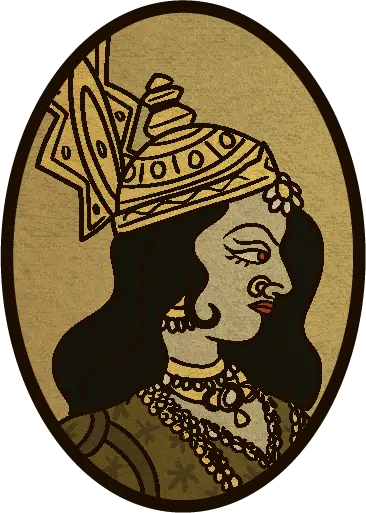
Despite the Second War for Dibayad, the Mathii Rebellion, and all the other small clashes over the past century, the “Long Peace” was said to have truly ended with the ascension of Mahatarani Raktii Zaaba, the first and so far only woman to directly be crowned as the ruler of the Kasaaqi Hukumat. Her ascension immediately caused the entire nation to erupt into a civil war on such a large scale that it dwarfed any of the previous conflicts since the War of Km’mala. On the very day of Azani II’s death in 3E203, Raktii was crowned as the Mahatarani while six months pregnant with her second child. On the same day, Zoran Zehir I, now aged 125 (about middle-aged for half-drow), would meet with his allies to rebel against Raktii’s ascension. By all laws of the land, he should’ve been the Mahataraja due to male-only succession. Immediately, the mahaan houses were all split into two factions. Raktii was supported by House Majhii and House Anganba, while House Mathii and House Kawar would support Zoran I. This created two fronts to the war, one in-between Kasaaq and Wa’sadak and one in the northwest in-between Koorjing and Mem’mala. Within a week, all banners were called and armies were mobilized. Zoran I would also acquire a major ally in Shahanshah Urhammu Dabull of Dibayad, after marrying his daughter to the minotaur’s son. This effectively caused the river to become a third front for the war.
Raktii became well known during this time for her controversial practice of blood magic. There were instances of her image being vandalized and tarnished by the laymen thanks to her infamy. People were beginning to call her “Khoon-ki-Rani” and other such insults, and one of these nicknames stuck as the “Blood Queen”. Raktii took this nickname in stride, as she wanted to both win and rule through fear and intimidation, as she expected no other way for the men of the land to respect her. Zoran I chose a nickname as well to oppose her, coming up with the “Venom King”. Raktii commanded the first battles of the war from Sitara Qila, and started to train an order of blood-mages loyal to her known as the “Khunfauj”. In early 3E204, a few months into the war, she gave birth to her second child and heir, Zrari Zaaba. She also married her sister to Raja Maurab Majhii of Therah, solidifying their alliance. The first year of the war was especially bloody, neither side gaining any ground and all the battles just leading to mutual losses more than any true victories.
In 3E205, after nearly two years of war the tide began to shift truly into Raktii’s favor. There was a climactic battle at Wa’sadak, with Raktii and Zoran I both commanding their armies themselves. Far as the chronicles go, Raktii goaded her uncle into attacking her directly in the middle of the battle, challenging him to a one-on-one fight much like he once had with Kuuja II. Whatever the case may be, Raktii was rumored to have used her blood magic to control Zoran I’s blood, hold him in place, and chop off his head. At the same time, Zoran I’s eldest son Kuuja Zehir I was killed off unceremoniously elsewhere in the chaotic battle. By dusk, the sand was stained red with blood, and she had captured both Raja Mael Mathii and Rakash Zehir, Zoran I’s only surviving son. They were both her cousins by blood, and both swore allegiance to Raktii, admitting defeat. Rakash Zehir became the new Nawab of Wa’sadak, having begged Raktii for mercy.
The war was far from over though, and having combined the two forces Raktii marched onwards towards Dibayad. This subset of the rebellion was often called the “Third War for Dibayad”, although it did not last long. Raktii faced little resistance, and her army quickly overwhelmed the Dabull forces for the first time in history. Famously after the short siege, Shahanshah Urhammu Dabull was led into his throne room to find Raktii already sitting on his throne. She taunted him by asking if he remembered what his father did to Kuuja II, while holding the entire Dabull family hostage. Surrendering his pride for the sake of his family, Urhammu finally swore fealty to the Zaabas. Shahanshah Urhamuu became Shah Urhammu, and Dibayad was incorporated into the Zaaba Hukumat finally reuniting the Kav’orra Desert into one unified nation after nearly a thousand years of being split into various states. The war ended with Raktii’s complete victory, with her popular image stained with blood and fear.
Blood Raj
Raktii was faced with the near-impossible challenge to repair and rebuild the nation, as the two-year war had been the deadliest conflict in living memory for the desert. The war drained away the royal treasury and the city of Kasaaq was severely starved. She kept the Sena and the Khunfauj funded through excessive taxation, and started to send her armies across the river to both loot and take control of the edeni settlements. At this point, the Kasaaqi Sena was the largest military power on the eqosi continent, and even after such a devastating war had more than enough resources to slowly take control of much of the northern Edeni Expanse. Raktii used the money looted from the edeni cities and villages to rebuild the Kav’orra, in what has now come to be known as the “Blood Raj”. The kasaaqi colonization and exploitation of the entire Rethi Floodplains would go on to cause deep generational trauma within the local population, much of which persists to this day.
Raktii restructured the Kasaaqi Sena to be much more modern, taking inspiration from the eastern aurian armies of the Crimson Empire and the Kingdom of Zietaria. This move of switching from a feudal temporary army to having a standing army across the nation helped solidify her power. Raktii also built a large stone-and-steel bridge across the Rethi River in the capital city of Kasaaq, allowing her armies to cross into the Edeni more effectively while also boosting trade.
By 3E210, Raktii’s Raj stretched as far south as the walls of Jamre in the Edeni, and included the city of Kaitzur in the Vyzum Wastes. Raktii’s rule was a particularly tumultuous time for the entire globe, as the entire continent of Aurial was fighting amidst each other in the “Great Aurian War” during these decades. Many aurian refugees flooded over into Eqos, settling down in the Edeni and especially the Vyzum. The rulers of the Edeni drafted many of these refugees escaping war to fight against kasaaqi control, leading to even more tragedy. One of the bloodiest battles of the Raj occurred in 3E222, when the Kasaaqi Sena met the forces of High Chieftain Idris Tokalu IV of Ghasarii in a field of grass southeast of Kasaaq. Nearly half of the nine-thousand strong Ghasaran forces were made up of refugees from the Great Aurian War across the sea, and the Khunfauj cut them down all the same. Of the nine-thousand men, only a little more than a thousand survived the battle. The brutality of Raktii’s forces caused a black mark on her reign beyond what was already there, but she doubled down by constructing a fort at the battle site named the “Bloodfort” or “Khunqila”.
In 3E224, when she was aged 47, Raktii came to a realization that fear would only get her so far, and that her male vassals would eventually try to usurp the throne in her old age. After only 21 years of rule, she abdicated the throne for the first time in kasaaqi history, passing her titles down to her 20 year old son Zrari Zaaba. She wished for the figurehead of the Hukumat to be someone free of all the dark stains she had collected, while she still got to control the nation behind the scenes. Mahatarani Raktii Zaaba is widely considered to be the strongest female ruler of Eqos since the days of Sol Sultana, and she is by far one of the most famous Zaabas across the world to this day. She is especially popular in the Dragoncoast across the Ashfall Sea, as kasaaqi food trade immensely helped the west-aurian nations during the Great Aurian War. Yet another controversy would affect her decades after her death, when the vedavin Lich-King Marayuu would claim to be an illegitimate son of the Blood Queen with no proof to back it up.
Zrari I - Raja of Gold
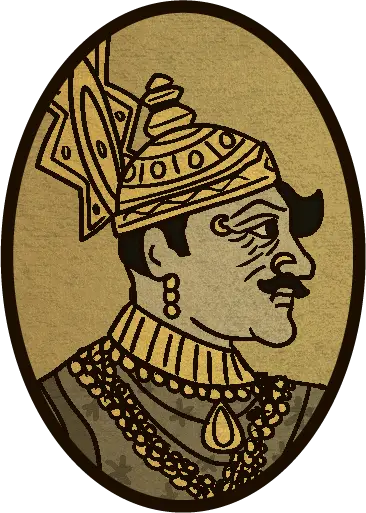
For the first 31 years of his rule, Zrari was by all accounts a figurehead being controlled by his mother, Raktii. He inherited her expansive territories as well as a booming economy, and his reign is known to be the economic peak of Kasaaq thus far. One of his first independent decisions was to let the Swarna Guild of the western rainforests conduct business within the Kav’orra. The capitalistic mining guild was allowed to act freely, but Zrari forced them to greatly strengthen worker rights. The miners working under House Kawar were allowed to essentially unionize, and to offset the loss of control House Kawar was given greater autonomy by Zrari. He became well known in the land to be the first Mahataraja to foster good relations with the dwarves of Ammba. He even carried out a massive extermination of mining pests such as aurumvoraxes which posed a huge threat to the miners. Zrari I married princess Aatrii Kwashii of Wesamala, further strengthening the trade relations between the Goldheim and the Kav’orra.
He married one of his daughters to House Kawar, which was the first noble marriage between a human and a dwarf in the desert. He was also famously a very close friend of his cousin Zoran Zehir II. Despite the rivalry between their houses and the trauma their parents had caused each other, the two connected over a shared love of falconry and were confidants throughout Zrari’s life.
By the time Raktii passed away in 3E255, the Zaaba Hukumat was potentially the largest contributor to the world’s economy. The nation had various colonies across the northern Edeni, and had complete control over the Rethi River with the full might of the cities of Dibayad, Kaitzur, and Kasaaq-Renara in their prime fuelling riverine trade. At the Hukumat’s greatest extent, many considered Zrari to be the richest man in the world especially as the eastern nations were recovering from their great war. Zrari further fed these rumors and legends by wearing ostentatious gold jewelry and decorating his throne room with jewels and riches from across the world, earning him the moniker of the “Raja of Gold”. Most kasaaqi gold coins found across the world even today were minted during his reign, and feature a bust of Zrari.
Zrari also finally consolidated the various riverlords and merchant families of the river lands. One of his close advisors was the sand-elf merchant Duin’hir, who owned vast swathes of land along the riverside. Zrari used his political influence in 3E271 to uplift Duin’hir into a new mahaan house, creating “House Rethi” to rule over the Rethi Riverbank and the city of Renara. Despite being a new dynasty, Duin’hir Rethi was initially a puppet of House Zaaba. Potentially Zrari’s only well known failure was his failed attempt to conquer the city of Jamre, the self-sustaining city outlasting his siege. Unlike most of his ancestors, he admitted his mistake, and formally apologized to the rulers of Jamre. Re-opening trade to the large city, he married his eldest daughter to the prince of Jamre, Iretti Vanem, tying the two great cultures together for the first time. Zrari managed to turn even this failure into something that he is remembered fondly for, being the first Mahataraja to construct a stone road connecting Jamre and Kasaaq. Zrari died at the age of 83, passing away peacefully in his sleep.
Rakash III
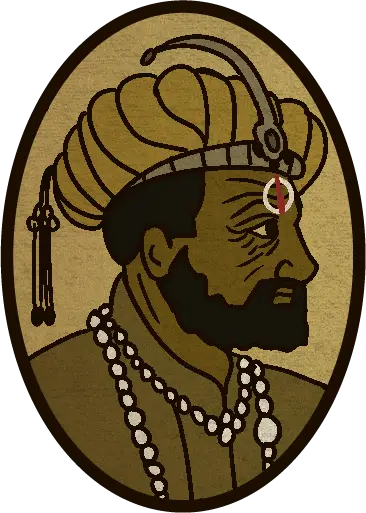
Crowned at the age of 26 in 3E287, Rakash Zaaba III inherited the richest nation on Abmarah, a status that would diminish greatly during his reign. A drought caused a great famine within the Rethi Floodplains, and more and more of the Edeni colonies would begin to revolt against Kasaaqi control. By 3E292, Rakash III had lost all the territories south of the river other than the city of Kaitzur, effectively ending the Blood Raj after 87 years. The young ruler was blamed for the drought and the economic downturn, even though the Kav’orra was only returning to its historical average economic output. In 3E298, the Goldheim Rainforest plunged into chaos, with the tension between the ruling monarchies and the merchant armies reaching a tipping point. This caused trade to suffer, further harming the kasaaqi economy. Rakash III was known to be a pensive man of few words, and rumors would spread of him being depressed and refusing to eat food. That being said, he was known to be a consumer of hashish as well as an avid smoker of the hookah.
Age of Steam
Rakash III would spend the next few decades of his reign trying to revitalize the kasaaqi economy and maintain peace across the desert. The world itself was changing rapidly, and by now the Lunar Collective was a major faction in the east. The Lunars had begun to expand into Eqos, making colonies in the Edeni Expanse and the Ashfall Isles alike. And with lunar influence and trade came the introduction of blackpowder into the Kav’orra. The Kasaaqi Sena would begin to create cannons and artillery, as well as purchase a few airships. Steam power would take the desert by storm, with the dwarves of Ammba especially making use of the new technology to create the massive system of plumbing used within the underground city. In 3E330, Rakash III would make arguably his most famous decision. The lunar armies were marching into the central Edeni towards Jamre, and Rakash III would decide to ally with the city states of the Edeni and send the Kasaaqi Sena to help the locals against the colonizers. Despite the fact that the same locals were colonized by him and his ancestors only a few decades prior, Rakash III held a firm belief that despite all the bad blood, the eqosi must help each other when faced with an outside threat. With kasaaqi aid, at least half of the Edeni Expanse remained independent within the Kwadenhi, while the other half would become the new Lunar Kazarin Protectorate.
Rakash was also rumored to be secretly helping the Swarna Guild with military or economic aid, as the guild managed to defeat the monarchies of the Goldheim and create the Swarna Authority in 3E346. The new corporate-monarchy became an ally of the Hukumat near-instantly, helping reinvigorate the kav’orran economy. His eldest son and heir Zavii Zaaba was one of the commanders of the Sena, and when he was aged 28 in 3E348 ended up in a juvenile altercation with a fellow dibayadi commander. The two young soldiers ended up fighting in a duel, one that Zavii Zaaba lost his life in. The loss of his son deeply affected Rakash III, and the grief would worsen his depression. His younger son, Janii Zaaba, was utterly blindsided to suddenly be the heir. Janii was always flagrantly profligate, unfit to be Mahataraja but now thrust into the role. Janii was also forced to marry Zavii’s widow, Aissa Vanem.
Having rarely felt like himself, Rakash III died peacefully at the long age of 104 in 3E365. He had always assumed that he would be remembered for his failures and his sadness, but history recognizes him as a great ruler who held the nation together through a tough time for 78 whole years, while also redeeming his errors by helping his former enemies defeat a greater threat.
Janii I
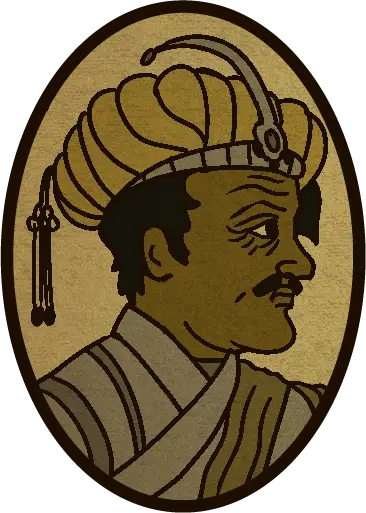
Janii Zaaba ascended the throne at the age of 40, having spent the past 17 years as heir apparent learning nothing of how governments work. He had voiced time and again that he didn’t even wish to be the Mahataraja, unlike his capable late brother. Janii was known to have loved feasting and partying, enjoying the high-society of the capital by attending plays and art exhibitions. Fond of consuming opium and drinking to his heart’s content, he mostly let his advisors take the reign of politics, expecting to coast through life. He certainly did not help dissuade people from having this image of him, holding both a smoking pipe and a glass of terrosi red wine in his official portrait. Later within the first year of his reign, the nation was shaken from the assassinations of House Majhii in Therah. Illyrion Alyarov was an ex-lunarian noble from the island town of Asekai, whose family moved to Therah escaping the dissolution of the nobility within the Lunar Collective. Illyrion used his family’s remaining wealth to gain importance in Therah and befriend Raja Zabhoy Majhii. He invited all the Majhiis—Raja Zabhoy, Rani Vrishtii, and their heir and only child Rajkumari Asha—to a dinner under the pretense of a marriage proposal to the princess. Instead, he poisoned the three, ending the direct line of House Majhii. Illyrion Aylarov proclaimed himself as the new ruler of Therah, causing much unrest across the nation. Janii’s advisors urged him to send the navy to retake the city, but Janii buckled under pressure and legitimized “Prince Illyrion Alyarov” as the new ruler of Therah and recognising “House Aylarov” as a mahaan house.
This action eroded almost all trust that the other mahaan houses had in Janii Zaaba, and would indirectly be the catalyst for his eventual downfall. Unbeknownst to him, a coalition was forming secretly to undermine Zaaba rule, led by none other than Vakram Zehir, the new Nawab of Wa’sadak. Vakram Zehir, also known as the “Blade of Night” was a charming warrior, who despite being half-drow was more reminiscent of the Zaaba leaders of old than the overweight Janii. House Zehir would marry two siblings to House Aylarov, while also reigniting the old alliance they once had with House Dabull. They also brought House Mathii into this new coalition using yet another marriage, and soon the scene was set for another civil war. This all erupted two years later during an official diplomatic dinner within Sitara Qila. Janii was handed a poisoned glass of wine by Shah Zarius Dabull V, leading to his death. Janii learned nothing from the Majhii incident, dying much the same way as his relatives did after only 3 years of rule. The coup was nearly successful, but before Vakram Zehir could be crowned they needed to also kill both of Janii’s children—the 18 year old Rajkumari Ziiva Zaaba, and the 15 year old heir Rajkumar Kretu Zaaba. The two children were protected by General Graos Vokiro, a common-born panshera soldier who acted quickly and prevented the coup.
The Blackpowder War
Kretu II
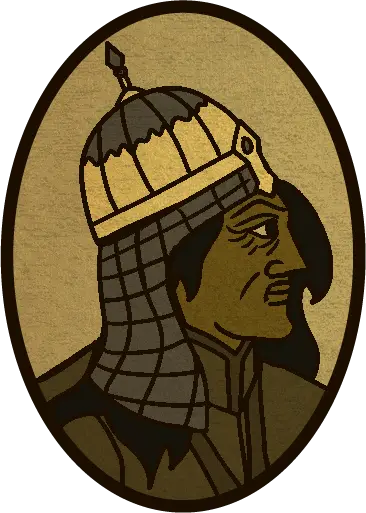
Kretu Zaaba II was crowned hurriedly the night of the attempted coup and his father’s death. The 15 year old was already a skilled warrior, and with the advice of his generals quickly consolidated as much power as he could. Reminiscent of the accession of Raktii 165 years ago, war broke out immediately. While both the coalitions were similar and the circumstances alike, this civil war would be much worse due to the relatively weaker position of House Zaaba and the introduction of blackpowder weapons such as pistols and muskets. This would be the first war fought in the Kav’orra using this new technology. For the initial couple of years battles were few and far between, with most of the mahaan houses taking a long time to assemble their armies and to pick a side. Kretu II was supported by House Kawar, House Rethi, and House Anganba, while Vakram was supported by House Mathii, House Dabull, and the new House Aylarov. Kretu II also called in his allies from Jamre to aid him. In 3E371, on the one hundredth anniversary of House Rethi, Kretu II married his elder sister to Duin’hir Rethi who was the sole member of his house even by this point. The elf was still young, and this would cause House Rethi to become a de facto cadet house of the Zaaba dynasty and be further connected together.
By 3E372, the war was leaning in Kretu II’s favor and he attacked Wa’sadak and House Zehir directly. Kretu II faced off against Vakram Zehir much like how Raktii had faced off against Zoran Zehir, the Zaabas making a habit of ending up in one-on-one duels. They were victorious against House Zehir once again as Kretu II executed Vakram Zehir, but then he made a decision much different to how things played out last time. He ordered all the remaining Zehirs to be locked inside Fort Wa’sadak. This included Vakram Zehir’s infant twins Kretu and Hasina Zehir, as well as Vakram’s brother Zoran Zehir III and his three children. Even their wives, Myraa Mathii and Princess Sasnae of the House of Mudara, were locked inside with the Zehirs. Kretu then ordered the fort to be lit on fire and melted down, burning down House Zehir entirely. “Burn down the House of Spiders.” was Kretu II’s direct quote, immortalized in history. It is said that the young Mahataraja watched the fire with glee, smiling upon hearing the screams of his kin. Secretly, one of Zoran III’s children, the five year old Zaran Zehir, was smuggled out of Wa’sadak before the fire and taken south of the river by loyalists.
Kretu II forced House Mathii and House Aylarov to stand down or face the same consequences, ending one half of the war. House Dabull continued to fight on though, declaring themselves independent after hearing of Vakram’s loss. Kretu II would then spend nearly two years trying to retake Dibayad in a so-called “Fourth War for Dibayad”. During this time, he forced Illyrion Aylarov to truly swear allegiance to him, threatening him with dire consequences if his family were to ever break this oath. By the end of 3E373, the kasaaqi artillery laid waste to the walls of Dibayad. Kretu II did not stop there though, and he razed down nearly 3/4th of the legendary city, burning down temples, historic sites, cultural buildings such as museums and libraries, as well as causing the half-collapse of the Labyrinthian Tower of Dibayad, often said to be one of the wonders of the world. This earned Kretu II the title of the “Destroyer of Dibayad”, something he wore with pride despite even his followers considering it to be an exceptionally brutal and inhumane act.
Kretu ordered the execution of all the House Dabull nobles that his forces captured, including Shah Zarius Dabull V and his two sons. He did not manage to exterminate as many of the Dabulls compared to the Zehirs, but ended the mahaan house all the same. Kretu II single-handedly ended both of House Zaaba’s rival houses, and by the end of the war, the Kav’orra had lost three of its mahaan houses within a decade’s span alongside the near-total ruin of one of its two legendary cities. He put his commonborn general, Graos Vokiro, in charge of Dibayad and uplifted “House Vokiro” as a new mahaan house. The panshera were a minority in the city of Dibayad as compared to the minotaurs, but House Vokiro was given the reign all the same. This would lead to many racial tensions in the city for the decades to come, something that persists today.
The Kasaaqi Oppression
The kasaaqi economy would slowly recover in the decades following the civil war, with Kretu II having been called a “Second Raktii”. He would follow in her footsteps, using the somewhat-rebuilt city of Dibayad as a launching pad for his invasions into the Vyzum Wastes. He avoided invading the Edeni Expanse, but went against the values of his grandfather Rakash III by marrying a Lunar noble, Irina Koporeva. It was reportedly a loveless marriage, and Kretu II and Irina would not have children until Kretu was in his late fifties. When not being a warmonger, Kretu II spent his time touring the Kav’orra as a show of force. While there would be celebrations and parades whenever the Mahataraja would visit a city, he would also be accompanied by enough soldiers to take over a small nation.
By 3E396, Kretu II controlled nearly the entire Vyzum. He did not use the Kasaaqi Sena to maintain control over this new colony though, instead relying on a new mercenary force that he created called the “Tufanifauj”, once again reminiscent of Raktii. These mercenaries, also known as the “Lightning Lords”, would create the “Toofani Raj” in the Vyzum. Kretu II’s tyranny is still within living memory of many residents of the Vyzum Wastes, causing much resentment against the kasaaqis to this day. In 3E414, Raja Duin’hir Rethi died mysteriously of no given reason, and foul-play was suspected. This caused his half-elf daughter Miina Rethi to inherit his titles, who then also married one of the foreign Tufanifauj generals. Raniji Miina Rethi became a great political opponent to her uncle Kretu II in the final decades of his reign, using her newfound political power to oppose most policies and decisions that he wanted to implement. She even forced Kretu II’s hand into marrying his elder son and heir Azani to her eldest daughter. In 3E415, the Valkani Games were being held in Sol’s Sandpit, the great colosseum of Kasaaq. During the gladiatorial games, Raja Graos Vokiro’s elder son and heir Claos Vokiro was maimed and killed. This caused Raja Graos to go into shock and have a heart attack, passing down the dibayadi throne to his younger son, the five year old Grios Vokiro. Many of the nobles conspired to do away with the boy-raja, still looking down on the commonborn origins of House Vokiro. However, Raniji Miina took Grios Vokiro under her wing, and protected him until he would come of age.
Raniji Miina often also acted like a third parent to Kretu II’s two sons, who were her younger cousins. His sons Azani and Rakash had a terrible relationship with their father, and Kretu II would often punish them with physical violence. His heir Azani grew up physically weak and sickly, but his younger teenage son Rakash was tall and in great shape, already training to be in the Sena. Near the end of his reign when Kretu II was in his late seventies, there were rumors of an incident in which the elderly Mahataraja fell down some stairs and broke his leg. He called his son Rakash to help him, but Rakash only stared at him and left without helping no matter how much Kretu II yelled in pain. Kretu II would pass away in 3E433 at the age of 80, unloved and alone. He reportedly died of cancer, suffering until his final breath. His death did not come as a relief to his heir Azani, who knew in his heart that he would be spending his entire life fixing all the mistakes that his father made.
Azani III
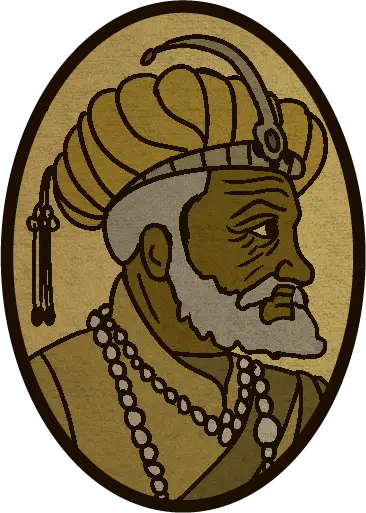
Azani III ascended the throne at the age of 21, while his brother Rakash would become an admiral in the Kasaaqi Navy at the young age of 20 only six years later. Almost immediately following Azani III’s ascension, the Toofani Raj collapsed due to rebellions and internal turmoil. Consequently, the Vyzum was freed from kasaaqi control, and there were rumors that many of the rebels were funded by the Lunar Collective.
Sins of the Past
The first few years of Azani III’s rule were tumultuous, as even after losing the vyzumi territories the Hukumat became involved in the ongoing “Lunar Ashfall War”. The Lunar Collective had been expanding their colonies within the Ashfall Isles, and set their sights on Therah in 3E435. The Lunar Navy quickly took control of the city, and House Aylarov temporarily moved to Kasaaq. The Lunars would hold the city of Therah for five long years while blockading Kasaaq from trade, the two nations witnessing maritime clashes throughout this occupation. In 3E439, the 20 year old Nausenapati Rakash Zaaba would ambush the lunar blockade off the coast of Suneb. The Battle of Suneb was infamously the biggest maritime loss that the Lunar Navy ever experienced, and by early 3E440 Azani III would use this victory as one of the bargaining chips that he needed to negotiate peace with the lunars. The occupation of Therah ended, and House Aylarov was once again put in control of the island. In truth, while Rakash’s gambit worked, he attacked the lunars without the approval of the Mahataraja. The brothers argued a lot about their choice of tactics, but everything seemingly worked out for the best. In fact, Rakash’s victory led to many calling him “Rakash IV” despite him not being on the throne. Despite the arguments the brothers constantly had, they were close to each other.
Rakash was then married to the princess of Jamre, Adeaa Vanem. She stayed in Kasaaq for the first decade of their marriage, but Rakash would spend most of his time at sea or abroad. Their daughter, Chikuu Vanem-Zaaba, was essentially raised by Azani III alongside his own children. Eventually Rakash and Adeaa became estranged, and she took their daughter back home to Jamre upon her ascension as the new ruler of the Kwadenhi.Azani III focused his efforts into improving the infrastructure of the Kav’orra, with his primary goal being the creation of a new railroad system that would connect all the cities of the desert. A nation connected via the steam locomotive would become more centralized, and would allow faster movement of troops and traders alike. He shared this goal with Ranaji Jai Kawar Sahib of Ammba, and the two began the construction of this railroad together. Ranaji Jai knew that this railroad would allow the Zaabas to exert further control over Ammba, but it would also connect the mountain city to the riverine trade routes and bring greater prosperity to the dwarves. The first leg of the railroad was constructed in between Dibayad and Ammba through the town of Tefniki, and construction finished by 3E463. The line was further extended south beyond the river to a new town called “Traintown”, giving the Hukumat a point of entry into the Vyzum Wastes now that they had lost Kaitzur. Now that they knew that the train line worked and would survive the harsh desert, they began construction of the second leg of the system that would connect Ammba to Kasaaq via Wa’sadak. A much longer route through a much sandier desert, this would take a long time to construct and the engineers faced many challenges due to the terrain. Construction is still ongoing to this day. Around this time, the new Vyzumi Republic had been constructing their own steam train line connecting Erumaltu to Newhope, and agreed to connect their railroad to the kasaaqi one in Traintown for a brief period of time.
In 3E467, there was a ball being held in Kasaaq in honor of the annual Artisan’s Fair with many dignitaries from across the globe attending the event. It was interrupted chaotically when an “Angel of Knowledge” descended upon the event, and declared that the kasaaqis were sinners. In truth, this was a declaration of war from the new Calamity Covenant. The Covenant was a coalition of the edeni nations, including the Vyzumi Republic, the Kwadenhi, the Varhamsat Khadumate, and the Kingdom of Yoldra. The angel was defeated, but not before it came to be known that the angel served Zaran Zehir, who had managed to become the president of the Vyzumi Republic. The surviving Zehir half-drow had returned seemingly from the dead, and swore revenge against House Zaaba while somehow commanding angels.