Tieflings are generally similar to their regular D&D counterparts as found in the Player's Handbook. They are a planetouched race, and are the fiendish alternative to Aasimar.
To be greeted with stares and whispers, to suffer violence and insult on the street, to see mistrust and fear in every eye: this is the lot of the tiefling. And to twist the knife, tieflings know that this is because a pact struck generations ago infused the essence of the Nine Hells into their bloodline. Their appearance and their nature are not their fault but the result of an ancient sin, for which they and their children and their children's children will always be held accountable.
Tieflings are generally derived from human bloodlines, and in the broadest possible sense, they still look like humans or whatever race their parents were. However, their infernal heritage has left a clear imprint on their appearance. Tieflings have large horns that take any of a variety of shapes - some have curling horns like a ram, others have straight and tall horns like a gazelle's, and some spiral upward like an antelopes' horns. They have thick tails, four to five feet long, which lash or coil around their legs when they get upset or nervous. Their canine teeth are sharply pointed, and their eyes are solid colors black, red, white, silver, or gold with no visible sclera or pupil. Their skin tones cover the full range of human coloration, but also include various shades of red. Their hair, cascading down from behind their horns, is usually dark, from black or brown to dark red, blue, or purple.
Tieflings subsist in small minorities found mostly in human cities or towns, often in the roughest quarters of those places, where they grow up to be swindlers, thieves or crime lords. Sometimes they live among other minority populations in enclaves where they are treated with more respect.
Lacking a homeland, tieflings know that they have to make their own way in the world and that they have to be strong to survive. They are not quick to trust anyone who claims to be a friend, but when a tiefling's companions demonstrate that they trust him or her, a tiefling learns to extend the same trust to them. And once a tiefling gives someone loyalty, the tiefling is a friend or ally for life.
Tieflings were known for their cunning and personal allure, which made them excellent deceivers as well as inspiring leaders when prejudices were laid aside. Although their evil ancestors could be many generations removed, the taint lingered. Unlike common belief, tieflings were not predisposed to evil alignments and varied in alignment nearly as widely as full humans, though tieflings were certainly devious.
Tieflings of Abmarah
Tieflings are the race formed from the corruptive touch of Fiends onto any of the mortal races. They are an outsider-touched race connected to the lower planes, and have little culture of their own in Abmarah.
In the Kav’orra Desert, tieflings are somewhat more common as compared to other regions and have thus become more normalized and accepted within their society. Even Ashtadharma does not vilify them as much as some other faiths. That being said, noble families still hold on to deep-rooted biases against them, and try their best to not introduce fiendish blood into their family trees with varying levels of success. In the Kav’orra, chthonic-tieflings are more common than infernal-tieflings, representing descent from rakshasas. On the other hand, abyssal-tieflings are rarely encountered here. The colorful tieflings of the desert tend to have brown-purple hues in their skin colors, and often find positions of power due to their natural charisma. Why they are more common in the desert is unknown, and could simply be due to migration caused by the acceptance.
The physical appearance of a tiefling often depended on the exact ancestry that spawned them, a bloodline that might have remained dormant for generations. These 'subraces' are generally linked to the Nine Archdevils of the Nine Hells, being:
Tiefling (Krros). The most common type of tiefling, with the distinctive red skin and horns. The tieflings connected to Tartarus command the power of fire and darkness, guided by a keener than normal intellect, as befits those linked to Krros himself. They use the Tiefling (Asmodeus) statistics as presented in Mordenkainen's Tome of Foes, or The Players Handbook.
Tiefling (Kaeha). The freezing misty plane of Letheos is ruled by Kaeha-te-tipua, the Blasphemer of Loss. He excels at corrupting those whose minor sins can be transformed into acts of damnation and losing their memories. Tieflings linked to this archdevil can corrupt others both physically and psychically. They use the Tiefling (Baalzebul) statistics as presented in Mordenkainen's Tome of Foes.
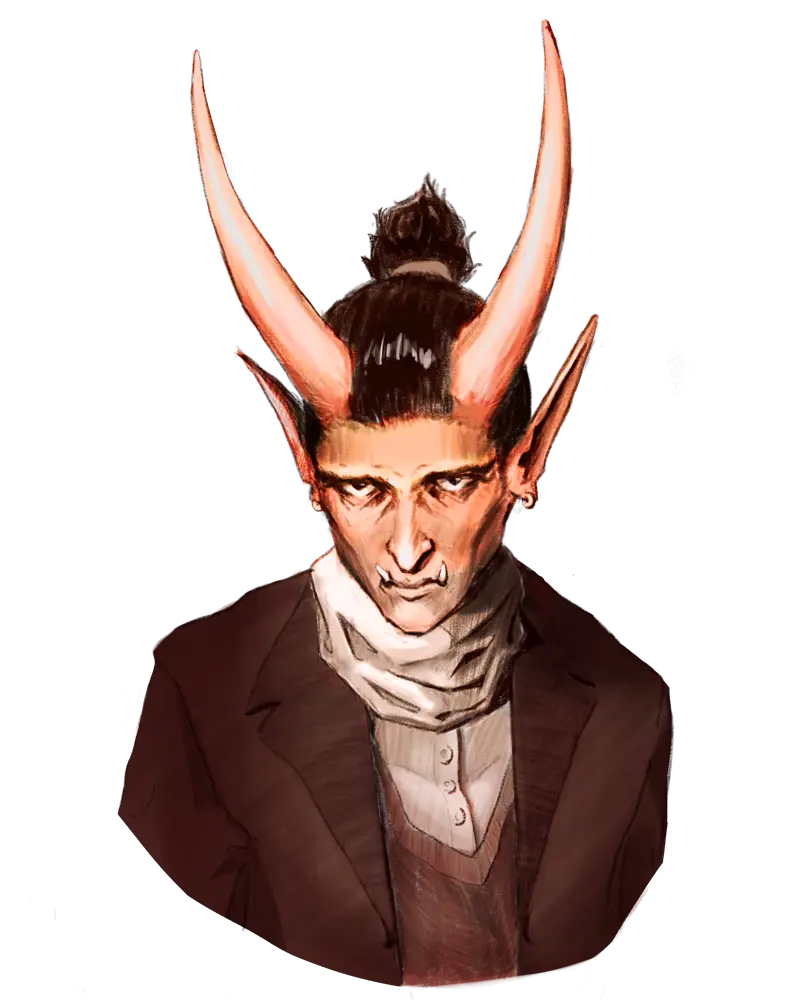
Tiefling (Iebael) / Oniling. The Kijin archdevil Iebael-no-Okami, the Lady of Flies, rules the plane of Meigoku. She lends her blood to two similar types of beings on the material plane: The monstrous Oni, and the Onilings. Onilings are regarded with awe and respect in Cinoh- their infernal bloodline seen as proof of their power. They regularly find themselves in positions of authority, much like the archfiend they draw their bloodline from.
An Oniling character has the following racial traits, and is considered to be a Tiefling for the purposes of meeting any prerequisites for feats.
Ability Score Increase. Your Charisma score increases by 2; choose any other +1
Age. Onilings mature at the same rate as humans but live a few years longer.
Alignment. Much like the devilish fiends themselves, Onilings tend to draw towards Lawful alignments.
Speed. Your base walking speed is 30 feet.
Size. Onilings are about the same size and build as humans. Your size is Medium.
Darkvision. Thanks to your infernal heritage, you have superior vision in dark and dim conditions. You can see in dim light within 60 feet of you as if it were bright light, and in darkness as if it were dim light. You can't discern color in darkness, only shades of gray
Hellish Resistance. You have resistance to fire damage.
Legacy of Iebael. You know the prestidigitation cantrip. When you reach 3rd level, you can cast the charm person spell once with this trait. When you reach 5th level, you can cast the alter self spell once with this trait. Once you cast the spells using this trait, you can’t cast that Spell with it again until you finish a Long Rest; however, you can cast the Spell using any Spell Slots you have of the appropriate level.
Intelligence, Wisdom, or Charisma is your spellcasting ability for the Spells you cast with this trait (choose the ability when you select the race).
Languages. You can speak, read, and write Common and Infernal.
Tiefling (Vazael). The craggy plane of Gehenna is ruled by Veiros Vazael, the Angel Archdevil known as the Dealer of Torment. He is known to be one of the most cunning devils, a trickster who can convince anyone to give away their soul and life. Tieflings descended from him can create nearly any illusion. They use the Tiefling (Glasya) statistics as presented in Mordenkainen's Tome of Foes.
Tiefling (Gol'roth). The icy river-plane of Styxia is ruled by Gol'roth, the Celebrant of Corruption. Known to enjoy death and carnage, he follows the iron logic- Might makes right. He often offers bargains to those who face an inescapable doom. Tieflings descended from him tend to be blue in color, and use icy magic. They use the Tiefling (Levistus) statistics as presented in Mordenkainen's Tome of Foes.
Tiefling (Dizimówáng). The lava-filled fiery plane of Phlegethos is ruled by Dizimówáng, the King of Punishment. He is the archetypical devil, ruling over the most hell-like hell. He enjoys dealing out punishment and pain to all who end up in the Hells. Tieflings descended from him know how to deal out fire and pain. They use the Tiefling (Mephistopheles) statistics as presented in Mordenkainen's Tome of Foes.
Tiefling (Kordeva). The stinking bog-plane of Duzakh is ruled by Kordeva, the Whisperer of Rebellion. Her chaotic nature allows for nearly anything to happen to those under her, as she often ends up taking a personal interest in her playthings. Tieflings descended from her know how to make their voice be listened. They use the Tiefling (Dispater) statistics as presented in Mordenkainen's Tome of Foes.
Tiefling (Lilithys). The barren city-plane of Vaitarnus is ruled by Lilithys, the Snake of Seduction. She is known to be able to seduce nearly anyone, be it man or woman. The succubus archdevil is the daughter of Krros and the siren goddess Aquesue. Tieflings descended from her are charming, and natural seducers. They use the Tiefling (Fierna) statistics as presented in Mordenkainen's Tome of Foes.
Tiefling (Judora). The first layer of the Hells, Acheren, is ruled by the chromatic dragon Queen Judora. She revels in the chaos of the endless blood war, and recruits many a dragon and knight to her cause. Tieflings with a blood tie to Judora are stronger than the typical tiefling and receive magical abilities that aid them in battle. They use the Tiefling (Zariel) statistics as presented in Mordenkainen's Tome of Foes.
In addition, there are a few more subraces of Tieflings that are not tied to any of the nine archdevils, but to the gods of the afterlife and other fiendish ancestries:
Tiefling (Theratis) / Winged Tiefling. The goddess Theratis rules Azydos, the plane from which she decides who goes to heaven or hell. Some tieflings descend from her influence, instead of a true archdevil's. Tieflings descended from her grow dragon-like wings that allow them to fly. They use the Tiefling (Winged) statistics as presented in the Sword Coast Adventurer's Guide.
Tiefling (Moros). The titan Moros used to be the ruler of Azydos, before his death in the Omniborn Crisis. While he is gone and replaced by Theratis, his blood lives on in some rare tieflings to this day. Tieflings tied to him excel at gathering and safeguarding their possessions. They use the Tiefling (Mammon) statistics as presented in Mordenkainen's Tome of Foes.
Tiefling (Abyssal). The heartless entropy of the Abyss calls to these tieflings. Horns, fur, tusks, black blood, and peculiar odors are common physical features of these abyssal tieflings, most of whom have the blood of demons coursing through their veins. They use the Tiefling (Abyssal) statistics as presented in The Players Handbook (2024).
Tiefling (Cthonic). These tieflings, also tied to the lower planes, derive their power neither from the devils nor the demons. Some of these tieflings look cadaverous, or they have physical features in common with a night hag, a yugoloth, or some other fiendish ancestor who doesn't fall in line with devils or demons. They use the Tiefling (Cthonic) statistics as presented in The Players Handbook (2024).