Most of the information here is sourced from the book 'On Lycanthropy' written in the year 3E048 by Archhunter Oliver 'Oly' Darkmere of the Blackreyne Brotherhood.
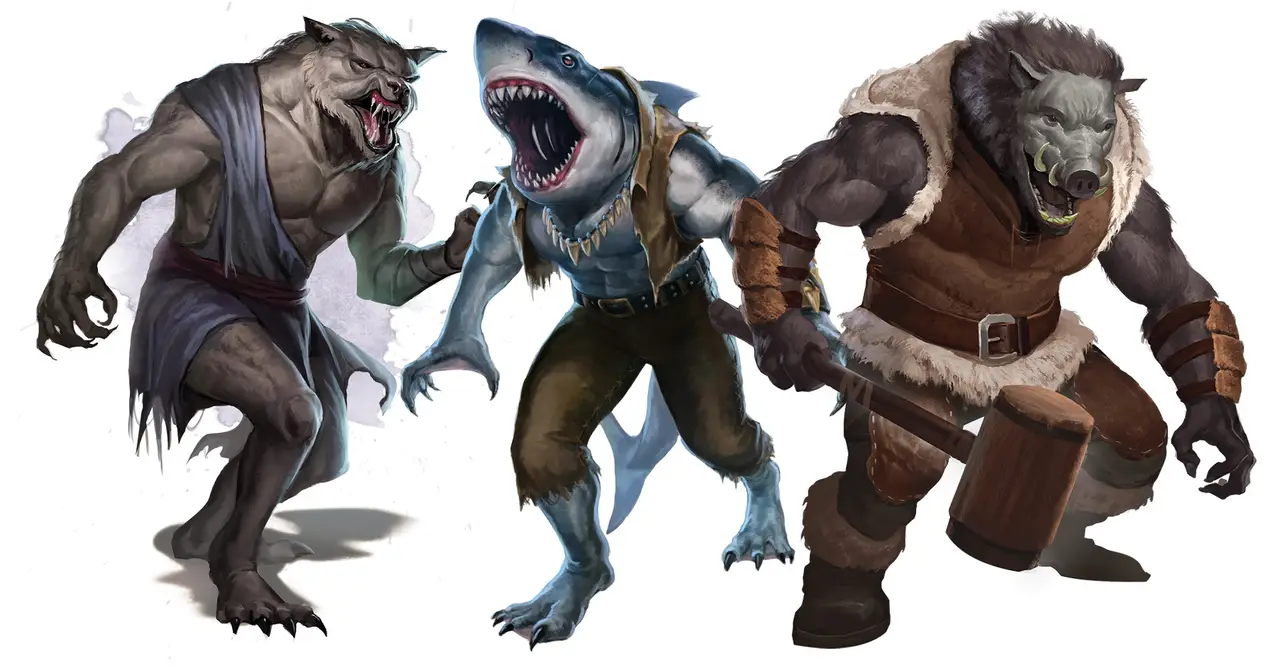
Lycanthropes, also known as Werebeasts, Weretypes, Nightwalkers, and Manbeasts, are individuals afflicted with the curse-disease of Lycanthropy. They are not a 'race', despite what those prejudiced against the Beastfolk would tell you. The origin of the word comes from the most common weretype, the wolf. Lycanthrope literally translates to Wolf-Human, or Werewolf, but of course there are various different strains of the disease related to different beasts. Werewolves are the most common Lycanthrope and the one most easily identified as one, as there is no race of beastfolk wolf-men otherwise. Other common ones include Wereboars, Weretigers, Werebears, Wererats, Werebats, and the Weresharks. Uncommon strains include the Wereapes, Werebadgers, Werebison, Weredogs, Werefoxes, Weremoles, Werespiders, Wereowls, Werewolverines, Werecrocodiles, and so on. There are rumors of the existence of Weredragons, but none have ever been proven to exist.
Origin
Lycanthropes are different from the actual beast races, who are sentient individuals in control of their actions born naturally. Almost all beast-folk be it Panshera, Owlin, Ursine, Saurian, or even Kenku trace their origins to one moment in history- The Beastbirth. During the Realmshatter in 810 BR, the once-creator god Omegus poured his life magic into the heart of the churning chaos. Some think this was an attempt to fix the Realmshatter, while some others think that he purposefully amplified his powers using the chaos. This created a surge of wild divine magic that spread through the cosmos, and 'awakened' beasts, monstrosities, and plants of all varieties into new humanoid forms. These were no mindless beings, but new intelligent races. The Beastborn were not accepted immediately, of course. They were despised by the existing races of Elves and Men alike, considered lesser due to their animalistic origins. Many became slaves, others shunned from society and left to make their own. It took hundreds of years for this animosity to disappear, and of course some might argue it never really did. However, the hatred that the Beastborn universally faced in the early years led to the darkness that we now call Lycanthropy.
In 721 BR, a cult of malevolent beastfolk mages and druids named 'The Silvermoon' came together in eastern Eqos near Kazarin Peak. Using arcane rituals gifted to them from Varkanus and Gunian alike, they created the curse-disease of Lycanthropy to be unleashed upon the other races of Abmarah. All beastfolk are immune to Lycanthropy, of course, barring a few exceptions here or there. The Silvermoon wished for the other races of the world who looked down upon them to become what they hated most- true beasts. A non-beast humanoid with the curse would lose their sapience, and turn into beasts. Some hybrid, some fully. This curse has one in-built weakness created by the mages: Silver. It is also connected to the largest moon of Abmarah, Lunaa, with the curse being its strongest every month on a full moon. This implies the influence of the goddess Atrius onto the phenomena as well, perhaps. This vile curse fueled by hatred, revenge, and spite has now infected nearly every corner of Abmarah and beyond. The Silvermoon is no more, and thousands of years have gone by since that age of hatred and racial tension. The Beastfolk are relatively accepted across the world, and yet Lycanthropy still exists as this curse that cannot be undone.
Effects & Society
While Lycanthropy can infect any non-Beastfolk race (barring exceptions) it is most easily transmitted to Elves, Dwarves, Humans, Omniborn, and Tritons. These races were the original targets of the curse, although others can catch the infection as well. While Beastfolk are generally considered immune to the disease, in reality it is more like a 0.1% to 1% chance of infection as compared to a nearly 50% to 70% chance for a human. The curse-disease is transmitted via blood contact, usually in the form of a bite but can also be transmitted through wounds, claws, sexual contact, or even magical items. There have been cases of physicians accidentally spreading Lycanthropy through the use of unwashed syringes. A child of a lycanthrope generally tends to inherit the condition, especially if the lycanthrope is the mother.
Lycanthropes are almost universally despised and feared, even by other beastfolk. While the ignorant masses may not be able to tell the difference between, say, a Tigari Panshera man and a Weretiger... If one stands next to the other, the difference becomes clear. A lycanthrope is taller, larger, more bestial, has sharper claws and salivating teeth, and of course... Usually completely devoid of any sanity or emotion other than rage and hunger. There are individuals who learn to control the form and use it as a power or even a blessing, but this control over the form is learned and refined over a long time of meditation and practice. Some Lycanthropes transform every night, others only lose control when the moon Lunaa is full, few have full control over their transformations, and the rare few can hide the beast forever. There are many organizations dedicated to hunting down lycanthropes, including the Blackreyne Brotherhood. Not every lycanthrope is evil, of course, but the ones who have little to no control over their transformations or their beast form are a danger to everyone around them. While most lycanthropes are solitary due to the nature of their lives and existence, many do group up into organizations of their own that serve as support structures for those afflicted with the disease. These organizations tend to view the curse as a blessing, more often than not.
Treatment
Like any curse or disease, lycanthropy can be cured. However, most curative spells, psionic powers, and methods that could usually rid one of a disease or curse have no effect against lycanthropy. The vile hatred imbued in the curse resists most attempts to remove it. In terms of mundane methods, consumption of the plant belladonna was widely believed to be capable of curing lycanthropy. However, this rarely has worked, and perhaps it just alleviates the symptoms instead of actually curing it. Some also claimed that leeches could be used to cure a victim, though this was demonstrably false.
In ancient days, violent anti-beastfolk groups would claim that the blood of beastfolk could undo the curse, only furthering the turmoil that created it in the first place. Other mythical cures went the opposite direction, as it was thought only beastfolk clerics and druids could cure a non-beastfolk humanoid.
Rare magical substances are said to be capable of curing lycanthropy, such as a Dragon's Blessing or a Moonstone. Gods and other celestials have been known to 'bless' afflicted individuals and cure them of the disease, and there have also been cases of Vampires who can remove the curse of lycanthropy but only if it is replaced by the curse of Vampirism. Suspended animation could be used to halt the progression of lycanthropy in a victim until an effective means of curing them could be found. There is a belief that if an individual's lycanthropy was hereditary, there was nothing that could be done to rid them of the condition. However, more research needs to be done on the matter.