"ROCK AND STONE."
Dwarves are generally similar to their regular D&D counterparts as found in the Player's Handbook.
Kingdoms rich in ancient grandeur, halls carved into the roots of mountains, the echoing of picks and hammers in deep mines and blazing forges, a commitment to clan and tradition, these common threads unite all dwarves.
Bold and hardy, dwarves are known as skilled warriors, miners, and workers of stone and metal. Though they stand well under 5 feet tall, dwarves are so broad and compact that they can weigh as much as a human standing nearly two feet taller. Their courage and endurance are also easily a match for any of the larger folk.
Dwarven skin ranges from deep brown to a paler hue tinged with red, but the most common shades are light brown or deep tan, like certain tones of earth.
Their hair, worn long but in simple styles, is usually black, gray, or brown, though paler dwarves often have red hair. Male dwarves value their beards highly and groom them carefully, while female dwarves often have enough facial hair to make them indistinguishable from the males to outsiders.
Whether or not the dwarven claim that they'd been carved from the world's stone was true, dwarves shared many qualities considered similar to the stone they lived with. Strong, hardy, and dependable, dwarves were polite, particularly to elders, and possessed a wisdom beyond that of many other races.
Dwarves valued their traditions, regardless of the subrace they came from, and looked for inspiration from ancestral heroes. Dwarves were also known for their stubborn nature and cynicism, traits widespread amongst the dwarves but which contributed to and were commonly offset by their bravery and tenacity.
Dwarven friendship was hard to earn, but was strong once won. Naturally dour and suspicious, the stout folk were slow to trust others, specifically those outside their family, suspecting the worst of an individual until the outsider had proved their good will many times. Once this trust was gained, dwarves held their friends to it and viewed betrayals, even minor ones, with a vicious propensity for vengeance.
Dwarves were unusually tough for humanoids, in more ways than one. Dwarven stomachs, for instance, were resistant to virtually all poisons and it took less effort for a dwarf to get back on their feet than other races. Dwarves also had dense bodies and were difficult to push around as a result, as well as having the capacity to bear loads that other races might find hindering with little ill effect. Dwarves also had a sense about them that few races did, with a preternatural awareness of their surroundings useful for a subterranean race as well as good judgment all-around in general.
Dwarves of Abmarah
Dwarves were supposedly carved out of the mantle by the titan Rhos in his own image, and he led the dwarves to become one of the greatest civilizations. Gnomes are said to be descended from dwarves as well. The great “Holy Dwarven Rhosian Empire” stood against the Omniborn in their rebellion against the gods, and were punished greatly with the loss of their empire. Rhos himself was slain in battle, and his student, the angel Vertum, became the patron of dwarven worship. Many still worship Rhos directly though, in hopes of reforging the titan. Vogh Vulfrhûn is the holy city of the dwarves.
Many kingdoms of dwarves across the world followed for centuries. The largest dwarven nation today is the Kingdom of Nûzabad within the Great Kingdom of Terros, conquered during the Great Aurian War. A prominent desert-dwarf kingdom, led by House Kawar, was built around the city of Ammba and stood independent for centuries until being conquered by the Kasaaqi Dynasty.
They have many subraces seen across the world of Abmarah. While the dwarves of Aurial have lighter skin, the desert-dwarves and jungle-dwarves of Eqos have darker skin-tones matching the warm lands they call home.
An Dwarf character has the same traits as found in the SRD or the Player’s Handbook, with the following lineages added to the existing option which we’ll refer to as “Mountain-Dwarf”. The Stonecutting feature of the mountain-dwarf is considered to be specific to that lineage, and is replaced with different features depending on the lineage with other features remaining the same.
Lineage | Feature(s) that replaces Stonecutting |
|---|---|
Mountain-Dwarf | Base Dwarf from the SRD or the Player's Handbook with Stonecutting. |
Hill-Dwarf | Base Dwarf from the SRD or the Player's Handbook with Stonecutting. |
Duergar | Superior Darkvision. You can see in dim light within 120 feet of you as if it were bright light, and in darkness as if it were dim light. You can't discern color in darkness, only shades of gray. |
Desert-Dwarf | Desert Hardened. You have Advantage on Constitution saving throws made to avoid exhaustion as a result of extreme heat, and have Resistance to Fire and Cold damage. In addition, you do not have Disadvantage on Wisdom (Perception) checks in sandstorms. |
Jungle-Dwarf | Forest Dweller. You have a Climbing Speed equal to your Walking Speed, and you have Advantage on saving throws you make to avoid or end the Charmed condition. |
In addition, Dwarf players have access to a unique Species Feat that they can choose to take in addition to other General Feats. Species Origin Feats can be chosen during character creation replacing any Origin Feat you would’ve received from your background.
Stonelike Resilience (Species Origin Feat). You can force your skin to harden and heal. As a Bonus Action, you can expend one of your Hit Point Die, regaining Hit Points equal to the number rolled + your Constitution modifier (minimum of 1).
They have many subraces seen across the world of Abmarah:
Mountain-Dwarves. The most common type of Dwarf, they are strong and hardy, accustomed to a difficult life in rugged terrain. They are a bit on the tall side (for a dwarf), and tend toward lighter coloration. A cynical and gruff people, but they are not, despite a reputation to the contrary, fatalistic, still possessing some hope for the future. Traditionally, clan and class meant everything among the mountain-dwarves but as their civilization declined so did the importance of these issues.
Hill-Dwarves. They are the aloof, confident and sometimes proud subrace of dwarves found commonly across the Dwarven Highlands. Considered to be less off-putting and gruff in nature than other dwarves, they were both materialistic and ritualistic, valuing themselves and others by what they possessed and by the reputation of their family. Hill dwarves were deeply conservative, rooting their values and beliefs in traditions that have survived for millennia even as the world changed around them.
Gray-Dwarves (Duergar). Duergar are dwarves whose ancestors were transformed by centuries living in the deepest places of the Underdark. They were further altered when mind flayers and other Aberrations invaded and performed horrific experiments on them. Those experiments left early duergar with psionic powers, which have been passed down to their descendants. In time, they liberated themselves from their aberrant tyrants and forged a new life for themselves in the caverns and beyond. Tyrannical, grim, industrious and pessimistic, the lives of the gray dwarves were bleak and brutal.
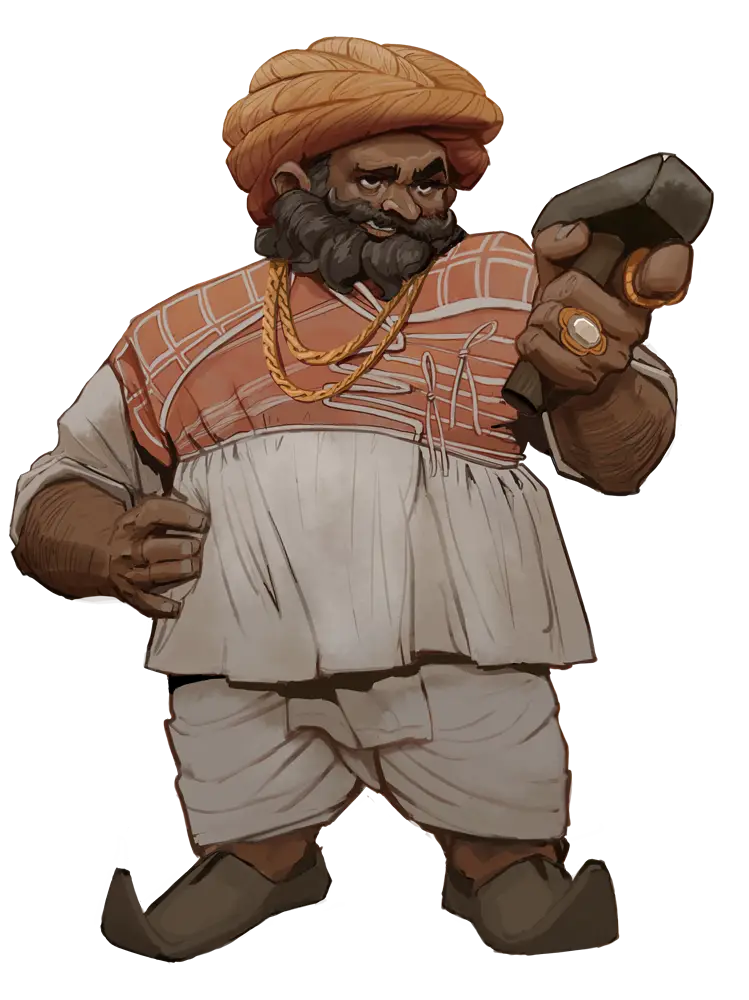
Desert-Dwarves (Ammban-Dwarves). The Desert-Dwarves are a small but proud people who call the lone mountains of the Km’mala Peaks and desert regions of the Kav’orra Desert their home. With their dark skin and thick black hair, they are well adapted to the harsh sun and rugged terrain of their homeland. They are famous for their love of food and drink, and their cuisine is a delicious blend of spices, flavors, and textures that are known across Abmarah. They are fiercely protective of their lands and traditions, but they welcome outsiders who show respect and honor for their culture. They are often called “Ammban-Dwarves” due to their central city, Ammba. Known throughout the land for their expertise in metallurgy and engineering, they are considered great artisans and patrons of the arts. Much like other dwarves, their society is organized around clans, guilds, and families, each with its own traditions, customs, and specialties. Like the city of Ammba itself, the desert-dwarves are based on the real-life rajasthani cultures of northern India. Unlike other dwarves who claim entire ranges, they were not able to expand further into the Km’mala Peaks due to fierce resistance by the dragonborn who already called the mountains home. The desert-dwarves were instead forced to hollow out the lone mountains within the desert and expand across surface sands and underground caverns.
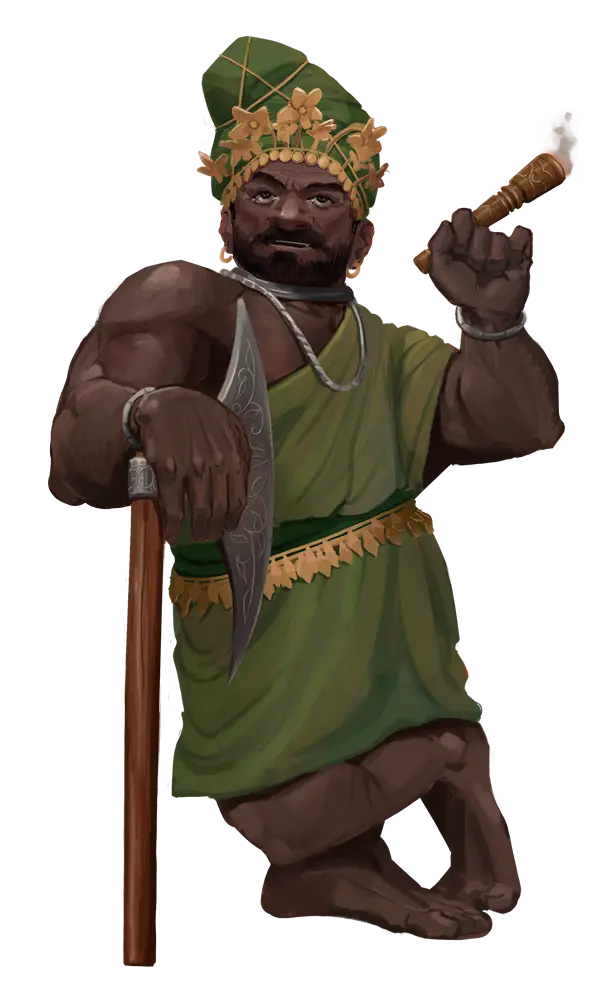
Jungle-Dwarves (Forest-Dwarves). The Jungle-Dwarves of the Goldheim Rainforest are possibly the least populous dwarven lineage. It's said that mountain-dwarves from Teer and the desert-dwarves from the Kav'orra Desert migrated to the Varkunasam Rainforest in the late primordial era, and over time developed into a unique culture. They are often called “Forest-Dwarves” or “Greenbeards”. They have darker skin with black-brown hair that is often decorated with leaves, flowers, or vines. Jungle-Dwarves are considered to be far more druidic and spiritual in their nature as compared to other lineages, creating intricate stone dwellings in and around the jungle hills. The dwarves have mined the southwestern Km’mala Peaks and the gold-rich hills of the Gold Beach for thousands of years now, and many of them hold influential positions within the Swarna Guild.