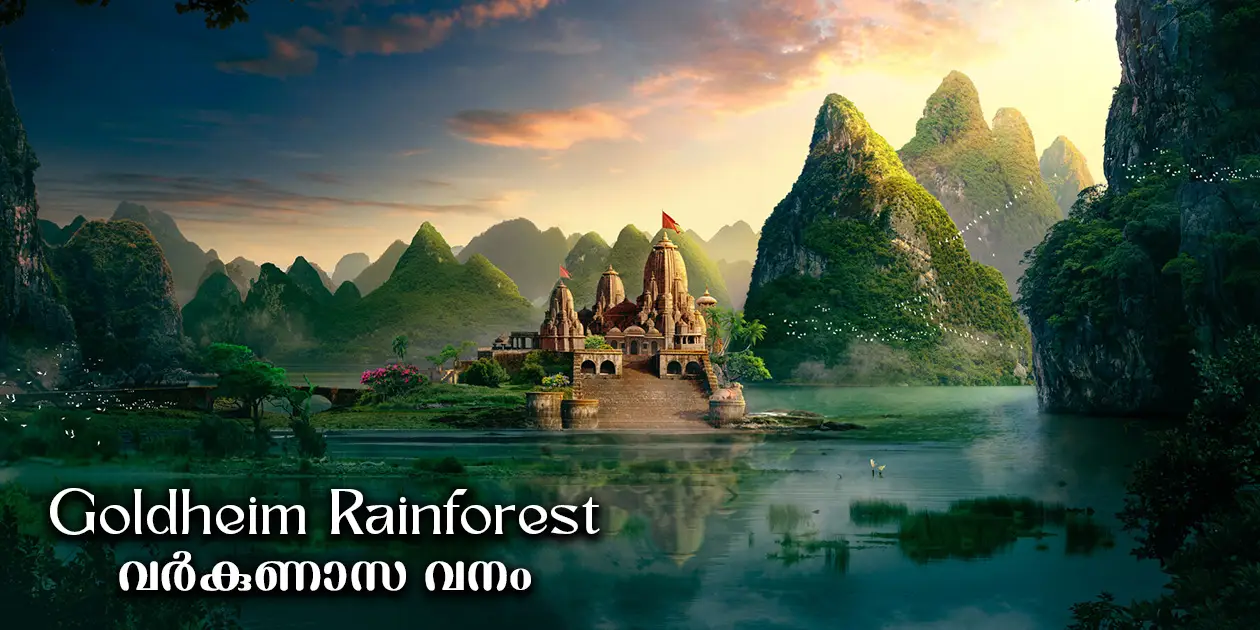
(Art credit: Anand Sonawale)
The Goldheim Rainforest or the Gullheim Regnskog (ᚵᚢᛚᛚᚼᛅᛁᛘ:ᚱᛁᚵᚾᛋᚴᚢᚵ), also known by its endonym Varkunasam Rainforest or the Varkunasa Vanam (വർകുണാസ വനം), is a large hilly rainforest in southwestern Eqos. It is entirely controlled by the Swarna Authority in the modern day, but has had a long history of political turmoil over its riches. Its coastline, also known as the Gold Beach, has long been raided by invaders from Teer and beyond for the gold found in the hills here. It is by far the greenest and most densely forested part of Eqos, isolated from the rest of the continent by the Km’mala Peaks. The forest is also full of rivers and lakes that dot its wet landscape, hidden from view beneath the dense canopy. While there are land routes that connect it to the rest of Eqos, trade and conquest has generally always taken place via naval routes around the Gold Beach.
The rainforest is the native home of the Bilari species, but has also been settled by humans and dwarves for thousands of years. It’s said that mountain-dwarves from Teer and the desert-dwarves from the Kav’orra Desert migrated to the Varkunasam Rainforest in the primordial era, and discovered the untapped veins of gold within the hills of the forest. The name “Goldheim” was coined by the dwarves, who over time have developed into a unique lineage often called jungle-dwarves or forest-dwarves. Through the entirety of the primordial era and most of the first era, the rainforest was an uncivilized expanse populated mostly by hunter gatherer tribal societies. In the late first era, it was taken over by the Surya Sultanate with little opposition. The Sultanate founded some of the first true major cities in the region, including the city that is now called Wesamala. After the death of Sol Sultana, the region fell under the split-off faction called the Varkani Emirate that centered on the city of Varkunast to the southeast of the forest. However, emirati control over the forest was nonexistent after a certain point, and the first native faction to gain control over the forest was the Varkunasam Kingdom led by a bilari clan named Varka. Their tribal monarchy lasted for a little under two centuries before it was completely replaced by the first medieval kingdom of the forest, the human-led Queendom of Wesamala which lasted into the third era. By the third era, many of the cities were beginning to grow in population and the area was effectively modernized. The gold mines were further developed and trade began to flow out from the forest into the world beyond, which of course attracted raiders and envy from outside forces. Varangian raiders from Teer would raid the coastal cities often, as naval warfare in the Goldroot Sea started to intensify. Internal strife and civil war would later lead to the rise of the Aatrii Kingdom in 3E126, who became the first faction to effectively repel the raiders and pirates that plagued the western coastline of Eqos. The gold trade made the Aatrii Kingdom especially rich, which eventually led to the rise of merchant guilds in the region that would create the Swarna Authority in the modern day.
The northern marches of Goldheim turn from lush forests into temperate coniferous hills. This separate area known as the Akshos Highlands (അക്ഷോസ് കുന്നുകൾ) is now often just called Vurmark, after the nation of the Vurmark Raj that controls it. It is the only land route that connects Goldheim to the Kav’orra. Vanadweep Island (வனாத்தீவு), also known as Kei’rss, is just off the coast of the mainland across the Kalapatthar Strait. The lush island is home to a large volcano called Mt. Neelamuki (நீலமுகி), and is the homeland of the vedavin species.
The Goldheim Rainforest or the Varkunasa Vanam is one of the only locations in this book that have extensively anglicized (or, well, scandinavized) names. This is due to the proximity of the nordic-inspired continent of Teer just across the sea from the western coast of Eqos. Therefore, in this fictional world where these two cultures have been put that close to each other, many words and names have been exchanged over time and places have multiple names. For example, the city of “Wesamala” is often called “Wesabos” by teerians, and the entire coastline is called the “Gold Beach” instead of the native “Swarna Samudratheeram”.