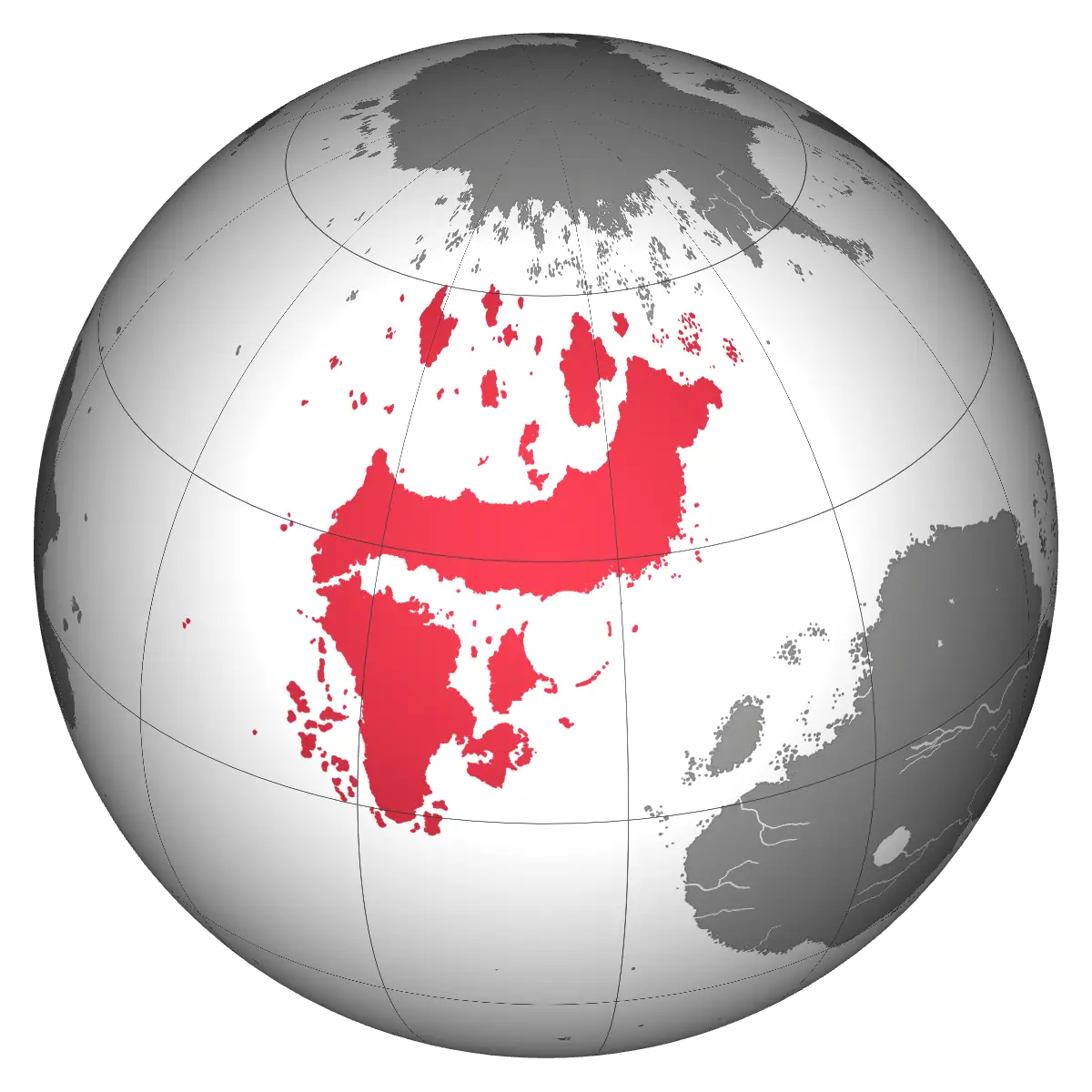
Teer (Tiir, Tir, Tyr, ᛏᛁᚱ) is the smallest continent of Abmarah. It is a rugged and isolated place characterized by icy mountains, fjords, deep forests, swamps, islands, and active volcanoes. Known as the "Spine of the World", it is primarily populated by Snow-Elves and Humans. The snow-elves primarily live in the western half of the main island, while the humans mostly populate the eastern half having migrated from Skion thousands of years ago. The two species have had deep rivalries and tensions throughout the history of the continent.
Though called a "continent", Teer generally refers to the combined landmass of all the islands of the region. More specifically, people use Teer to refer to the four largest islands: The largest island of Tirø, the second largest island of Sydön, the third largest island of Jotunøy, and the fourth largest island of Gigurinsaari.
The continent is home to multiple scandinavian-inspired nations, including the human-led theocratic High Kingdom of Jørdheim. Their capital city of Jordtræd is a marvel of druidic magic, built into the branches of a colossal 4500 meters tall world-tree known as the Jørðaskr (ᛁᚯᚱᚦᛆᛋᚴᚱ). The tree is a sacred symbol of their connection to the other realms, and their belief in the power of nature to sustain and protect them. There are other nations in and around Teer as well, including Jómagarðaríki in the east comprising primarily of snow-elves, Tórviland in the south, and the pirate islanders of the Sigmúnnlög in the north.
The world-tree is essentially the central focal point of the entire ecosystem of Teer, as its roots stretch below most of the continent and even into the Underdark. Funeral rites in Teer, especially in Jørdheim, involve burying people in barrows connected to the roots of the world-tree where their bodies and nutrients are absorbed into the Jørðaskr.
Though the Fylkir, the kings, and the queens hold most of the power over the lands of Teer, the free population still holds much sway in the governance through democratic assemblies known as "Things" or "Folkmoots". These regular meets are presided over Lawspeakers that are generally jakunist priests who mostly work for the monarchs. Things provide legislative functions as well as social and trade opportunities for those attending at the thingsteads.
Despite their reputation as fierce raiders across Eqos, northern Aurial, and western Eteru; the teerians are also famous as traders and merchants. Much of the eqosi west coast has areas named by teerians and house a significant population of them who have assimilated into the regions.
Climate and Seasons
TBD
Holidays
TBD
Languages
TBD
History
The continent of Teer was first settled by the Cloud-Giants, who ruled its entirety as "Jöturia", the kingdom of clouds. Their seat of power was the great World Tree of Jöturia, situated where modern day Svedäng is now. This first "World Tree" or "Jörðaskr" was a colossal ash tree nearly 4,500 meters tall, rising higher than all but one of the mountains of the nearby mountains. The giants made their city within its branches, with the giant tree representing a miniature aspect of the cosmic tree of realms.
However, at the end of the Angel Rebellion of 1182 BR, Khór ascended as the first archdevil and burnt the roots of the cosmic tree. This manifested physically at Jöturia, as Jörd and the angels fought against Khór and the new devils. As the first Jörðaskr burnt, Krros cut the tree cleanly in half, and used its branches to pierce the heart of Jörd. As both the physical tree and the cosmic tree were sundered simultaneously, the cosmos was plunged into the Realmshatter for a thousand years to come. The kingdom of the giants was destroyed, and Teer was then left to be claimed by the Snow-Elves.
The elves formed no kingdoms during the Realmshatter, and all their cities acted as independent city states. The largest and most important city of the Snow-Elves was Lyssost (later called Jómagarðr, now called Ljusbro) in the western reaches of the continent. They called Teer "The Spine of the World" for its shape, settling mostly around the rivers and fjords near the coastline of the densely forested land. They shared the continent with Mountain-Dwarves and other species such as Goliaths, but remained the majority. However, near the end of the Realmshatter, the first Human migrants arrived from Skion aboard a thousand ships. Escaping their rapidly freezing homeland and countless civil wars, these climate refugees landed on the eastern shores of Teer and founded the town of Jórvík. Initially, they were cautiously welcomed by the natives. However, as more and more of these northern humans began to settle Teer over the next few centuries bringing their militaristic culture with them, relationships became tense.
Little is known about the exact history of Sydön, the southern island of Teer. The South Island has always been a wilderness full of hills, swamps, and bogs. Though it is nowadays considered to be a part of Teer culturally and geographically, before the Cometfall the kingdoms of northern Teer paid little to no attention to the South Island due to its perceived danger and hostility of its tribal chiefdoms in addition to the comparatively harsh and warmer climate. What has always been true about the island post Beastbirth in BR810 is that it has been mostly populated by beastfolk. Cervans, Panshera, Saurians, Vulpines, Ursines, and Aven have long populated the island with the other species such as humans and elves always being in the minority. Most of these beastborn residents believe that the Beastbirth took place at Sydön, though it more likely happened across the sea in the Goldheim Rainforest.
At the end of the Realmshatter and the very first day of what marked the First Era of Abmarah, the new god of the realms Moðr commanded Cloud-Giant druids to plant one of the remaining saplings of the Jörðaskr tree near the center of the continent, on the eastern bank of the Tir river. With his blessing, this sapling would grow into a new Jørðaskr world-tree over the next thousand years. A new city was founded at the base of this sapling that would grow upwards into its branches like Jöturia of old, named "Jordtræd" and led by a High Priest or "Hofgoði". However, the city of Ljusbro (Formerly Lyssost) took offense with the tree being planted firmly on the perceived "human" side of the continent, and the western Snow-Elves banded together to form the Kingdom of Álfaríki. Around the same time, most of the other city states across the continent also started to form petty kingdoms such as the Kingdom of Jórvík, the Kingdom of Anheim, the Queendom of Goldörr, and others.
The initial centuries of the First Era were marked by constant territorial clashes between these many petty kingdoms across the continent, all while the new Jørðaskr grew taller over it all and Meiðrism spread. While all these kingdoms had all species, there was still a major human versus snow-elf undertone to the centuries of conflict. The middle centuries of the era actually brought a state of fragile peace, partly because all the kingdoms had to stop their in-fighting to deal with the threat of the "Cloud Giant Uprising." The neglected and looked-down upon Cloud-Giants of the mountains tried to carve out their own kingdom of the mountains, making enemies of all the humanoid petty monarchs. The uprising lasted many decades, but the giants were slowly pushed back into their mountain tribes and away from the lowlands.
However, the Omniborn Crisis at the end of the First Era would change Teer forevermore. When the Crisis finally reached the continent in 1E904, Álfaríki and Goldörr supported the gods while the other kingdoms stayed neutral. The two kingdoms merged to form the kingdom of "Jómagarðaríki" (Named in honor of the valkyrie Jómaboða Jomael and one of Ljusbro's older names), and protected the now tree-city of Jordtræd from Omniborn invasions for decades who sought to burn down the Jørðaskr. On the other hand, Anheim and Jórvík continued to feud with each other and used the chaos to their advantage. What happened next in 1E972 is debated to this day. Perhaps it was some sort of magic circle or cage spell that went awry because they used branches of the older Jörðaskr, or a curse upon the land by the gods or the Cloud-Giants. Perhaps it was an attack by Anheim, or an attempt by Jórvík that rebounded upon themselves. Endless magical fog and mist flooded the eastern shores of Teer, enveloping the entirety of the Kingdom of Jórvík and the entire eastern half of the Kingdom of Anheim. The fog permeated the land completely, rendering it uninhabitable to this day. This inhospitable region is now known as "Tåkevidda". Jórvík, the first city of the human settlers, was lost. When the actual Cometfall occured, Teer was shaken by multiple volcanic eruptions and intense earthquakes due to being on nearly the exact opposite side of the planet from the impact. The tree was almost destroyed in this cataclysm, but the druids managed to protect the continent from complete destruction.
Jordtræd survived the Crisis, and post-Cometfall this meant that Teer was surprisingly one of the continents least effected by the chaos of the Second Era. Unlike the rest of the world, instead of splintering into city-states, the remaining lands of northern Teer unified under the branches of the Jørðaskr. In an aim to finally end the centuries of bloodshed, High Priest Ysaak I of Jordtræd asserted his divine right and declared himself the King of Kings under Moðr's blessing in 2E004. With the new title of "Fylkir", Ysaak consolidated the cities together under a new theocratic monarchy led by him and his line. This new High Kingdom of Jørdheim controlled the entire northern island of Teer, with all previous petty kings and queens becoming "Jarls".
Whatever the pre-written tribal history of Sydön island may have been, the first city-state petty kingdoms started forming after the Cometfall into the second era. Exposure to foreign technologies and cultures through trade between Eteru and Eqos forced the native beastfolk to modernize and adopt new ways. The largest of these tradeports was the city-kingdom of Hirvelä. However, these cities were all quickly conquered by the new High Kingdom of Jørdheim which sought to unify the continent. Sydön was primarily colonized by the former Jómagarðaríki's snow-elves who brought in much of their language, culture, and writing system into the island.
The chaos of the Second Era did not truly escape Teer though, as this new unified Kingdom would spent decades dealing with raiders from the north. While the "vikings" of Teer were infamous as raiders themselves, they had to deal with raiders of their own. The Sea of Arrows north of Teer was a lawless region controlled by pirates and raiders for thousands of years, and despite the Fylkir's best attempts no order could be brought to the isles. In 2E346, a legendary viking pirate-queen by the name of Yurion Sigdóttir claimed to be a demigoddess daughter of the god of the seas, Sigmar. She took control of the largest city within the Sea of Arrows, Västergryt, and named herself the "Queen of all the North Seas". She brought a sense of order to the chaotic sea, putting down "Sigmar's Law" to form the loosely defined pirate-nation of the "Sigmúnnlög". After her death, successive kings and queens were chosen democratically in councils known as Sigmoots.
As the centuries progressed, without a common enemy to fight the old rivalries between the snow-elves and the humans began to resurface. The western elves resented being ruled by human Fylkirs, and sought to regain their independence. By this time, much of the nobility of the eastern cities was replaced by rich immigrants from Fyrstland across the sea. Near the end of the second era, a huge civil war broke out after racial tensions erupted. At the end of the brutal war in 2E487, the elves managed to secede from Jørdheim and reinstated Jómagarðaríki as its own kingdom. However, over the following decades they ended up losing Goldörr back to Jørdheim. The borders between the two kingdoms settled in their modern position divided by the Tir river by the time the Third Era began.
The locals of Sydön tried to reassert their power multiple times through the second era as well over centuries, though the combined might of the high kingdom—stretched thin as it was—proved difficult to overcome. However, post civil-war and the independence of Jómagarðaríki, the restored elven queendom got to keep Sydön though not for long. The elves alone were no longer able to maintain their hold on the island, and after a small war of independence in 2E613 the islanders separated to form their own kingdom. For the first time in its history, the entirety of Sydön island unified to become "Tórvi" or the Kingdom of Tórviland.