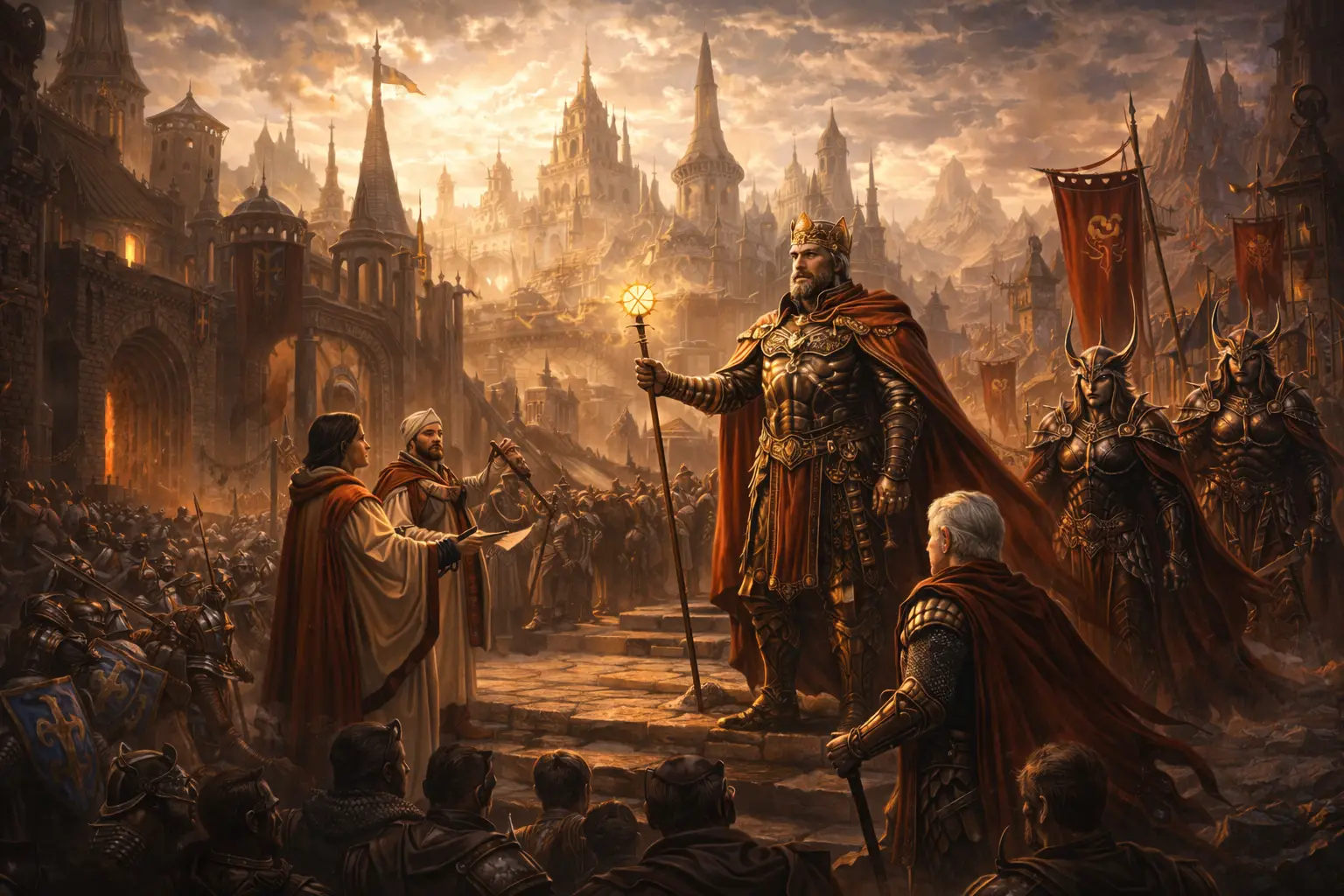
Human Migration and the Dragonmarked Houses
Period: ~3,000 Years Ago to 1 YK
Scholars at Morgrave University call the last five thousand years the Age of Humanity, contending that its defining trait is the rise of human civilization and its spread from Sarlona to Khorvaire. The gnome sages of the Library of Korranberg call it the Dragonmarked Age, asserting that the appearance of the dragonmarks and the achievements of the dragonmarked houses are more significant in the grand sweep of history than mere human achievements. Most people dodge this debate by simply referring to it as the modern age.
Both sides have a point. Humanity arrived on Khorvaire roughly three thousand years ago and spread across the continent with an aggression and adaptability that reshaped everything it touched. But the dragonmarks — mystical sigils appearing on the skin of specific bloodlines, granting abilities tied to specific functions — had already been appearing for centuries before humans arrived, and they did more to reshape the political and economic landscape of Khorvaire than any king or army.
"Humans did not discover Khorvaire. They moved into it. The continent already had owners. That distinction tends to get lost in the textbooks written by the new tenants." — Korranberg historian, comparative civilizations
The Migration from Sarlona
Approximately three thousand years ago, the adventurer Lhazaar led a wave of human settlers from Sarlona to the eastern shores of Khorvaire, establishing what came to be known as the Lhazaar Principalities. This was not a single expedition but the beginning of a sustained migration. Human civilization was well established on Sarlona — but it was also unstable, and over the centuries that followed, waves of conflict and upheaval on the eastern continent would push more settlers westward.
The most significant of these later waves came during the Sundering, approximately 1,600 years before the founding of Galifar. Over the course of two hundred years, the quori used manipulation and greed to stir up riots and wars across Sarlona, eventually establishing the Inspired regime that rules the continent to this day. These conflicts led to a wave of human refugees settling on Khorvaire, notably in the Shadow Marches and the Demon Wastes.
The humans who arrived in Khorvaire found a continent shaped by ten thousand years of Dhakaani civilization — and by several thousand years of Dhakaani collapse. The goblinoid empire had fragmented in the wake of the Kapaa'vola in the Age of Monsters. What remained were warring tribes living in the ruins of grand cities. The humans expanded aggressively, fighting and oppressing the goblins and other natives. Roads built by goblinoid engineers carried human settlers to territories goblinoid armies had cleared. Many early human settlements were built directly on Dhakaani foundations — often without understanding or acknowledging what they were building on.
When human explorers found goblinoid tribes living amid the ruins, many assumed the goblinoids had claimed the remnants of a human civilization they had destroyed. This false narrative was used to justify the displacement. Goblins were enslaved. Bugbears and hobgoblins were driven into the wilds or the upper levels of Khyber. In time, scholars learned the truth — that the foundations were goblin cities, not human. But by then, the political facts on the ground had long since been established.
"The halflings joke that the Mark of Hospitality prepared them for the arrival of humans, allowing them to make their new guests comfortable. There is some truth in the humour. The services provided by both halfling houses helped enable the spread of humanity across the continent. Hospitality and Healing were infrastructure before they were industries." — House Ghallanda historian, institutional history
The Early City-States
By approximately 2,500 years before the founding of Galifar, humans had spread across Khorvaire and the city-states that would eventually become the Five Nations were well established: Daskara, Korth, Metrol, Thaliost, and Wroat. These were not yet nations — they were competing power centres whose borders shifted with every succession dispute and military campaign. Political authority was personal and territorial. Alliances formed and dissolved. The period produced heroes, legends, and cautionary tales, but few durable states.
Malleon the Reaver built a fortress amid goblin ruins on the edge of the Dagger River around 2,975 years before the founding of Galifar, naming his keep Shaarat. Over time, it expanded into a powerful city. Five hundred years later, King Bregor of Wroat destroyed the rival city of Shaarat, asserting his power over the region. He eventually rebuilt the city and renamed it Sharn — the same Sharn that would be destroyed twice more before the present day, and which still sits on Dhakaani foundations that predate all of its human iterations.
Karrn the Conqueror, approximately two thousand years before Galifar, seized control of Korth and established the nation of Karrnath. After defeating the remaining goblinoid settlements, he attempted to conquer Daskara, Metrol, Thaliost, and Wroat. He failed. Karrnath became a nation; the other city-states remained independent. The pattern was set: Khorvaire's human settlements were powerful enough to resist conquest individually, but no single warlord could unite them by force alone.
"Karrn the Conqueror is remembered as the first man who tried to unite the Five Nations by the sword. He is not remembered as the last. The interesting question is why it kept failing, and what Galifar Wynarn eventually did differently." — Rekkenmark military historian
The Dragonmarks
The dragonmarks did not arrive with humanity. The first marks appeared among the halflings and elves centuries before human settlers even reached Khorvaire.
The Mark of Hospitality and the Mark of Healing appeared among the halflings of the Talenta Plains approximately 3,200 and 3,000 years before Galifar respectively. The Mark of Shadow and the Mark of Death appeared among the elves of Aerenal around the same time as the halfling marks. The Mark of Scribing appeared among the gnomes of Zilargo as humans were expanding across Khorvaire. By the time humanity was established on the continent, dragonmarks were already a known phenomenon — and the bloodlines that carried them were already accumulating influence.
Among humans, the marks appeared in rapid succession over the centuries that followed: the Mark of Sentinel among humans in Korth, the Mark of Making among humans of Metrol, the Mark of Storm among half-elves of Daskara, the Mark of Passage among humans of Thaliost, the Mark of Handling among humans of western Thaliost. Each mark was tied to a specific bloodline, and each bloodline organised itself into a house — a dynastic structure that combined family, guild, and economic monopoly.
The Mark of Warding appeared among the dwarves of the Ironroot Mountains. The Mark of Detection appeared among half-elves of Wroat. The Mark of Finding appeared much later, among the people of the Shadow Marches, and was not discovered by the wider world until House Sivis found its heirs there in 498 YK.
"The marks appeared among different species, in different regions, over the course of centuries. Nobody planned this. Nobody coordinated it. And yet the result is a system where every major economic function in Khorvaire is controlled by a specific bloodline with a specific magical advantage. If you designed this on purpose, you would be called a tyrant. Because it happened gradually, we call it commerce." — Brelish political theorist
The Destruction of the Mark of Death
One dragonmark did not survive into the modern age.
The line of Vol was a noble line of Aerenal with a long tradition of necromancy tracing its roots back to Xen'drik. When members of the line developed the dragonmark known as the Mark of Death, they undertook a series of experiments — magebreeding with rogue dragons — designed to unlock its full powers. Some whisper that what the Undying Court truly feared was a path shown in the Draconic Prophecy: that a child born of dragon and elf could become a godlike avatar of death. Others contend that this was simply good business for the Undying Court, who would not suffer others' mastery of immortality and thus create a rival to their power.
When the Aereni discovered the experiments, the Undying Court joined forces with the dragons of Argonnessen — an unprecedented alliance — and completely wiped out the line of Vol. Elves who had supported Vol but did not bear its blood were given the choice of exile or swearing fealty to the Sibling Kings. This resulted in a wave of exiled elves settling in the Lhazaar Principalities and spreading west into the lands that are now Karrnath. These exiles brought the knowledge of necromancy with them, along with stories of how the heroic family of Vol had sought to attain godhood only to be destroyed by the jealous gods.
The Mark of Death was eradicated. The dragonmark houses do not speak of it. Most people in the Five Nations have never heard of it.
"The dragons and the Undying Court agreed on exactly one thing in recorded history: that the line of Vol had to be destroyed. When those two powers agree on something, you should ask what frightened them both." — Morgrave lecturer, elven history
The Twelve and the Dragonmarked Houses
As the individual houses grew in power, competition between them became increasingly destabilising. Approximately 1,500 years before Galifar, the houses formed a formal alliance called the Twelve — a council and governing body that standardised practices, resolved disputes, and coordinated the collective interests of the dragonmarked bloodlines.
The Twelve gave the houses a unified political identity. It also gave others a common enemy.
"The Twelve was presented as an alliance for the common good. It was also a cartel. The distinction between the two has never been entirely clear." — Zilargo intelligence analyst
The War of the Mark
The first aberrant dragonmarks appeared soon after the true dragonmarks. Unlike the twelve recognised marks, aberrant marks were unpredictable — no two were exactly alike, and they could appear on members of any race, at any age, regardless of bloodline. They were also, at the time, generally more powerful and more dangerous than those known today.
The Twelve took true stories of innocents harmed by uncontrolled marks and amplified them. House propaganda and whispering campaigns built the perception of aberrant marks as dangerous and uncontrollable. Some members of the Twelve truly saw aberrant marks as abominations. Others considered them a convenient scapegoat to unite the houses and strengthen their collective position. Fear progressed to violence, and in time, to squads of Deneith soldiers, Vadalis trackers, and Medani inquisitors "protecting communities from the aberrant threat."
The title "War of the Mark" implies two even sides. It was not. It was a purge — a systematic campaign of eradication waged by the most powerful economic institutions on the continent against scattered individuals whose only commonality was that they bore marks the houses had not sanctioned.
Toward the end, a few aberrant-marked champions rallied others and challenged the houses. The most infamous were Halas Tarkanan and the Lady of the Plague, who seized the entire city of Sharn as both a hostage and a headquarters with their powerful magic and declared it a haven for those with aberrant marks. Eventually, the forces of the Twelve laid siege to the city. When Tarkanan and the Lady saw victory was impossible, they unleashed the full power of their marks. Tarkanan's mark gave him power over the earth, and he shattered the towers. The Lady of the Plague called vermin up from the depths and spread vile diseases through the ruins. Both the aberrants sheltering in the city, the civilians trapped inside, and the armies attacking it perished. Sharn remained in ruins for centuries.
Aberrant marks were almost completely eradicated. When they reappeared in later centuries, they were far weaker than Tarkanan's earth-shaking power. But since the Mourning, aberrant marks have been manifesting with greater frequency and greater power, and no one can explain why.
"Everyone knows Halas Tarkanan destroyed Sharn. Fewer people know why. The houses made sure the story started with the destruction and ended with the lesson: aberrant marks are dangerous. They did not include the part where the houses besieged a city full of refugees. That part does not appear in the curriculum." — House Tarkanan recruiter, Sharn
Main article: The War of the Mark
The Road to Galifar
The War of the Mark left the dragonmarked houses more powerful and more unified than ever. It also left the human city-states exactly as fractious as they had been before. The five major settlements — Daskara, Korth, Metrol, Thaliost, and Wroat — competed constantly. Karrn the Conqueror had demonstrated that no warlord could unite them by force. The War of the Mark had demonstrated that the houses could coordinate across political boundaries more effectively than the nations themselves.
The stage was set. What was needed was someone who understood that uniting Khorvaire required not just military strength but political architecture — someone who could offer the city-states something worth surrendering sovereignty for, and who could negotiate with the houses rather than trying to dominate them.
Galifar Wynarn was born in Karrnath years before the founding of his kingdom. He assumed rulership of Karrnath in what would later be calculated as –45 YK. In –15 YK, he began his campaign to unite the Five Nations.
Galifar did not simply conquer. He abolished slavery in his domain and promised freedom to the oppressed subjects of his enemies — a move that drew a significant number of goblins to his cause. He met with the Twelve and established the Korth Edicts: the houses would remain a neutral force, forbidden from holding land or noble titles, while receiving regulatory power and industrial preeminence in exchange for their support. This bargain gave the houses economic dominance while keeping them politically subordinate — or at least, that was the theory.
After a long campaign of conquest and diplomacy, Galifar I united the nations of Khorvaire under his rule, declaring this realm the United Kingdom of Galifar. During a later reign, a new calendar established this year as the first Year of the Kingdom — 1 YK. The modern age had begun.
He appointed his five eldest children as governors of the provinces and renamed them: Daskara became Thrane, Metrol became Cyre, Thaliost became Aundair, Wroat was named Breland after his daughter Brey. Karrnath, already bearing a conqueror's name, remained unchanged. In 5 YK, Galifar I and Princess Brey began reconstructing the ruined city of Sharn. In 15 YK, he established the Arcane Congress. In 40 YK, at the age of eighty-five, he stepped down and passed rulership to his eldest daughter, Cyre, which would establish the inheritance pattern for the ensuing nine centuries. He died in 53 YK.
"Galifar succeeded where Karrn failed because he understood something Karrn did not: that you cannot hold a continent with soldiers. You hold it with systems — laws that people trust, services they depend on, institutions they believe in. The houses provided the services. The laws provided the framework. The soldiers came last, not first." — Arcanix lecturer, political history
Main article: The Kingdom of Galifar
What This Period Established
The two thousand years between Lhazaar's landing and Galifar's coronation established every major structural feature of modern Khorvaire.
The Five Nations took shape as distinct political entities with their own identities, even before Galifar renamed them. The dragonmarked houses grew from family enterprises into continent-spanning monopolies whose services — healing, transportation, communication, manufacturing, banking — became the infrastructure of daily life. The Korth Edicts established the fundamental tension between crown authority and house power that would define every subsequent century of Khorvairian politics. The War of the Mark demonstrated what the houses were willing to do to maintain their position, and established the precedent of aberrant marks as a political and existential threat.
The goblinoid displacement was normalised. The false narrative — that goblinoids were primitives living in the ruins of a superior civilisation — became the foundation of Five Nations cultural identity. The truth — that human civilisation was built on goblinoid foundations, using goblinoid roads, atop goblinoid cities — is known to scholars but has not meaningfully altered public attitudes.
And on the eastern continent, the Sundering created Riedra — a quori-controlled state whose Inspired rulers have watched Khorvaire's development with interest and patience ever since.
"The modern age did not begin with Galifar. Galifar inherited a continent that had already been shaped by migration, displacement, dragonmark monopolies, and one very efficient purge. What he did was give it a name and a calendar. Which, to be fair, is more than anyone else managed." — Sharn journalist, editorial column