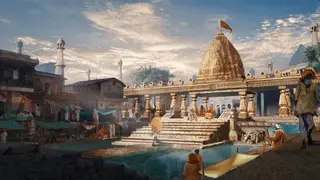
Therah (থেরা or थेरा) is a city on the similarly named island of Therah within the Ashfall Isles. It is the second largest city within the Kasaaqi Hukumat, and is currently controlled by House Aylarov. However, the city was controlled by the now-extinct House Majhii for most of its modern history until a coup in 3E365. A major trading hub, it projects kasaaqi influence across the sea and is a major strategic point of contention for other great powers such as the Lunar Collective who occupied the city for 5 years between 3E435 and 3E440. The tropical climate of the island is very different from the Kav’orra Desert, and supports rainforests that have been used as a source of lumber for the vast Kasaaqi Navy. The lumber was one of the major reasons why the city was “founded” in 2E607. In truth, the Hukumat simply conquered an existing town of saurians that was growing on its own for nearly a thousand years and renamed it Therah for the goddess Therahti. The city was settled primarily by the renari residents of the eastern Rethi Riverbank, leading to its modern rethvi culture and language. In fact, Therah is known for its unique culture and architecture influenced by all the various powers that have controlled it over the years.
From its origins as a village of saurians, to its growth as a renari settlement bringing in kav’orri aesthetics, and then the kazareth influence of its new Aylarov masters. Even the brief period of Lunar occupation created many buildings with a distinct lunarian aesthetic to them. Even the rethvi language spoken in Therah resembles real-life bengali much more than the rethvi spoken on the mainland which could be considered a bit archaic. This blend of cultures has led to Therah becoming somewhat of a philosophical and educational powerhouse, known for its centers of learning and artisanry.
The shores of the island are lined with mangrove swamps and coconut trees, and the grand docks of the city house ships from all over the world. Trade, fishing, and lumber are some of the most important economic forces in Therah, and its location grants it a lot of political power in the Hukumat as well as relative autonomy from the Mahataraja. Its streets are lined with fish markets and spice sellers, and the city is even known for growing and selling indigo. The island also houses many temples and ghats dedicated to the various gods, especially Aatrii and Sigdev. Mystics and shamans even claim that the island is alive, and that the tides can speak to them.
Therah’s trading markets and alleys are a haven for crime as the island-city’s wealth attracts thieves and pickpockets. As an island city, Therah is a hub for smugglers and pirates, who are known to bribe dock officials to unload their contraband. There are many secret docks around Therah known to be these black-market ports where ships go to avoid kasaaqi tax collectors. The city is also the home of an unnamed assassin’s guild, known only to nobles and criminals. While talking about crime in Therah, it is impossible to ignore the many dark cults known to have taken root within the city and its jungles. These black-magic occultists occupy abandoned temples and worship dark gods and demons alike. The Kasaaqi Sena patrols the streets, and is good at maintaining order in the wealthier areas of the city. However, the Sena is known to turn a blind eye in poorer areas especially when bribed. The docks are often instead patrolled by paid mercenaries working for individual shipping companies and merchants.
Areas of the city include:
Mooncastle. The largest fort and one of the most dominating features of Therah’s skyline is this coastal Chandqela (চাঁদকেল্লা) that is the home of House Aylarov. The foreign house rebuilt and expanded the earlier qila of House Majhii in a more modern and aurian style, trying to rival the qilas of the mainland. Some locations of interest other than the castle include:
The Senaghar, which houses the Kasaaqi Sena in Therah. It is one of the larger Senaghars in the Hukumat, serving as a port for the military vessels of the Kasaaqi Navy as well.
The Moon Tower, a tall observatory dedicated in the name of the moon goddesses Saedevi, Atrii, Noxa, and Arremidevi.
Munapura. The largest district of the city and the most middle and low-class one as well, Munapura (মুনাপুরা) is almost synonymous with Therah these days. It contains both the docks as well as the major markets of the city, and houses much of its population. Some locations of interest include:
The Thervi Harbor, a series of large docks and ports that are the primary entry point into the island and the city. Active both day and night, there are always hundreds of ships docked here at any given time from all over the world.
Hiramarket, the largest market street of Therah, is lined with shops selling everything from fish to jewels. It features many artifact shops as well, including a famous magic shop called the Kalapathar run by an amethyst-dragonborn named Thirosh.
The thervi branch of the Department of Dungeons, which is also one of the largest guildhalls in the Hukumat. This guildhall is built in an aurian style and houses many aurian employees.
The Statue of Illyrion Aylarov, a large obsidian-sapphire statue in the middle of the market square of the city. It replaced an older statue of Rajiin Majhii.
Saepura. The upper-class district of Therah built on a hill overlooking Munapura, Saepura (সাইপুরা) is lined with mansions and villas belonging to rich nobles and merchants. Many houses are actually not even occupied, owned by rich people from across the world who only visit the city once every few years. Some locations of interest include:
The Aylarov Akademiya, a large university funded by House Aylarov (and house Majhii before them) serving as the centre of science and philosophy in Therah. It is much smaller as compared to the Zrari Academy on the mainland.
The Gold Quarter, a street housing immigrants and merchants from the Swarna Authority who hold important positions in the various merchant guilds within Therah.
The Great Tax Office, a large aurian-style building built during the Lunar occupation of Therah. It was initially built as an administrative headquarters for the colonizers before it was repurposed to serve as a tax office for the Ashfall territories of the Hukumat.
Bhatialli Theatre, a large open amphitheater built during the initial few years of Therah’s founding by House Majhii. The best plays and songs are performed here, and many travel from the mainland just to attend them.
Atriikala. Atriikala (আত্রিকালা) is a small temple district on the western edge of the city where many pilgrims flock to. It contains a large plaza surrounded by temples dedicated to various gods, the largest one here belonging to the goddess Atriidevi. Some locations of interest include:
The Dilah Tree, a large banyan tree in the middle of the plaza that is considered sacred in Ashtadharma and is left countless offerings. It is believed that Yogi Athira once meditated under this tree for an entire year before his death.
The Lawhall, which is both the temple to Jakuu as well as the judicial court of the city presiding over matters that do not end up reaching House Aylarov.
Sigdevpura. Situated on a small island northwest of the main island of Therah, Sigdevpura (সিগ্দেবপুর or सिग्देवपुरा) is often considered to be a separate town from Therah entirely. However, it is still considered to be a district of Therah administratively, and is yet to gain true independence from the city. A rather poor community of fishermen, it is built around a large temple called the Sigdevmandir, dedicated to Sigdev, the god of the seas. It is believed that the temple was built in the early days of settlement by the kav’orri people, and visited by Sigdev himself in human form. While there is no proof of this, it has become the only point of tourism for the town.