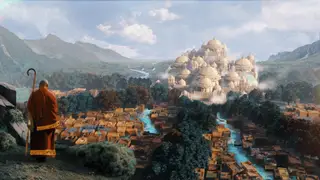
Koorjing (ꯀꯨꯔꯖꯤꯡ) is a small city of dragonborn within the northern Km’mala Peaks, situated in a small grassy valley just northwest of the Kav’orra Desert. It is ruled by House Anganba of the Kasaaqi Hukumat, and inspired by real-life manipuri culture. Koorjing is an ancient city and used to be smaller than its sister city Keningjei before its destruction during the War of Km’mala in the early third era. Even though the city was brought into the Hukumat by conquest, it has never rebelled after House Anganba was put into power. It is often considered to be the most culturally different city from the rest of the Hukumat, in part due to its different language, somewhat different view of Ashtadharma, and even the different climate. The temperate climate of the Koorjei Valley is wildly different from the desert, being much more hospitable due to the small streams within it as well as the large freshwater lake the city is built next to known as Lake Maglok. Agriculture and mining fuel the economy of the city, as trade is much more limited with only a few trade routes leading out of the valley. The koorjei-dragonborn of the city used to worship an ancient draconic faith, but have slowly accepted their localized version of Ashtadharma. The main deities that they worship are the dragon-goddess Therahti as well as the god of destruction, Murudev (here called Magrath). This has given the city a reputation of serenity and peace. However, House Anganba and therefore the city has rejected Solism from taking root within the city, preventing the Church of the Black Sun from influencing the valley to the best of their ability.
Much of the city is built in tiers on the hilly slopes, similar to the terrace farming present in the valley. It is known for its white marble temples and forts that are visible from a long distance away. The city has a strong warrior tradition, known for its discipline and loyalty. This dragonborn sense of honor and warrior traditions lead to strong laws and a heavy presence of the Kasaaqi Sena, employing mostly local dragonborn soldiers to prevent controversy. Crime is therefore somewhat rarer in Koorjing compared to some of the other cities within the Hukumat. Punishments for criminals focus on public service and atonements more so than long imprisonment or death, depending on the crime. Due to the dragonborn focus on clan and family, shame and loss of status are powerful deterrents in the valley. Warriors of Koorjing are trained in the local martial art disciplines known as Thang-Ta and Sarit Sarak, the first focusing heavily on swords and spears while the second focusing on hand-to-hand combat. Music and dance (including Raas Jagoi) are also important in the city’s culture, but usually have a religious aspect to them with plays and songs usually retelling stories of gods and divine heroes instead of focusing on new stories or fiction. The city’s food focuses on fish-based dishes flavored with mountain herbs, bamboo, and chillies. Temples and monasteries are central to Koorjing, and old draconic temples are given equal respect as the new ashtadharmic ones. Outside of the main castle-temple district, smaller temples are scattered across the city devoted to gods not worshiped as much in the region. Monasteries are mostly run by warrior-monks who follow more spiritualist beliefs rather than any specific religion.
Areas of the city include:
Angaa Fort. The largest fort and one of the most dominating features of Koorjing’s skyline, Angaa Fort (ꯑꯡꯥ) was constructed a few centuries ago and is built from white marble mined from the nearby peaks. It is the seat of House Anganba, and has many monasteries and temples within its walls. All of the upper-class residents of the city live within the complex as well. Some locations of interest other than the castle include:
Theralaisang, a large monastery dedicated to the goddess Therahti. It is the largest temple-complex within the city, and open to the public at all times.
The Rasenaghar, which houses the Kasaaqi Sena in Koorjing. It doubles as a temple to the god of death Raasha.
Tabupura. The largest district of the city, Tabupura (ꯇꯥꯕꯨꯄꯨꯔ) refers to the middle and low-class housing surrounding the Angaa Fort. Streets are built in a natural pattern following streams instead of grid structures, leading to many outsiders getting easily lost in the city. The district also has a lot of trees, with large canopies casting shade over the streets. Some locations of interest include:
Tabughar, the largest smithy in the city. It is government-owned and makes weapons and armor for the Sena. It basically has a monopoly on metalworking within Koorjing, with the smaller blacksmithies unable to compete with their prices.
The Silver Wyvern, a luxurious inn situated in the main street of the city. It primarily serves traders and merchants over adventurers, but is more affordable than the luxury inns of other cities.
The Koorjing branch of the Department of Dungeons, the newest guildhall of the Hukumat.
Magloka. A low-class fishing district built on the coast of Lake Maglok, Magloka (ꯃꯥꯒꯂꯣꯛꯥ) contains ramshackle houses and small docks meant for the ships that traverse the lake. The only point of interest is an old temple dedicated to Magrath.