The Omniborn Crisis, also known as the Age of Doom, is an apocalyptic war that lasted for a hundred years in between 1E875 to 1E977, marking the end of the first era with the near complete destruction of Abmarah through the Cometfall. It was led by the Omniborn race and many other mortals in a rebellion against almost all gods and the theocratic empires under them.
Before the Banquet (1E850 - 1E875)
Khaz Draxal ruled the Temporal Empire alongside his empress, Khaz Zaenak. The two were immortals, having lived for thousands of years already. By all measures, the world was at the apex of a golden age. Thousands of gods walked openly amidst mortals, and the empires stretched across the various planets and stars above in this age of arcana.
Draxal was one of the favored sons of Elder Mekalus himself, as one of the first Omniborn to be created alongside Zaenak. The two received the blessing of immortality from their creator, selected to lead their race forevermore. They saw all the ages of the world, going from using stone tools to hunt and farm to the grandeur of an interstellar empire. By all measures, they were like minor gods themselves, and the Omniborn surely saw them as such. The Empire was more bureaucratic and elective than truly feudal as modern empires tend to be, and the two immortals did not command supreme authority.
There are two interpretations of Khaz Draxal in the modern day. The more popular one is that he was a man with aspirations of becoming a true god-emperor, and that his hubris led to his downfall. The other one is more sympathetic, saying that Draxal saw the poison of the gods' decadence starting to rot the cosmos. He is one of the most talked about men in history and philosophy, as his actions have defined the course of the planet's history more so than any others. Modern rulers still style themselves as 'Khaz' to try and legitimize themselves as would-be successors to his legacy.
In some ways, Draxal was not wrong. The gods were numerous and enjoyed free luxury amidst mortals. In his eyes, far more gods than needed to exist. Even if some gods were necessary to the cosmos, thousands of minor gods of every creek and concept needed to be culled in his eyes. Many saints since have claimed that Draxal grew mentally ill, and that this psychopathic view of the arguably idyllic age around him was a symptom of his infinite age. Many philosophers have used Draxal's example as proof against seeking immortality or lichdom.
As much as he is vilified and defamed, he was not alone in his views, and slowly an unspoken philosophy of Draxalism started to spread amidst the population. This philosophy rejected all gods and instead revered only three forces: The Omniborn Law, the Omniborn Royalty, and the Omniborn Will. While this movement died out alongside the Omniborn in the Cometfall, traces of its philosophy remained in many places across the world, eventually forming the basis of Triadism in the modern day. Of course, Draxal would have hated this.
In the end, Draxal's views were simple. Gods had died before, thus they can be killed. A mortal was ascended to divinity, thus mortals could become gods. And in his eyes, that meant that gods having reign and status for simply existing was tyranny, and that all gods must be destroyed and cast down from their thrones, replaced by mortals to serve their roles like all the other jobs and bureaucratic positions within the empire. And only major roles need to be filled, and there need not be a god for every forest and every concept.
"Never again shall a farmer have to give tribute to the minor god of the hill he chose to live on. The gods deserve no taxes nor offerings, for they don’t promise any improvements nor securities. They only promise to exist—And that is why they ought not to." - Draxalite Philosophy, Volume II
Little is known about Empress Zaenak. Most pre-cometfall records and stories are lost to time, and what is known about her character is written by cultures that changed the stories to fit their views, religions, and gender norms. As such, she is far more mythologized than Draxal. What is known is that she was considered to be fair, shrewd, and far more politically active than Draxal. Most legends emphasize that there was no true love between the two immortals, and that they acted against each other all the time. (Some argue that this confuses the dynamic of the Omniborn gods Krakus and Saenus with those of the two Khazai.) They famously had no children together, despite their thousands of years of life. Some have interpreted them more so as platonic life partners than husband and wife as they are considered in a modern light. However, she is known to have supported Draxal in his decision to rebel against the gods, although many myths claim that she regretted this.
Regardless of the circumstances of why they rebelled, it must have been severely important in their eyes having seen more than any mortal now could comprehend. They chose to actively end the world's age of peace and decadence and plunge themselves into a war that they would not see the end of. Sentiment amidst the population of being against the gods would've been high, else the population would not have supported the two's decision as readily as they did.
The sentiment was certainly there even among non-Omniborn, as the Holy Triton Sigmosi Empire had fallen to civil war in 1E864, leading to the rise of the Aethian Dominion that only followed the goddess Aethys and was sympathetic to this growing anti-divine sentiment.
Start of the War (1E875 - 1E880)
Although the war lasted a hundred years, almost all the stages were set within the first five years of the spark. These first few years were the hardest for the mortals, since the gods had a significant advantage and near-indestructibility that they would later lose to Azbantium.
The Banquet (1E875)
Famously, the war began on the first day of the new year 875. A banquet was held in the capital city of Ikariyus, a glorious event attended by many of the leaders of the world including the Pontiff Aeternum of the time, Caelor III. The chief guest of this particular event was the goddess Alphus, who was universally loved and considered to be among the most important goddesses of the time. Some say that she was actually a lifelong friend of the Khazai.
That is, until Draxal murdered her while giving his toast. It's said that he toasted to the health of everyone in the room, to the world leaders that were in attendance, and when he looked to Alphus, he had a regretful look upon his face. He apologized to her, much to her own puzzlement. He said that she deserved this possibly the least, but she was to be the one whose example would set the world aflame.
Some sources say that Alphus understood, and silently mouthed forgiveness to Draxal, although there is no proof of this other than literary dramaticism. What there is a lot of proof for is the method of her death. Draxal cast a soul bind on her the likes of which had never been seen before, and destroyed the goddess within six seconds.
The leaders reacted with shock and awe, and Pontiff Caelor III immediately fired a spell at Draxal, causing a lasting scar on his horn attested in most sources. Some swore against him immediately in the war to come, while some such as the tritons vowed neutrality. Sol Sultana famously was present at this banquet, and is said to have laughed in shock when Alphus died.
Draxal immediately called the entire empire to war against all gods, decreeing them fallible like anyone else. Many minor gods already died on this first day as rebellion and chaos broke out across the world.
"And when we finally kill the gods neither hell nor heaven will be waiting for them, because they created those to imprison US." - Emperor Draxal
The First Years (1E875 - 1E880)
The Elven Imperium Aeternum as well the Holy Dwarven Rhosian Empire declared war against the Temporal Empire, taking the sides of their gods.
The Curse of the Nokren (1E880)
Even though the gods still had the upper hand, this was about to change. On Eqos, there was a city of Nokrborn known as Nokren that stayed neutral to the war and did not rebel against the gods. Great mages and scholars, they did not want to partake in the death and destruction.
However, in their patron Gunian's eyes, they were still Omniborn and had to pay for the sins of their emperor. What of the non-Omniborn mages living in the city? Well, they were guilty by association. Gunian descended on the city one fateful night alongside many minor gods, and unleashed terrible arcane destruction on the defenseless mages. Some say that he did this not out of zeal, but to gain the knowledge that the Nokren refused to share with him.
This betrayal of their patron god when they had already vowed to stay out of the war led to complete despair among the dying scholars, and the highest mages unleashed the woes of the city into a curse upon the gods that is unbreakable to this day. No longer would the gods have their invincibility, as the metal known as Azbantium (called Azbaan by the Omniborn) would be cursed to kill gods for the rest of time. Suddenly, the gods had a weakness.
They say that this curse manifested as Gunian was about to kill the Archmage of Nokren, when he stabbed the god with a dagger made of the metal. While this would've done nothing to a god, Gunian felt pain for the first time in his divine life as the curse took root. The Omniborn began to mass produce weapons made of Azbantium, and the fall of the gods was to follow now that they were on a more equal playing field.
Fall of the Gods (1E880 - 1E910)
starweapons
In 1E901, the southern extent of the Rhosian Empire was conquered by the Omniborn, forever separating the southern dwarves of Dobuka from their northern brethren.
The Death of Sol Sultana (1E898)
The Dying World (1E910 - 1E960)
Rule of the Lightwatchers (1E928-1E931)
In the middle of 1E928, an Omniborn named Kol-Han who was one of the generals of the Draxalite army stumbled into an ancient ruin deep under midwest Aurial in what is now the Cinder Steppe. It's said that he was in the middle of a fight against an unnamed god (possibly Magmus) when his troops were wiped out by the god's magic. He fell through the earth and ended up in a forgotten ruin, where he discovered the Pure Light and the truth of the cosmos. Realizing that this cosmos is the second one, the light accepted him as its new herald.
Kol-Han began to preach about the Light as a replacement against the gods, something that appealed to a lot of the people fighting against the gods at the time. His first twelve followers became the Liikor (now called the The Ballista) and together they created the Liikran (Lightwatch). Some prominent heroes joined him, including Zanisa of the Golden Souls and the angel Leonak. However, Khaz Draxal began to suspect Kol-Han and the Lightwatchers of treachery. He did not speak out against him at first, as they were another weapon to use against the gods.
The Lightwatchers became a zealous division of the military that slowly separated from the Draxalites over the year. For the next three years, they put down gods and converted people to the light especially in northern and western Aurial. At their height, the Lightwatch composed of ten thousand men under the thirteen Liikorai. In 1E931, Khaz Draxal summoned Kol-Han to his court in Ikariyus just to denounce the Light as yet another form of divinity. He exiled Kol-Han and the Lightwatchers from the Empire.
In retribution, with their usage of the light, Kol-Han forged the Liikal (Lightclaw), a dagger capable of heralding in the light. With this, he would be as strong as Morghos, and rise to become a god of light. However, the Omniborn and the Elves paused the war for a brief month, in which the two sides stopped fighting to exterminate the Lightwatchers instead. The light was too strong an enemy that would end mortals and gods alike. Gods, Elves, and Omniborn took down the Lightwatchers and the Liikorai, including an especially destructive battle between Magmus and Aries that led to him defeating her and taking the Lightclaw which was being delivered to Kol-Han.
The enemies of the Lightwatchers soon discovered that they were unable to kill the Liikorai due to protections cast upon them by Kol-Han being attuned to the Lightclaw even from a distance. They opted to imprison the Liikorai across Aurial, sealing them for eternity. They then conducted an arcane-divine ritual to sever Kol-Han from the Lightclaw, before sealing the dagger away forever under the watch of Markal Zuriel. Sensing the end, Kol-Han ended up sealing himself away deep under the Cinder Steppe, ending the rule of the Lightwatchers. He and the other Liikorai would not reawaken until the Lunar Revolution a thousand years later.
The Ruin of Celestia (1E960)
Pandemonium of the End (1E960 - 1E977)
Calamity of Death (1E962)
Krakus & Saenus' Betrayal (1E976)
The Cometfall (1E977)
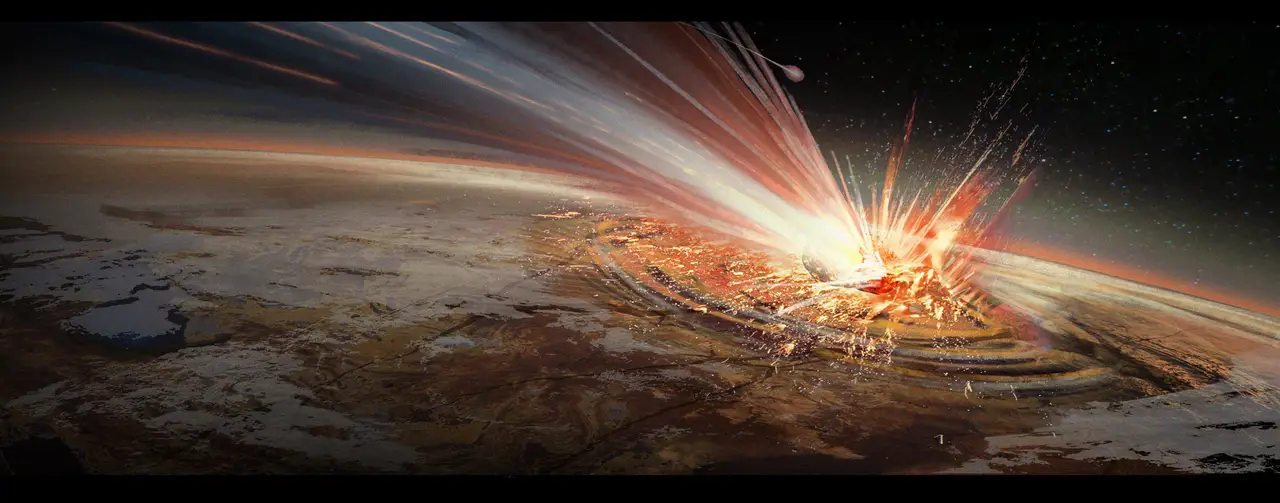
This war came to an abrupt end in the year 1E977, when the periodic comet ‘Zaenak’s Light’ inexplicably crashed into the shining city of Ikariyus, the capital of the Temporal Empire. Many myths state that Khaz Zaenak, who the comet is named after, called it to herself in penance for her sins. This impact shattered the southern half of the continent of Aurial, and caused severe destruction across Abmarah as a whole. Magic shields and the work of many gods helped to prevent a near complete destruction of all life on the planet, limiting the brunt of the cataclysm to southern Aurial.
As the shattered continent fell, the ocean rushed in to create the Blood Sea and new islands arose from the pieces of crust and volcanic activity. Many comets and meteorites have fallen on Abmarah, but this was a cataclysm the likes of which the world had never seen. The proudest city in the world was gone in an instant, becoming the epicenter of the new Cometfall Sea. It's said that the comet fell directly on the palace of Khaz Draxal, taking him out before any other Omniborn.
The impact of the comet caused magnitude 9 and 10 earthquakes all across the world, devastating most cities beyond repair. It caused tsunamis that swept hundreds of kilometers in-land, destroying everything in their wake. Many of the older cities that still remain were protected from this devastation through magical shields and wards, or perhaps devotion to the gods that remained. The impact caused the supervolcano Kazarin to erupt along with most other volcanoes on the planet, adding to the plume of debris and ash that filled the atmosphere. Within a matter of minutes, a blanket of darkness covered the entire sky, blotting out the sun for a decade to come and causing fire and acid to rain across the world for years more in a winter that lasted for countless years.
At the same time, all the Omniborn magically disappeared from the world as a whole, good and evil alike. The mystery behind all this is unexplained to this day, with only speculation to turn to. Some believe that the god that created the Omniborn, Elder Mekalus, destroyed them to undo his ‘mistake’. Some others believe that the comet was the god Varkanus’ doing somehow, and that he had used the Omniborn as a blood sacrifice. Some argue that the Omniborn themselves caused the comet to change course and hit Abmarah, either a failed tactic or Zaenak herself unable to bear the weight of her sins. A general consensus was that their godlessness and hubris had led to their downfall.
One fringe theory about the race's disappearance is that the Omniborns somehow escaped the cataclysm, and flung their entire race into the future. These seers believe that all the Omniborn will return one day, and Khaz Draxal will end the world as we know it. However, most scholars disagree with this, as there is no proof of this. In fact, many priests of Tempos believe that due to the war, the empire had lost favor with the goddess of time, and her slumber caused by this betrayal would never allow such a flash-forward to happen.
Some Omniborn survived the Cometfall and the disappearance of their race, either by being in stasis or offworld in other realms. Some of these remnant populations are said to persist to the modern day. Many races forever left Abmarah following the crisis, the Faiiali and Vezaborn all but abandoning the planet. Spelljamming arcana and most advancements in technology and magic were lost for a long time after this worldwide apocalypse.
Whatever the case may be, all the empires of old had fallen into individual warring kingdoms and city-states. Gods no longer walked amidst humans as commonly if at all, and were forced to take a lesser role in world events. It's hard to say whether the gods truly won- they lost so many of their ranks, lesser and major deities alike, that few were left and replacements had to be made for key roles. The world population was reduced to a fifth of what it was before the crisis, as food and plant life would be scarce under the blanket of ash for decades, leading to worldwide droughts and famine.