Most stories, campaigns, and one-shots are set in the Third Era of Abmarah, more than a thousand years after an apocalyptic cataclysm that nearly ended the world known as the Omniborn Crisis. High Fantasy has fallen by the wayside in this post-apocalypse, as steam power and technological marvels take over the world to try and restore what once was, if not go beyond.
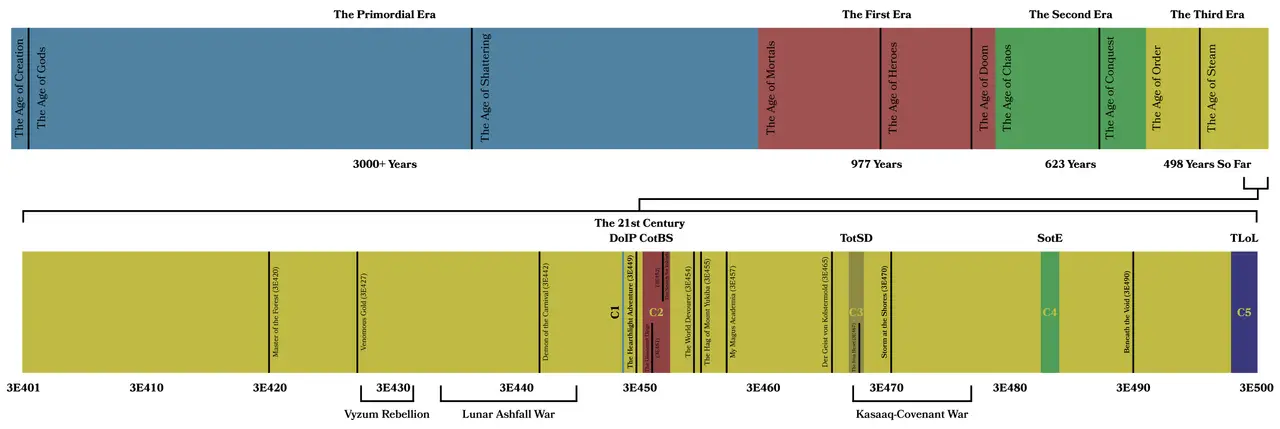
There are multiple calendars in this multicultural world such as the Elven Calendar that divides history into BR (Before-Regrowth) and AR (After-Realmshatter). However, the most popular one is the Common Calendar that divides recent history into three major eras. While the world is much, much older, most scholars and stories focus on the events of the past two thousand years, neatly divided into three eras and many ages. This written history begins after the “Realmshatter” at the start of the first era, as records from prior ages are inaccurate at best and complete fabrications at worst. The First Era lasted 977 years until the Cometfall, and the Second Era lasted for 623 years until the formation of the Great Kingdom of Terros in the east. This neatly bridged the Elven and Common calendars, with the year 2E623 / 3E000 matching up evenly to the elven year 1600 AR. The Third Era lasted for an even 500 years until the final invasion of the The Dark Hunt during the events of The Light of Lunaria. The Fourth Era of Balance has begun.
Abmarah usually operates on a 13-month calendar of equal lengths, totalling 364 days per year. The planet is in a ‘perfect’ orbit, and experiences no leap years or orbital variances. The names of days and months vary across cultures and languages, but these names listed here are the largely common ones used across Eqos. The calendar was developed in the first era by Omniborn astrologers, and much of the modern calendar still references its origins. The days in the common languages are named after the Omnikarn word for day, ‘Cel’, and the months of Freki and Vani still reference the old Omnikarn numerals. Both the Elven and Common calendars use this system now for consistency.
This page presents a general summary of the ages of the world so far, with more detailed histories in individual pages elsewhere.
The Primordial Era (0E)
The Age of Creation (Unknown - 3000 BR)
A senseless age that could have lasted anywhere from billions of years to mere days, time had little to no meaning. There was little life, and no sense of place. Theologically, the cosmos is said to have begun with the Original One, followed by the other Elders and then the Titans. These first gods shaped the universe as we know it, and created the first species such as Elves, Dwarves, Giants, and Omniborn. These first mortals were primitive, as even the advanced elves started out with stone tools and druidic magic. Priests of Tempos state that time itself began in an orderly flow at the end of this creation era, a year now referred to as 3000 BR. Recent developments in research and history of the creation myth has led priests and scholars to believe that our cosmos of order and chaos is the second one to exist, and a previous cosmos based on the principles of light and darkness had existed before this one.
The Age of Gods (3000 BR - 1182 BR)
Often known as the tribal period, this stone age of the world involved most of the 'divine species' forming local tribes and small settlements across the cosmos. The jewel of this early universe was the planet of Abmarah, which the gods cultivated themselves. The gods are what this time period is named after, as they all walked amidst the mortals freely and had glorious confrontations. Most of the early gods of the world are attested to this period, although the true divinity of most of them is questionable. Legendary heroes became countless minor gods, while larger tribes gave rise to major gods. Whether belief made these deities or deities made the mortals, gods are truly said to have forged the world in this age. Perhaps all gods started ‘minor’, and the beliefs of those that won out simply became stronger. But clearly the Elder Gods are the ones who created life and the cosmos to begin with, and what of the monoliths or the primordials or the elementals? Most of these other religions have little surviving texts from this period, so everything comes down to speculative theology.
The most glorious civilization in this age were the Giants, who formed the first kingdoms across Abmarah under the divine light of the Giantmaker, a titan named Dimensus. Their raw strength and innate magic put them ahead of the technologically primitive smaller species of the time. The Elves were said to have started off in the Feywild as Eladrin, until their first gods allowed them entrance to Abmarah. Elves in Abmarah first appeared on the edenic island of Aeteria, where most high elves still live. The Dwarves were first forged in the upper Kosmosi Mountains, while the Omniborn were first created in southern Aurial. Of all these ancient species, elves were the most successful in diversifying and spreading to almost every corner of the globe thanks to their adaptable nature.
Two thousand years is a long time to condense into a single age, but early progress was just that steady. Slowly came farming, houses, irrigation, lettering, writing, and early society. People were still ‘uncivilized’, whether it be Omniborn or Triton. As the population of mortals and gods alike grew to innumerable sizes, the gods created the angels and the first celestials to help them in their divine duties.
While most other species including the 'kingdoms' of giants still lived in tribal holds, near the end of this age the high-elves created the first true city on Abmarah—Alsorion. Constructed around the portal from which the elves first entered the world, the mountaintop city marked the true beginning of civilization as most elven historians put it. This does downplay the importance and grandeur of the early giant kingdoms, as there is a considerable bias against them especially in the modern age. People consider giants to be primitive and incapable of accomplishments, even though the large giant cities to come after would dwarf even early Alsorion.
The Angel Rebellion (1182 BR)
The first angels, brothers Krros Zazael and Azriel Zazael, sought to teach mortals arcane magic separate from divine magic. Most of the gods opposed this, but none more than the Giantmaker, Dimensus, who wanted pure divine power over mortals for the rest of time. This kickstarted an angel rebellion against the gods. The god of knowledge, Gunian, offered the brothers a way out—a new spell that would free them from their celestial shackles, turning them into something new. Azriel denied the offer, and was struck down by Dimensus and erased from the world.
The remaining brother, Krros, took Gunian's offer and cast the spell upon himself, rising as the first Archdevil. He burnt the roots of the world tree, destroying the order of the cosmos. He pierced Dimensus' heart with the roots, and killed the titan while becoming one himself. Many of his angel followers cast the spell as well, becoming the first devils and archdevils. Krros then created the nine hells with his newfound powers.
This started the Realmshatter, a period of nearly a thousand years in which all the realms were a chaotic intermingling mess.
The Realmshatter / The Age of Shattering (1182 BR - 0 BR)
The cosmos turned into an ever churning chaos. All the realms merged with each other to a degree, with few layers of separation. Hells would appear on Abmarah, and darkness would corrupt much of the Feywild into the Shadowfell. Parts of Mechanus were replaced by the Plane of Madness, and nothing made sense. However, the damage was slowly controlled and fixed by the gods over the years, and the later years of the Realmshatter were much more stable than the early ones. While the fabric of space was tattered, the fabric of time was still intact. Technology continued to improve, as writing systems became more organized and early civilizations turned to the use of bronze. Many new beastfolk species would appear during the ‘Beastbirth’ when the god of creation Omegus poured his powers into a surge of chaotic wild magic that awakened many beasts. Even the first humans appeared around this chaotic time, their origin now lost but attributed to Gunian.
One of the major events that compounded the chaos of the early years of this age was the death of Vark, the titan of magic. Between his death and the ascension of his successor and usurper Varkanus, the weave of magic either ceased to function altogether or functioned unpredictably. This resulting arcane chaos is said to have birthed the first dragons. The giants, left without their god, fought the dragons for much of this age. Many new species were born from this conflict, such as the slave species of Goliaths and Dragonborn, both made to serve their makers. The dragons and the giants succeeded in destroying each others’ kingdoms, and the giants were left to look for their god’s return for the rest of time.
The Darkness of the Shadowfell (984 BR)
Somewhere deep in the cosmos, an eladrin witch discovered the pure darkness. She sought to corrupt her brethern to the darkness as well, and many minor gods and elves alike followed her dark witchcraft. With the power of the pure dark, she became its herald, now called Morghos. She focused the darkness into an artifact, a scepter, with which she started to cast her ultimate spell. Around the cauldron of darkness, she and her followers started to corrupt the Feywild itself and ascend Morghos into godhood.
The armies of the Seelie court intervened, aided by many gods with the key ones being the elven creators, Deltus and Serenox. With the two major gods commanding the battle, the witch's forces lost, and the spell was interrupted. With her powers, the lady Serenox cut off the half-corrupted half of the Feywild, and essentially created the Shadowfell. Lord Deltus bound Morghos in great divine chains, sealing the witch away within the heart of this new Plane of Shadow. Additionally, the archfey elders broke her scepter into three halves, for they could not destroy its darkness. Half of Morghos' followers joined the Unseelie, while the other half remained in the Shadowfell, becoming Shadow-Elves. Morghos still has her followers, often called the Dark Hunt.
The Beastbirth (810 BR)
One of the events during this period known as the 'Beastbirth', when the once-creator god Omegus channeled his powers into the churning chaos of the realmshatter. Some think this was an attempt to fix it, while some others thing that he purposefully amplified his powers using the chaos. His wild surge of creation magic recreated many of the beasts that surrounded him into the first beastfolk much like himself- Panshera, Vanara, Minotaurs, Khenra, and the like.
More worldchanging than any of these other races was the arrival of the first Humans. The origin of humans is lost even to themselves, and there is no consensus on whether they were created by deities like the others or not. While Gunian claims to be the god-creator of mankind, actual creator gods dispute this fact. The Elven theory is that humanity simply appeared from chaos itself during the start of the realmshatter, when the churning chaos of the realms birthed many new races. They have an evolutionary link to other ape-folk such as the Vanara, so the origins are truly in the air. Humanity's importance and perseverance is undoubtable even by the gods, and they are considered one of the first people.
Some believe that the first humans appeared on the then-lush continent of Skion, and migrated south-ward in waves as the continent got colder and colder. Others believe that that humans first appeared on Eqos, and migrated eastward. While humans started off more primitive than the other races, they spread rather quickly across most of the planet. Their importance would be low for the first two thousand years of their existence, as they were always outmatched and controlled by 'divine' races such as Omniborn or Elves. One thing that gave them the edge over these 'better' races was their adaptability and explosive population growth. With humans out populating these earlier races, the tides slowly started to shift in their favor.
Meanwhile, the elves in 700 BR cast the spells required to lift their capital city into the air. The city of Alsorion rose into the sky never to touch down again, and the everlasting nation of Imperium Alvanum Aeternum was founded.
War between Hells and Heavens (543 BR - 466 BR)
With the worship of Jakuna cemented as the 'leader' of the Pantheon under Aeterian beliefs, Krros challenged her dominion over the gods. The divide between good and evil was never more apparent, as the hells and heavens armed themselves and started destroying each other in yet another war between gods. The boundaries between the hells and heavens were blurry due to the nature of the realmshatter, and this led to intense bloodshed of celestials and fiends alike. During this war, the Abyss was formed either out of malice or chaos, and many fiends were turned into demons. Varkanus takes credit for this, but who knows whether he was even involved. This turned the war into a clash between celestials, devils, and demons.
Eventually, Krros was struck down back into the hells by Jakuna, ending the war between the gods. This marked a symbolic victory of good over evil, as far as the scriptures go. Devils and Demons continued to fight for the ages to come, while the heavens were finally at peace.
The Lost Centuries (466 BR - 0 BR)
Kingdoms rose and fell, heroes came and went, and so-called empires were founded and withered away. Tales of heroes from this age such as Aurion the Golden-Soul, Vanos the Serpent, and Aetheros the Founder are commonly told today. Whether these heroes of legend actually existed or not is up to debate, but their stories have been warped beyond recognition. For example, even calling Aurion a 'Golden-Soul', a name attributed to the champions of Aethys who would not come to be until the golden age hundreds of years after the supposed life of Aurion, brings to light how warped these stories have become from whatever actually happened. Historians have added details or changed them to fit their agendas and beliefs, while singers have embellished the tales to fit whatever era they so happened to be in. Prince Alric or Rajan Alrik of the First Era is famously depicted with full steel plate armor—which did not come to be until hundreds of years after his death—instead of the banded iron armor that would’ve been more historically accurate.
Much of this history is lost in this form, with only legends and oral histories passed down. Near the end of this age, metalworking took a leap forward as the smelting of iron was innovated by the dwarves and quickly spread across the world, replacing bronze. The Realmshatter ended when the new god of the realms, Mutrev the Angel, stabilized the cosmos by nurturing a new world tree. Many of the now-lost planes were destroyed beyond repair, and he combined all of them into a dreg heap now known as Shatterrealm. With the end of this thousand-year calamity, the elven calendar began anew with a new numbering system separating the calendar into BR and AR. At the same time, a new mortal common calendar began, with the First Era of truly written history.
The First Era (1E001 - 1E977 / 1 AR - 977 AR)
The Rise of Empires / The Age of Mortals (1E001 - 1E500 / 1 AR - 500 AR)
The first era of Abmarah is known as the Era of Mortals. The world was ruled by species created by the gods, and the species that most defined this era was known as the Omniborn, a people with four arms, multiple eyes, and red leather-like skin. The first era was dominated by the four divine species, the Elves, the Dwarves, the Tritons, and the Omniborn.
These species created the first true large empires to grace Abmarah. The surviving Imperium Alvanum Aeternum, The Holy Dwarven Rhosian Empire, the Holy Triton Sigmosi Empire, and most importantly, the Holy Omniborn Temporal Empire. The Temporal Empire would go on to become the largest single nation-state in the history of Abmarah, and its capital city of Ikariyus was well known as the greatest city to be, not rivalled again until the modern day.
The legendary founder and immortal-emperor of the empire was Khaz Draxal, alongside his consort Khaz Zaenak. These two immortal omniborn led the nation as champions appointed by the gods. The empire stretched for nearly the entire length of the once-great continent of Aurial, only sharing it with the dwarven empire to the north and the drow kingdoms in the Underdark. The sheer dominance of the Omniborn gave them a fearsome reputation, as they slowly came to see themselves as the rightful rulers of the cosmos itself. The Temporal Empire was seen as the progenitor of civilization itself, and every empire to come would try to prove themselves a rightful successor.
While they were led by the emperor couple, the empire was more democratic than the feudal kingdoms to follow. Every mortal who held land had a voice in the government, and could elect regional governors from among themselves to lead provinces of the empire for limited terms. The Khazai shared some power with elected generals and senators in the government, and the bureaucracy of the empire is legendary to this day.
In Eqos, Sol Sultana would form the Surya Sultanate encompassing most of the continent, including the entire Kav'orra. She was said to be an avatar of a primordial sun goddess. These continent-spanning empires would not be seen again. Humans, while numerous, were still a minority and rarely held any positions of power in this era. One thing common to every one of these empires was slavery of the non-divine species, which unfortunately fueled the construction and expansion of their civilizations.
The Golden Age / The Age of Heroes (1E500 - 1E875 / 500 AR - 875 AR)
With Omniborn leading the world technologically with their shields and spears as well as their magical spellsmithing, they took the world to heights never seen before. It was a period of prosperity with advances in culture and technology. With the creation of arcane spacefaring ships, mortals began to colonize Voidspace and other planets. At the height of the age, the omniborn even had permanent cities on the moons of Abmarah, and lights were visible on their surface from Abmarah. These cities and spaceports are now lost to ruin.
After the Cometfall, many of these great cities of the Omniborn fell to ruin even on Abmarah. While the southern half of the Aurian continent was obliterated completely including all the cities on it such as Ikariyus, Omniborn ruins dot the landscape of northern Aurial and even places in Eqos and Eteru today. Some of their cities survived with new rulers, such as the cities of Olzaria, Sergorod, Etabrück, etc. Many other cities (mostly the ones with a majority Omniborn population) were abandoned completely and left to ruin, such as Varkaria, Xeycaria, or Zin. Some cities such as Diiriyus were abandoned for a time and then built upon by newer settlements. In Eqos, almost all of these cities were abandoned with the notable exception of Furukiri.
The divine laws and the rules of the cosmos were codified and set in place, and this period of history spawned most of the fairy tales and myths that people learn about in the modern day. Events surrounding the gods such as the Tournament of Champions or the Golden Massacre defined the age. The Pantheon of Eights was officially organized in Aeteria by their Pontiffs, and gods still roamed the planet freely and commonly.
The Tournament of Champions (1E750 / 750 AR)
In 1E750, the first and so far only Tournament of Champions was held between all gods in Ikariyus. Varkanus challenged the domains of Aethys, and wanted full control over the domain of 'Life' instead of sharing it with her. This argument between the two gods spiraled out of control as many other conflicts and arguments of various other deities also rose to the surface, such as a disagreement between Magmus and Omegus. This led to Jakuna calling for an organized tournament of champions to settle all disputes. It ended with the victory of Ser Valkan Zuriel, the champion of Aethys. In the modern day, the recurring competitive festival known as the Valkani Games is named after Valkan.
The Omniborn Crisis / The Age of Doom (1E875 - 1E977 / 875 AR - 977 AR)
(Check the main article that goes into more detail.)
This golden age was brought to a downfall when the emperor of the Temporal Empire, Khaz Draxal, declared war on the gods. There are many reasons for this, with some attributing this rebellion to mortal pride and overconfidence, and some attributing this to the tyranny of a thousand minor gods. Draxal rebelled against the gods when he betrayed and killed the balance goddess Alphus, and started a war to exterminate all deities. The dwarves and elves banded together against the omniborn, while the tritons as well as Sol Sultana stayed neutral as long as they could.
Now known as the Omniborn Crisis, this war lasted for just over a hundred years and resulted in the deaths of countless gods and kingdoms, not to mention the severe losses of the omniborn themselves. It led to the near complete destruction of the world as we know it, with technologies and civilizations lost to dust. They created legendary starweapons to kill gods, and cursed the metal Azbaan to forever be able to kill gods.
The Cometfall (1E977 / 977 AR)
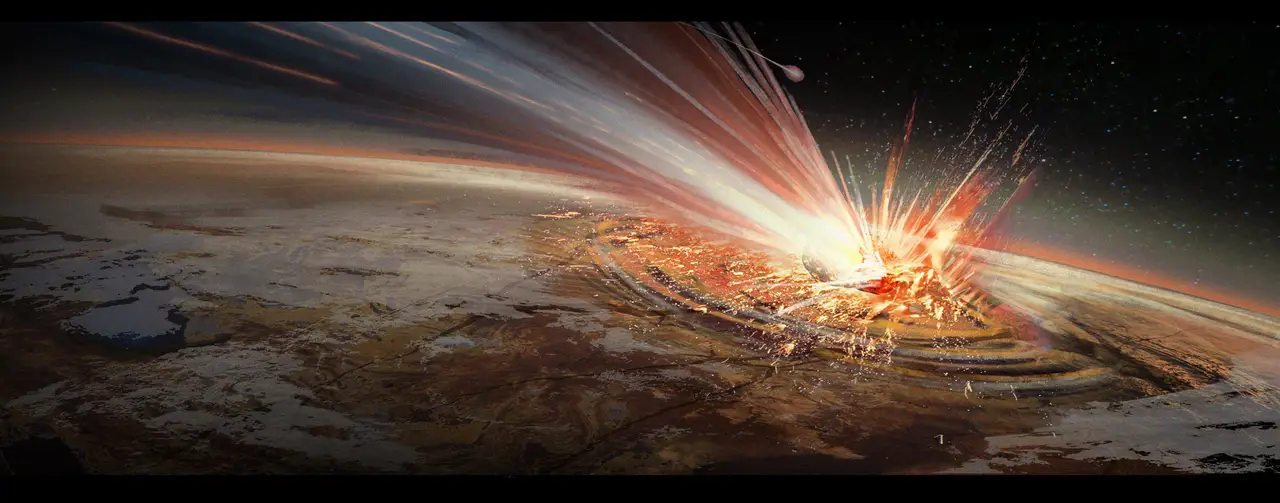
This war came to an abrupt end in the year 1E977, when the periodic comet ‘Zaenak’s Light’ inexplicably crashed into the golden city of Ikariyus, the capital of the Temporal Empire. Many myths state that Khaz Zaenak, who the comet is named after, called it to herself in penance for her sins. This impact shattered the southern half of the continent of Aurial, and caused severe destruction across Abmarah as a whole. Magic shields and the work of many gods helped to prevent a near complete destruction of all life on the planet, limiting the brunt of the cataclysm to southern Aurial.
As the shattered continent fell, the ocean rushed in to create the Blood Sea and new islands arose from the pieces of crust and volcanic activity. Many comets and meteorites have fallen on Abmarah, but this was a cataclysm the likes of which the world had never seen. The proudest city in the world was gone in an instant, becoming the epicenter of the new Cometfall Sea. It's said that the comet fell directly on the palace of Khaz Draxal, destroying him before any other omniborn.
The impact of the comet caused severe earthquakes all across the world, devastating most cities beyond repair. It caused tsunamis that swept hundreds of miles in-land, destroying everything in their wake. Many of the older cities that still remained were protected from this devastation through shields and wards, or perhaps devotion to the gods that remained. The impact caused the supervolcano Kazarin to erupt along with most other volcanoes on the planet, adding to the plume of debris and ash that filled the atmosphere. Within a matter of minutes, a blanket of darkness covered the entire sky, blotting out the sun for a decade to come and causing fire and acid to rain across the world for years more in a winter that lasted for nearly an entire generation of humankind.
At the same time, all the omniborn magically disappeared from the world as a whole, good and evil alike. The mystery behind all this is unexplained to this day, with only speculation to turn to. Some believe that the god that created the omniborn, Elder Mekalus, destroyed them to undo his ‘mistake’. Some others believe that the comet was the god Varkanus’ doing somehow, and that he had used the omniborn as a blood sacrifice. Some argue that the omniborn themselves caused the comet to change course and hit Abmarah, either as a failed tactic or Zaenak being unable to bear the weight of her sins. A general consensus was that their godlessness and hubris had led to their downfall.
One fringe theory about the species' disappearance is that the omniborn somehow escaped the cataclysm, and flung their entire species into the future. These seers believe that all the omniborn will return one day, and Khaz Draxal will end the world as we know it. However, most scholars disagree with this, as there is no proof to back up this theory. In fact, many priests of Tempos believe that due to the war, the empire had lost favor with the goddess of time, and her slumber caused by this betrayal would never allow such a flash-forward to happen.
Some omniborn survived the cometfall and the disappearance of their species, either by being in stasis or offworld in other realms. Some of these remnant populations are said to persist to the modern day. Many species forever left Abmarah following the crisis, the Faiiali and Vezaborn all but abandoning the planet. Spacefaring arcana and most advancements in technology and magic were lost for a long time after this worldwide apocalypse.
Whatever the case may be, all the empires of old had fallen into individual warring kingdoms and city-states. Gods no longer walked amidst humans as commonly if at all, and were forced to take a lesser role in world events. It's hard to say whether the gods truly won, as they lost so many of their ranks—minor and major deities alike—that few were left and replacements had to be made for key roles. The world population was reduced to a fifth of what it was before the crisis, as food and plant life would be scarce under the blanket of ash for decades leading to worldwide droughts and famine.
The Second Era (2E001 - 2E623 / 978 AR - 1600 AR)
The Age of Chaos (2E001 - 2E437 / 978 AR - 1414 AR)
Long ages of chaos reigned after the cometfall. While the other continents had to do relatively less rebuilding after the cataclysm, Aurial was scattered to the wind with each and every remaining city having to fend for itself. The next six hundred years or so were full of warring city-states, petty kings, failed nations, and disarray. The shattered isles that made up the remains of southern Aurial began to be re-settled, with immigrants from all over the world claiming the new lands across the ‘Blood Sea’. In Eqos, the dissolution of the Surya Sultanate caused a similar fracturing into city-state kingdoms.
What truly marked this era as distinct for the world as a whole was the disappearance of gods. While the gods were present on the material plane in physical forms during the first era, they were nearly absent in the second. It is theorized that the gods saw the omniborn crisis as a mistake of their own making, and deliberately pulled away from having such a heavy presence among mortals. Divine influence never disappeared, though. With the loss of so many gods during the crisis, many new gods rose to take their place in the pantheon. In doing so, their followers increased their power and standing across the world, allowing them to get away with acts that the previous gods would’ve stopped beforehand.
While the cometfall was still within living memory for some of the longer-lived species, humans and many of the other younger species spread across the now depopulated world having forgotten much of what came before. These dark ages were essentially a return to zero, with individual city-states vying for greater power and trade networks having to rediscover routes. Much of written history skips a lot of this era as either “not much happened” or “a lot happened but there are no records remaining.”
The Age of Conquest (2E437 - 2E623 / 1414 AR - 1600 AR)
Less and less modern history is summarized in this section the closer we get to the present day, as regional histories get more detailed and take priority over a global summation.
As the horrors of the crisis faded from all living memory even for the elves, Abmarah entered into what could be called the true medieval age. City-States had finally transformed themselves into new kingdoms all across the world, and conquerors began to consolidate power. The age of conquest is defined by the origin of many of the modern great nations. The Kingdom of Olzaria in Aurial, the Baishu and Xing dynasties in Eteru, and the Kasaaqi Hukumat in Eqos all trace their origins to this warring age. Rulers and loyalties shifted all the time, and steadily the chaotic cities of the second era were starting to be consolidated into large kingdoms.
The new gods cemented their positions within the pantheon as the successors of all the deities lost in the crisis, and new religious sects such as Ashtadharma began to spread across the lands. The history of the age of conquest is hard to summarize globally, as each and every region of Abmarah had a complicated shift from one power to another during this period. This tumultuous age was brought to an end in Aurial by the Pontiff Aeternum who, in 2E623, declared an end to the chaos of the second era and the start of a new third era of order.
The Third Era (3E001 - 3E500 / 1601 AR - 2100 AR)
The Age of Order (3E001 - 3E215 / 1601 AR - 1815 AR)
The Third Era brings us to modern history, with the establishment of major nation-states across Aurial and the shifting of political powers across the world as a whole. It is often called the era of order in comparison to the chaos that reigned before. Between large nations such as the Great Kingdom of Terros, the Crimson Empire, and the Kasaaqi Hukumat, many smaller nations also consolidated their power to stand up to these larger threats.
This late medieval age involved widespread expansion of territory, the cementing of feudalism into many political systems, as well as the rebirth of globalized trade networks and international communication. Mortalkind was once again looking at Abmarah as a whole instead of just focusing on their local regions. Many prominent factions rose to prominence during this period, such as the Department of Dungeons, the Swarna Guild, the Blackreyne Brotherhood, and the Pirate Federation just to name a few.
The world population also expanded greatly in the third era, even eclipsing the pre-cometfall population due to advances in agriculture including the discovery of new crops such as potatoes and corn, the adaptability and faster rate of reproduction of the newer species such as humans, as well as the relative peace and prosperity that many of the larger nations enjoyed. The early third era is once again within living memory of the oldest elves and haanari, who have seen the world change rapidly with their own eyes. Another radical new change that people witnessed was the re-emergence of democratic processes around the world. The Crimson Empire of Aurial saw their emperor give up much of his political power to a parliament, and even in Eqos the various tribes of the Edeni Expanse started to act more democratically with local leaders being elected in the city of Jamre. The industrialization to come also started to erode feudal attitudes, though feudalism still remains prominent.
The Age of Steam (3E215 - 3E500 / 1815 AR - 2100 AR)
Recent history also marked a change in technology. With the grace of the goddess of technology, Eurion, mortals began to move past the ideals of knightly chivalry into relatively more modern ideals. Kingdoms slowly turned into nations with flags and anthems, technology started focusing on engineering and science over pure magic, and warfare took a new turn with the invention of early firearms and gunpowder. This renaissance also brought with it new ideologies and religions such as Golden Triadism which worships only three goddesses.
With advancing technology began the true age of sailing, with bigger and better ships that continued to increase in size and strength. Across the Blood Sea and the world as a whole, the seas of galleys and longships quickly became full of frigates, galleons—and in Aurial especially—airships that took to the skies. Steam and arcane power led to the creation of fledgling railway lines that connected far away cities via new trade routes. Artificers are seen as equally important to wizards now, shaking the old systems of power in which those who could wield magic were given an advantage. The Lunars especially praise firearms as the great equalizer that can help mundane soldiers stand up to mage-soldiers.
The spark of this new age was the Lunar Revolution and the Great Aurian War fought from 3E215 to 3E227. The twelve year war would change the cultures and demographics of Aurial and Eqos permanently, and create the modern nation of the Lunar Collective. The war was fought between two coalitions, the eastern Jakunists and the western DCA. The Lunar Collective has since colonized much of eastern Eqos, and is the greatest colonial threat to the native eqosi nations. In the far east, the Xing Dynasty was overthrown in the Rose Jade Revolution of 3E382 and the first true democracy on Abmarah, the Republic of Xi-Di, was founded.
With this, we come to the present centuries as depicted in our campaign settings. It is a time of territorial expansion and idealistic wars that still have the influence of gods and outsiders that threaten to destroy all that mortals have built.
The 21st Century (3E400 - 3E500 / 2000 - 2100 AR)
Most of our campaigns have taken place within the second half of the 21st Century of Abmarah, including Dragon of Icespire Peak, Curse of the Blood Sea, Tale of the Sunless Dunes, Shards of the Empire, and The Light of Lunaria.
The The Dark Hunt invaded for the final time on Varkosi Arcanos, 3E500/12/18. They destroyed nearly a third of all infrastructure on Abmarah in the process, but were finally banished forever to the Shadowfell by the Darklight Crusaders. They also let in more chaos into the world, finally bringing the cosmic makeup into balance- 40% Order, 40% Chaos, 19% Balance, and within the leftover 1%, Light and Dark and Void finally at peace.
The Fourth Era (4E001 - Present / 2101 AR - Present)
The Age of Balance (4E001 - Present / 2101 AR - Present)
The Fourth Era started with the cosmos finally in balance after a very long time, maybe even the first time.