The Omkres Script
The script used to write the Omnikarn and Nokarn languages is known as Omkres. The script initially included 9 vowels, 20 consonants, and 20 numerical symbols for a Base-20 vigesimal counting system. Additionally, it included 3 punctuation marks:
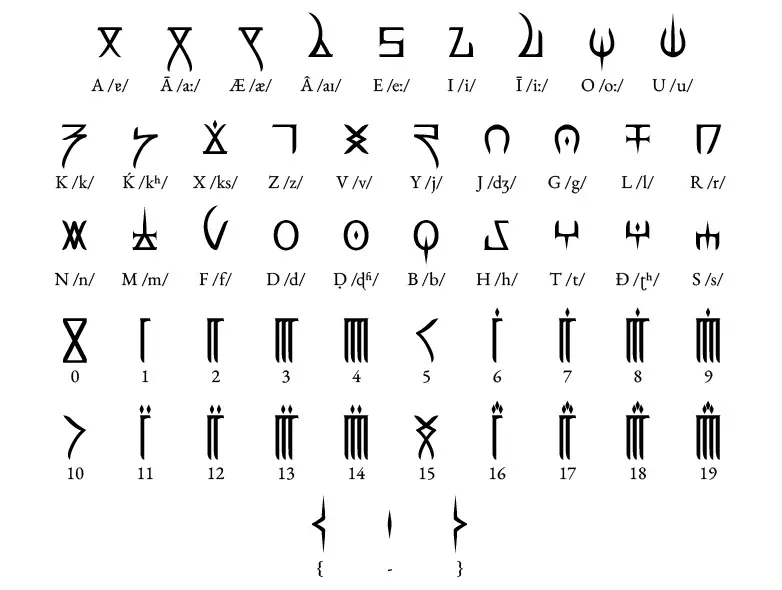
Sentences start and end with the { } symbols, which function similar to the full stop/period symbol found in the Latin script as well as the 'danda' symbol found in the Devanagari script. It also evokes the feeling of modern code notation, which makes magic feel like science. Later in the first era and beyond, the script was expanded. The ‘X’, ‘M’, and ‘F’ letters changed due to the difficulty of writing the previous glyphs as well as influence from other languages, and new letters for ‘P’ and ‘Ch’ were added for ease of transliteration since those sounds were not present in Omnikarn. Another thing of note is that Omkres lacks glyphs for the latin letters ‘C’, ‘Q’, and ‘W’ which are transliterated using ‘S’ or ‘K’, ‘K’ or ‘V’, and ‘V’ respectively. For example, ‘Quake’ might be written as ‘Kvake’. The expanded five glyphs were:

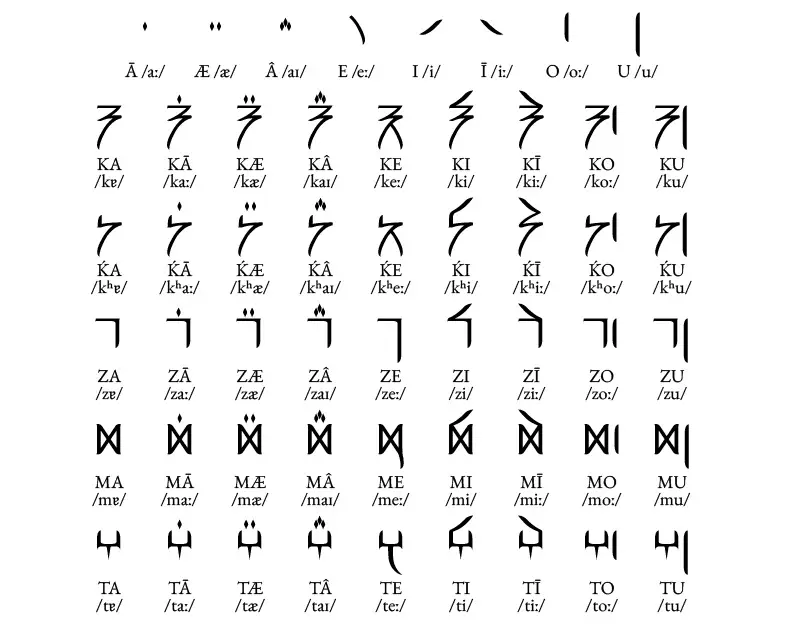
The expansion of the script went beyond just five additional glyphs. The Nokarn language developed in the late first era through the influence of other languages such as the eqosi, dwarvish, and elvish tongues. A new abugida mode was added to the Omkres script in addition to the earlier alphabetical mode, with every consonant requiring a vowel diacritic to write Nokran. The vowel ‘A’ became inherent to every consonant, but most usages of ‘A’ changed to the diacritic ‘Ā’ instead. There are 8 vowel diacritics in the Nokran mode, resulting in 8 variations of every consonant:
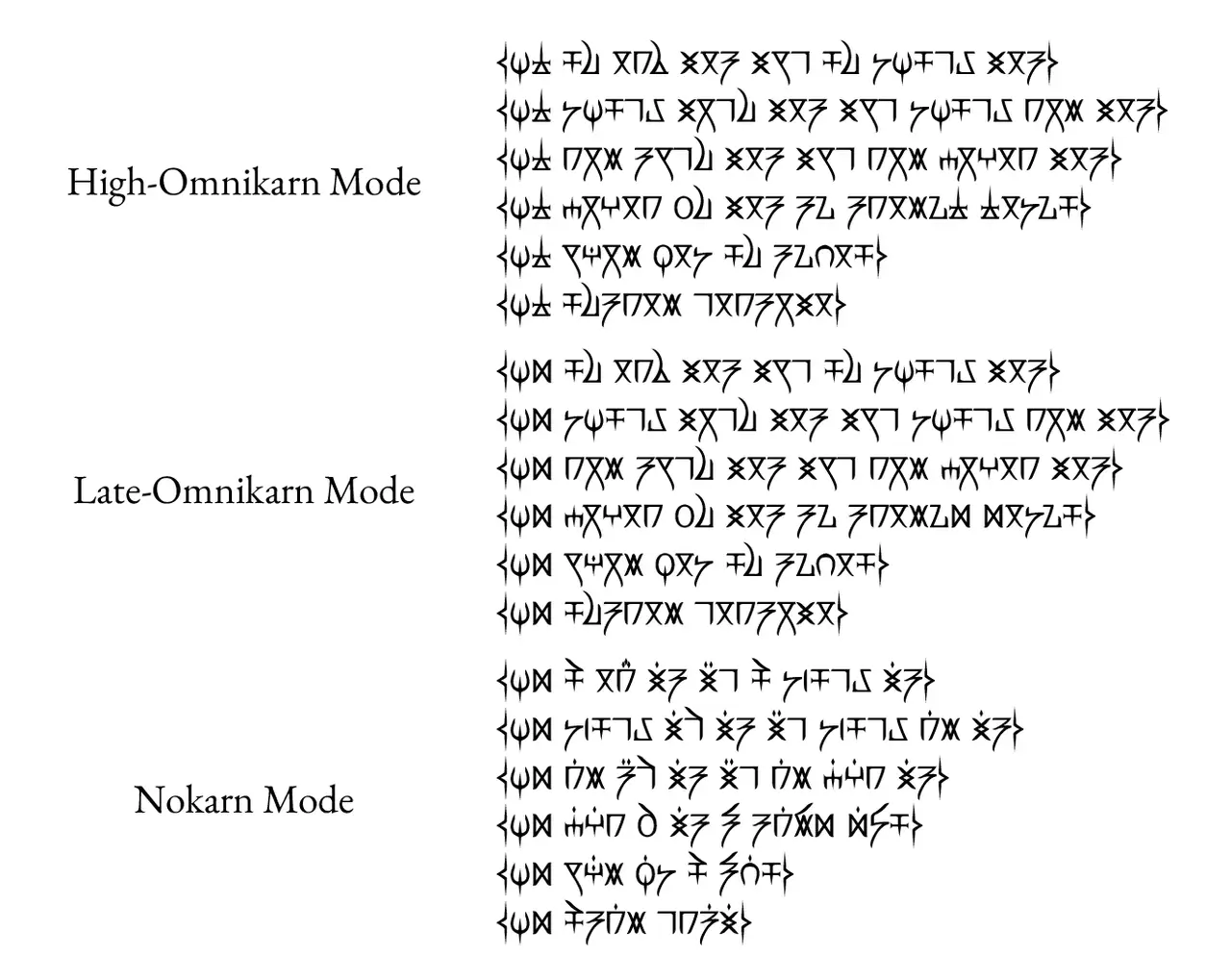
Any further evolution of the script ceased post-cometfall, as both the Omnikarn and Nokarn languages transitioned from everyday languages into liturgial and academic languages. As of the third era, there are three ‘modes’ for the Omkres script: The ‘High-Omnikarn’ mode that used the initial alphabet, the ‘Late-Omnikarn’ mode that used the expanded alphabet, and the ‘Nokarn’ mode that uses the abugida instead. When transliterating English, the ‘Late-Omnikarn’ mode is preferred.
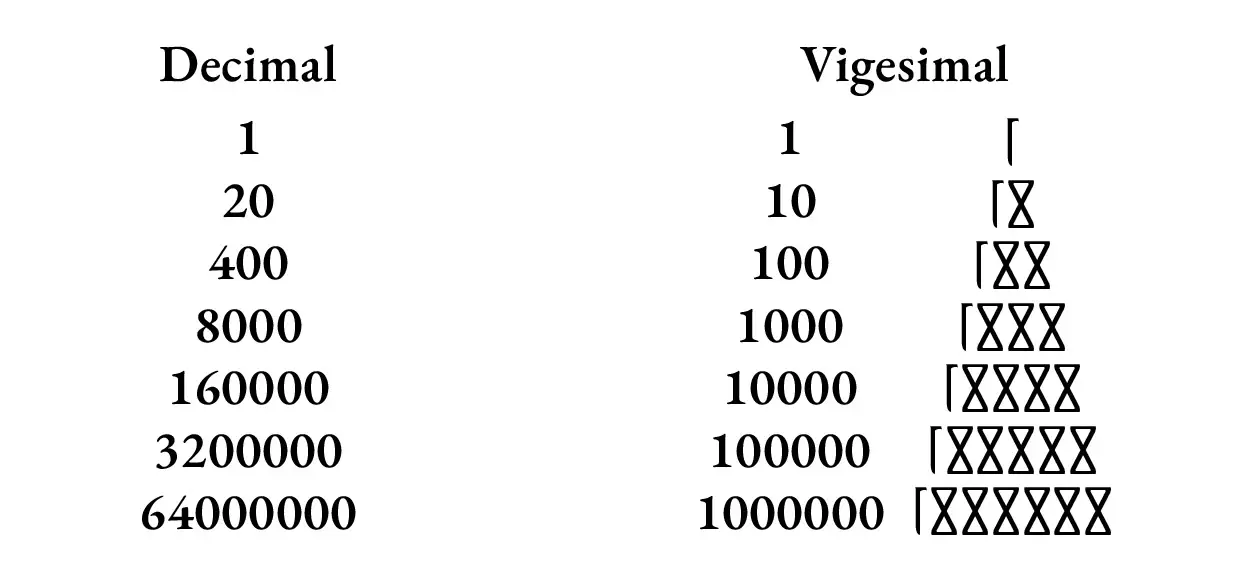
Since the Omniborn had four-arms and thus twenty fingers, it didn’t make sense for their numbering system to be based on decimal like ours is. As such, they use a Vigesimal numeral system, also known as Base-20. In a vigesimal place system, twenty individual numerals (or digit symbols) are used, ten more than in the decimal system. In fact, zero itself was a late addition to the language, hence the symbol looking vastly different to the others and more like an infinity symbol. Only after the nineteen individual numbers are used do you add a second digit to the number, hence 'Base-20'. Thus, their '10' is actually our decimal '20', their '100' is our '400', their '1000' is our '8000', and their '10000' is our '160000'.
Only a few real-life cultures use a vigesimal numeral system, such as the Bhutanese, Inuit, Yoruba, Maya, Aztec, and Chukchi cultures among others. Some other cultures have had some quasi-vigesimal aspects in their numeral, including Greenlandic and Māori.
The Omkres numerals are also inspired visually by the cuneiform scripts of ancient Persia. They evoke the feeling of claws or sharp pens slicing numbers or tally-marks into clay tablets, adding a mark on top after every fifth place until 19. The fifth and tenth digits look unique to mark the end of a ‘Hand’, while the fifteenth is a combination of the two. The zero looks visually different from many of the other symbols and letterforms to represent its late entry into the evolution of this script in-universe. This also means that the language has unique ways to count that correspond to this vigesimal system.
Letterforms
There were a lot of inspirations for the script, the primary ones being the Elvish script created by J.R.R. Tolkien for the Lord of the Rings as well as the Daedric Script from the Elder Scrolls. The script also has some vague similarity to other Indo-European scripts such as Latin or Devanagari in some letter-forms, done to re-enforce the ‘lost-cousin’ aspect of Omnikarn.
Most of the letterforms have a consistent x-height and baseline, but some of them extend into long ascenders or descenders. However, no letterform has both an ascender and a descender, with only a few punctuation marks and numerical symbols utilizing the full height of the typeface. Many of the letterforms also have subtle serifs to denote the roman-like aspect of being chiselled into stone, and most letterforms taper-off into sharp claw-like points to give an almost evil, magical, mystical, or imposing feeling to the script. Even the diacritical dots used in some of the letterforms look almost like diamonds due to the tapers. The script was designed to be the language that magical notation is written with in-universe, so even if a viewer understood no words and only saw the script inside a spellbook, it would feel magical and immersive.
There are some notable differences that make the script different from the Latin script, and other than the missing and additional letters the most jarring one is the letter ‘O’ which in Omnikarn actually makes the ‘D’ sound. The actual ‘O’ symbol of Omnikarn, ‘O’, is often considered to be the most iconic letter of the script and is also used as a coat-of-arms by the Omniborn people. This is why the letter is emphasized on the cover, as well. In-universe, some of the Omniborn airships had a similar design to the letter. This letterform, sometimes called ‘Oht’ or the ‘Omniborn Trident’, went on to become the most famous symbol of the Temporal Empire.
As an additional context to this project, many of the glyphs are based on some of my childhood scribbles and doodles as I’ve tried to create ‘languages’ even as a teenager. While they have been tested and refined, I wanted to evolve these old glyphs into something professional and well thought-out. I treated the older glyphs almost like a real lost-language since I have no recollection of ever drawing them. This conlang and typeface is meant for the expansion of my worldbuilding into more professional spaces, including the publication of settings for Dungeons & Dragons under the brand of ‘Cometfall Press’, a name that we created for our group of friends and designers who have worked with me on this world.
A hypothetical evolution of the script from an archaic ancestor script is modelled here. These ancient precursor letterforms are based on various scribbles and doodles from my childhood notebooks, while the new script is based on actual design principles and testing based on repeated drawings and handwriting analysis. As a worldbuilding exercise, I’ve created an in-between stage of the two scripts. This creates a realistic representation of linguistic evolution in the fictional world.
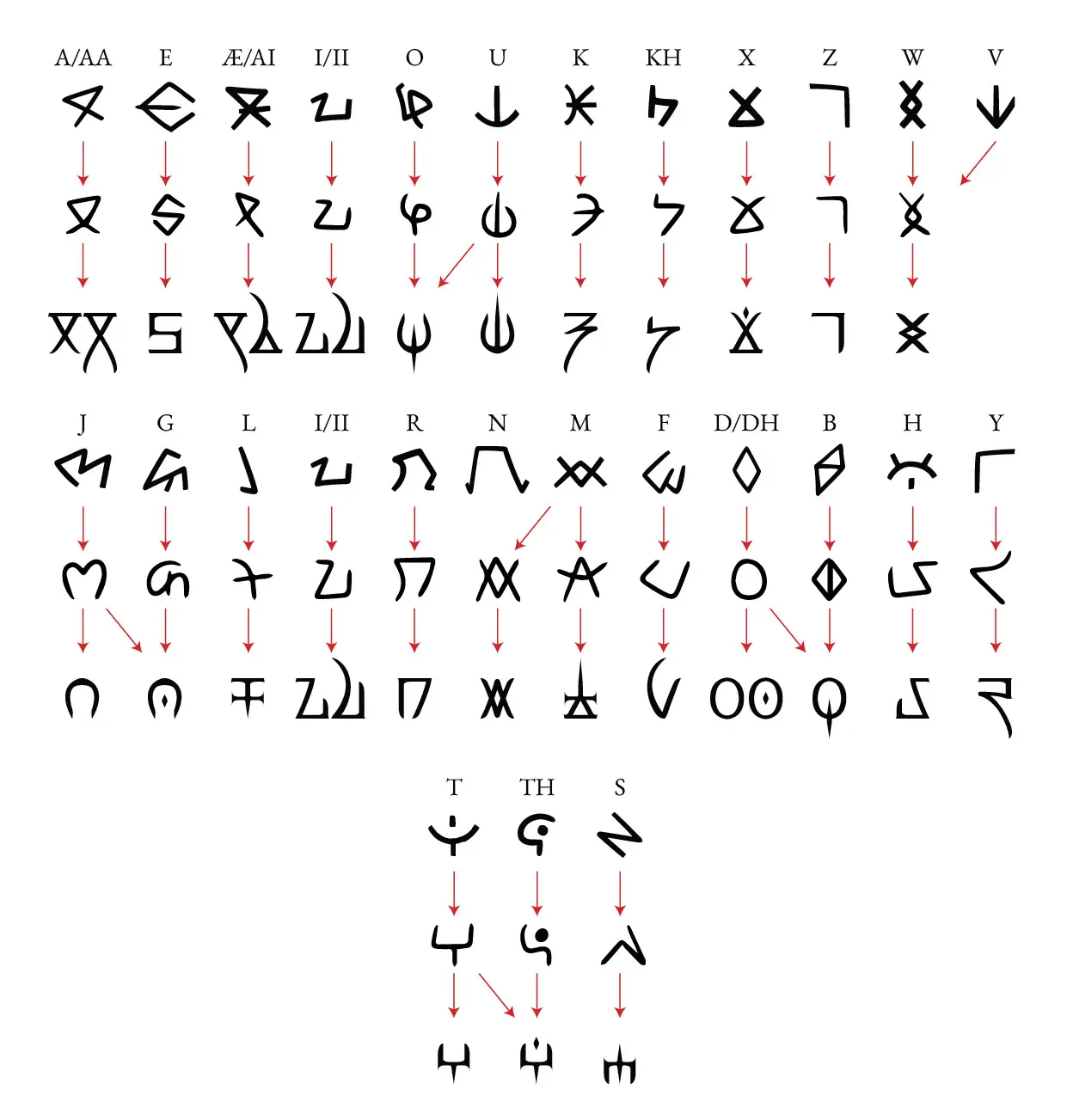
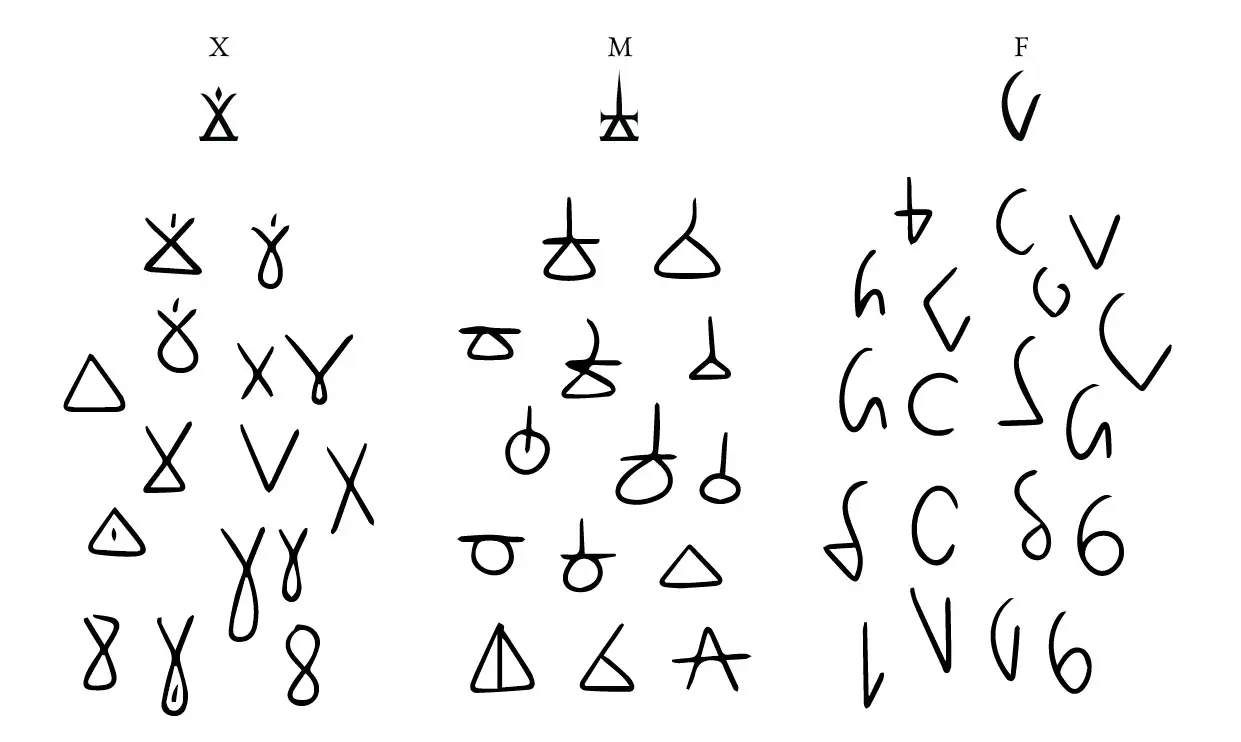
Omnkres and its languages went ‘extinct’ in-universe alongside its native speakers in an apocalypse. While it is still used as an arcane script by mages and historians alike in the world a thousand years later, it has essentially been stuck as it was with no linguistic evolution. However, as a thought process, I’ve tried to model Omnikarn’s evolution further and figure out how it could’ve evolved if given the chance to do so. Glyphs tend to simplify as time goes on, or change to accommodate new mediums. The Latin script had many changes as well from its original Roman roots, especially after the invention of the printing press. Glyphs tend to start out as pictograms, eventually evolving into logograms and then further simplified shapes. Bringing the script to paper, I wrote the glyphs hundreds of times at varying handwriting speeds, which led me to discover the three most complicated glyphs that I see being simplified or changed down the road if the language was to develop further. The X, M, and F glyphs of Omnikarn are the only ones that remain needlessly complicated. While the X is an inversion of the A glyph, it simply does not flow well when writing, same as the F glyph. Meanwhile, the ankh-like M glyph requires five strokes to create it, which is far too many strokes for the letterform to maintain over a long period of time. Some of my experimentations into the future evolution of these three letterforms are presented here:
The Omnikarn Language
The Omnikarn language was developed for the fantasy world of Abmarah, and is considered an arcane ancient language within the world. This is a worldbuilding project that has been on-going for years now. In the universe, the language was originally created by the Omniborn species, it is still widely used in magical texts, arcane notation, and other scholarly pursuits. In this world, many modern-day words, titles, and phrases are influenced by this language’s wide usage in the first era more than a thousand years ago.
In some ways, this language is similar to Latin, Avestan, or Sanskrit of real-life and serves a similar role in the lore of the setting. It is not meant to be an alien language, instead it is supposed to feel like a long-lost cousin of modern Indo-European languages like English, German, French, Persian, Hindi, and even the aforementioned Latin, Avestan, and Sanskrit. Some words and grammatical structures in Omnikarn are are similar to these languages to further emphasize this.
Additionally, the language and its original alphabet script are purposefully archaic in some ways. Omnikarn lacks many punctuation marks like the comma, and has some letterforms that are complicated and would’ve been simplified over time if the language did not go extinct. It even has a unique vigesimal numbering system. The language would’ve been etched into stone and clay, while also written in the air itself via magic. As such, it is most visually similar to Roman fonts, while also giving a distinct exotic feel to the letterforms. There is a modeled ‘evolution’ of the script from a hypothetical earlier and even more archaic script used in the ideation process when creating Omnikarn. Additionally, there are two typefaces in this type specimen, a roman-like primary one called ‘Omnikarn Regular’ as well as a pixel typeface called ‘Omnikarn Pixel’ created for possible gaming applications that involve retro-style aesthetics.
Many of the sounds within it are not found in English, but are found in other Asian languages. Similarly, it lacks some of the sounds found in English. Omnikarn lacks 'P', 'Ch', 'C', 'Q', and 'W' sounds which were transliterated in the original mode using 'B', 'Kh', 'S' or 'K', 'K' or 'V', and 'V' respectively.
For an example phrase, we’ll translate the motto or war chant used by the Omniborn for their empire.
"GLORY TO THE HOLY TEMPORAL EMPIRE, OUR LIVES ARE YOURS. REMAIN PERFECT BEYOND GODS, ACROSS EVEN THE SKIES."
If we then translate this back to its ‘original’ Omnikarn, the phrase would look like this once its converted into the SOV structure. To write this in the script’s typeface, we’ll need to convert the words into the specific symbols used to transliterate the script:
{OM OLZAǶ ӃAZARUS ZARKĀVA} {ZE KÆLÂ ZEA JAK} {OLZǶ ĀVARÂ GODUSÂ ZORKOZ} {OM ZAVARIÂ KAZOǶ SĀTAR VAK}
“OM (The) OLZAHL (Temporal) KHAZARUS (Holy Empire) ZARKAAVA (Glory), ZE (Our) KAELAI (Lives) ZEA (Yours) JAK (Are). OLZHL (Remain) AAVARAI (Perfect) GODUSAI (Gods) ZORKOZ (Beyond), OM (The) ZAVARIAI (Skies) KAZOHL (Even) SAATAR (Spread/Across) VAK (It-is).”
Grammar
Omnikarn’s word order is Subject-Object-Verb (SOV), similar to Hindi or Turkish. This is different from English’s Subject-Verb-Object (SVO) word order, which makes translating between English to Omnikarn slightly more complicated. To further complicate things, the word order is not necessarily needed as other word orders are also used uncommonly. Adjectives tend to go before Nouns, and so do Prepositions. The Possessor also comes before the Possessee.
Sentences begin and end with the { } brackets when written down. There is no concept of a comma or a sentence break in the language yet, and any such small pauses during communication must simply be inferred from the context of the sentence when reading it. It is possible for the language to have developed a comma-like punctuation mark in-between the brackets, although it was never given the opportunity to do so. The language prefers compound words in its dictionary, where two or more words and suffixes combine to create new words.
The language generally prefers gender-neutral terms over gendered ones unless specificity is required, for example the word for ‘Parent’ over ‘Father’. Many common words simply do not have a gendered version at all. As an example, the word ‘KHI’ means spouse, but there are no specific words for ‘Husband’ or ‘Wife’. To actually denote the gender of your spouse, you would have to say ‘HAKĪ KHI’ which translates to ‘Female Spouse’. Something like this is not a common enough phrase to have turned into a compound word, as the gender of your spouse is generally left to context. Omnikarn rarely uses prefixes, but has many, many suffixes.
The ‘-AI / Â / Â’ vowel suffix can indicate plurality. If ‘Â’ follows an ‘O’ (eg. ‘OAI’), the pronunciation changes from /aɪ/ to /ɔɪ/ (oi) essentially ignoring the ‘A’. If the word ends with ‘A’ or ‘Ā’, ‘Â’ replaces it in both sound and spelling (eg. ‘ÆDA’ becoming ‘ÆDÂ’). However, if the word ends with a ‘U’ or ‘I’, the two vowels are pronounced separately (eg. ‘IAI’ or ‘UAI’).
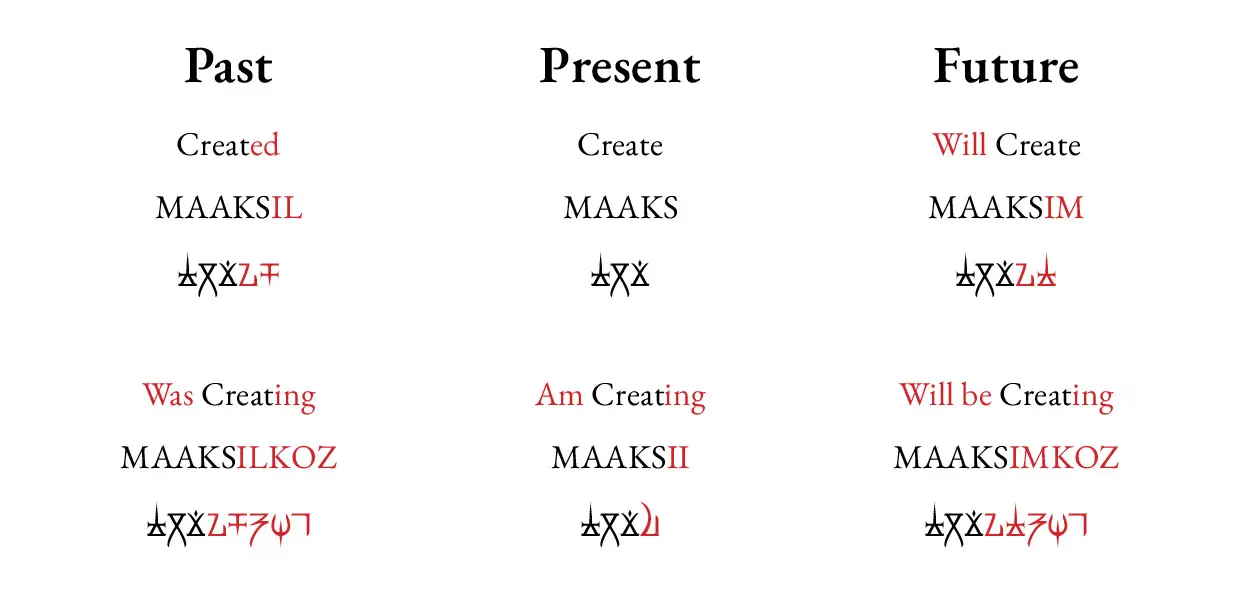
The ‘-HL / Ƕ / Ƕ’ suffix can be used to denote comparisons or qualities, even creating nouns related to the verb. It fuctions similar to the English suffixes ‘-er’, ‘-al’, ‘-ian’, ‘-ist’, or ‘-ism’. A similar suffix is ‘-UN / UN’ which denotes similarity or resemblance, similar to the English suffix ‘-like’ as in ‘Catlike’. Another versatile and common suffix in Omnikarn is ‘-II / Ī / Ī’ which is used to turn nouns and adjectives into adverbs, similar to the English suffixes ‘-ly’, ‘-ish’, or ‘-ity’. It can sometimes be used to create the present particle in the present tense, similar to the English suffix ‘-ing’. Omnikarn has three tenses: Past, Present, and Future. The ‘-IL / IL’ suffix is used to indicate the past tense of verbs, similar to the English suffix ‘-ed’, for example ‘Watch’ becoming ‘Watched’. An additional longer suffix imperfective ‘-ILKOZ / ILKOZ’ is used as an auxillary verb in the past tense, similar to the English ‘Was Watching’. While English actually lacks a particle suffix for the future tense, Omnikarn uses the ‘-IM / IM’ suffix to denote the future tense of verbs, almost like an inversion of ‘-ed’. The imperfective suffix is similarly ‘-IMKOZ / IMKOZ’ which is used as an auxillary verb in the future tense, similar to the English ‘Will be Watching’.
As stated earlier, some of the glyphs found in the Latin script were not used in the original Omnikres script. It specifically lacks ‘C’, ‘Q’, and ‘W’, using ‘K’ or ‘S’, ‘KU’ or ‘KV’, and ‘V’ for those sounds. More importantly, Omnikarn actually lacks two major sounds and glyphs common in other Indo-European languages such as English , Persian, or Hindi: The /p/ sound and the /tʃ/ sounds.
The lack of ‘P’ is the most obvious difference in Omnikarn, similar to Arabic in this regard. The ‘P’ sound generally becomes a ‘B’ in Omnikarn, while ‘Ch’ becomes ‘Kh’. For example, the word ‘Chapter’ if written in the Omnikarn script or spoken by a native speaker of the language would come across as ‘Khabter’. A hypothetical predecessor to Omnikarn likely would’ve had a ‘P’ sound, but it would’ve gradually shifted into an ‘F’ sound much like in Japanese or Vietnamese.
There are other, less common suffixes used in Omnikarn that have nevertheless been popularized. Some of these are:
‘-KA / KA’ which is used as an adjective for ‘Magical’ or ‘Arcane’.
‘-ZI / ZI’ which is used as an honorific for elders, and sometimes even used as a synonym for ‘Yes’, similar to the Hindi-Punjabi ‘-ji’.
‘-US / US’ which is used as an honorific for gods as well as simply being an adjective for ‘Divine’.
‘-AN / AN’ which is used as an honorific for assistants, attendants, servants, and occasionally slaves.
Some of the words in the language have been left similar to words in other Indo-European langauges on purpose, such as the words ‘Born’ and ‘God’ which are the exact same in Omnikarn. This is to create a sense of familiarity for the reader or listener, making the language feel less alien and more earth-like.
The Nokarn Language
(TO BE EXPANDED)